
NCIDQ Practicum Practice Exam
$69.00
- Buy to unlock unlimited access to all Quiz questions and Answers in this Quiz.
- After purchase you can print a PDF of the whole quiz at any point. The PDF will contain the questions and the correct answers.
About this Exam
The National Council for Interior Design Qualification (NCIDQ) Certification is the North American benchmark for demonstrating competence in interior design.
It is designed for dedicated interior designers who have met specific education and work experience requirements.
The NCIDQ Examination consists of three distinct sections, with the Practicum (PRAC) being the third and final hurdle.
This exam focuses specifically on the practical application of design knowledge, ensuring that professionals can effectively protect the health, safety, and welfare of the public.
Earning this certification is the pivotal moment that transforms a talented designer into a qualified professional recognized across the industry.
Ready to test your knowledge?
Buy Now to Access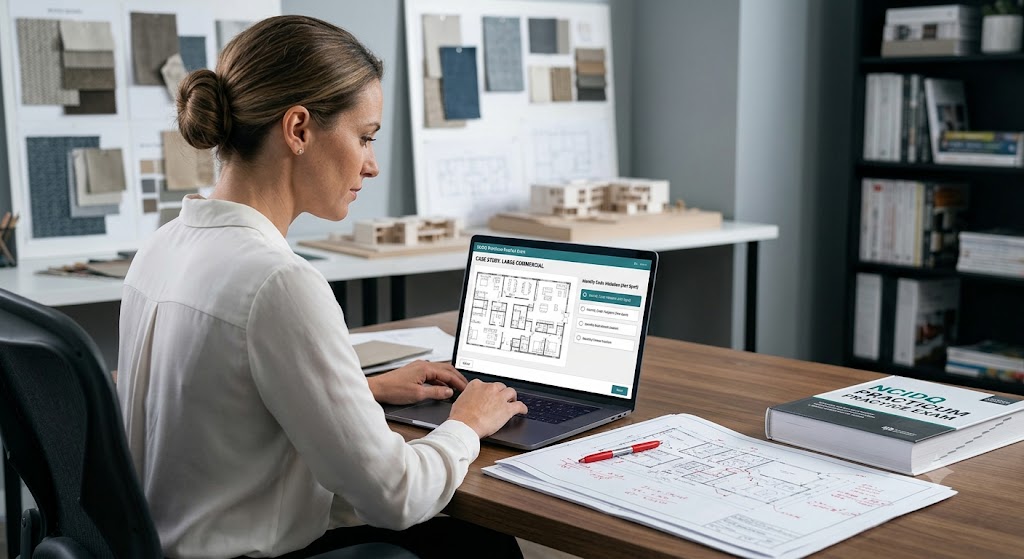
Additional Information
What the Course Entails and Exam Details
The NCIDQ Practicum is unique because it assesses your
ability to apply your entire knowledge base to realistic design problems rather
than just recalling information.
Instead of standard multiple-choice questions, the entire
exam is a simulation centered on three comprehensive Case Studies.
These Case Studies replicate the challenges you will face as
a lead designer on diverse project types.
The core domains covered within these case studies include
Codes and Life Safety, Integration of Building Systems, Construction
Documentation, and Furniture, Fixtures, and Equipment (FF&E).
You will be expected to synthesize complex programmatic
requirements, navigate challenging constraints, and interpret regulatory codes
to create functional, compliant interior solutions.
Proficiency in reading blueprints, understanding
architectural detailing, and applying universal design principles is essential.
What to Expect in the Final Exam
The NCIDQ Practicum is a rigorous, four-hour computer-based
examination.
You will be presented with three distinct, detailed case
studies: one focused on a large commercial project, one on a small commercial
project, and one on a residential space.
Each case study provides you with a project program, floor
plans, elevations, and relevant code excerpts.
You must answer interactive questions using different
formats, such as Hot Spot (clicking to identify an error), Drag-and-Place
(positioning elements within a plan), and Fill-in-the-Blank.
There are no standard multiple-choice questions in this
section; you must interact with the drawings to demonstrate mastery.
The exam is scored on a scale of 200 to 800, with a scaled
score of 500 required to pass.
Since the scoring is scaled to account for slight
differences in exam difficulty, focusing on accuracy across all question types
within the four-hour time limit is paramount.
How to Study and
Exam Centers
Studying effectively for the NCIDQ Practicum requires moving
beyond rote memorization and focusing on dexterity in problem-solving.
First, you must master the specific NCIDQ Codes provided by
the CIDQ, understanding how to apply them to space planning and life safety
scenarios.
The absolute best way to prepare is by utilizing practice
exams that precisely simulate the interactive, computer-based format you will
encounter.
Work through multiple mock case studies, forcing yourself to
analyze the documentation and solve drawing-based problems within a timed
environment.
Familiarize yourself with the interface and practice
identifying code violations and coordinating drawing sets.
To take the exam, you must first apply to the Council for
Interior Design Qualification (CIDQ) and receive notification of your
eligibility.
Once approved, you can register for the exam during the
April or October testing windows.
The exam is administered at Prometric Testing Centers, which
are professional, authorized testing facilities located in physical centers
across the United States and Canada.
Remote proctoring is not available for the Practicum due to
the highly visual and interactive nature of the drawing-based questions.
Job Opportunities from the Course
Earning your NCIDQ Certification significantly elevates your
professional profile and opens doors to advanced career opportunities and
increased earning potential.
Holding this qualification signals to clients and employers
that you have achieved the highest standard of professional competency.
Completing the Practicum and receiving your full
certification unlocks numerous specific job titles and career paths, including:
- Licensed
Interior Designer (in regulated jurisdictions)
- Registered
Interior Designer (in regulated jurisdictions)
- Certified
Interior Designer
- Senior
Interior Designer
- Interior
Design Project Manager
- Commercial
Interior Design Specialist
- Hospitality
Interior Design Lead
- Healthcare
Design Professional
- Corporate
Interior Designer
- Interior
Design Consultant
Frequently Asked Questions
Reviews
5.0
Based on 0 reviews
Leave a Review
No reviews yet. Be the first to review!