
NCLE-AC Practice Exam
$69.00
- Buy to unlock unlimited access to all Quiz questions and Answers in this Quiz.
- After purchase you can print a PDF of the whole quiz at any point. The PDF will contain the questions and the correct answers.
About this Exam
Elevate your career and solidify your expertise with the National Contact Lens Registry Advanced Certification (NCLE-AC). This prestigious certification is designed for experienced contact lens professionals who have already mastered the fundamentals and are now seeking to demonstrate their advanced knowledge, critical thinking, and refined skills in complex fitting scenarios. Achieving the NCLE-AC is a significant milestone, showcasing your commitment to professional excellence and your ability to provide specialized care to a diverse patient population with challenging ocular needs. The accompanying NCLE-AC Practice Exam is your essential tool for ensuring readiness, allowing you to assess your current understanding, identify areas for improvement, and build the confidence needed to succeed on the final certification. This practice exam mirrors the rigorous standards of the actual certification, offering a comprehensive review of advanced contact lens principles and practices.
Ready to test your knowledge?
Buy Now to Access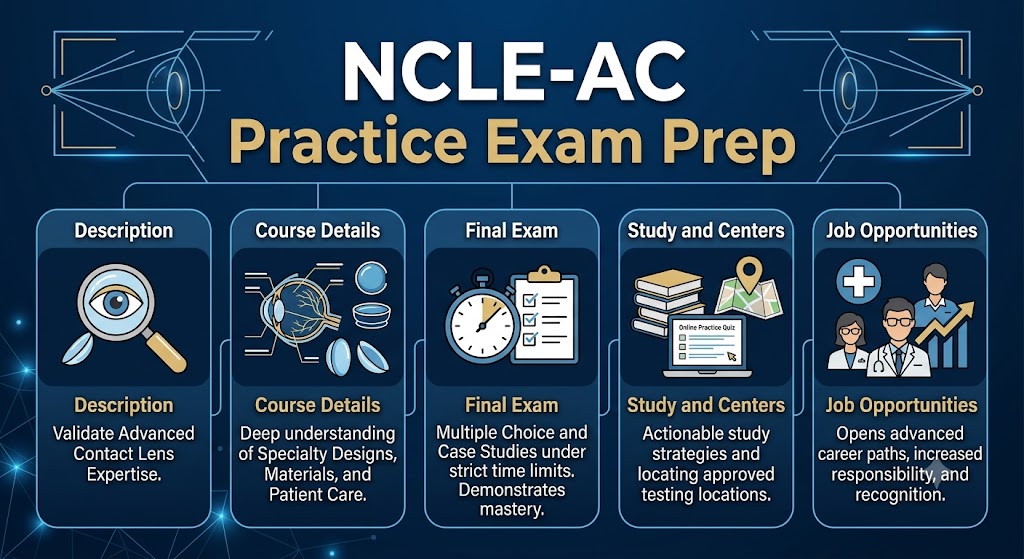
Additional Information
What the Course Entails and Exam Details
The path to the NCLE-AC certification typically involves both professional experience and dedicated study. The official advanced certification course and the corresponding NCLE-AC Practice Exam cover a deep and broad spectrum of advanced topics, ensuring that certified individuals possess the high-level competencies required.
Core Topics Covered (and heavily featured in the practice exam):
Advanced Contact Lens Fitting: In-depth knowledge and application of fitting principles for complex conditions (keratoconus, irregular astigmatism, post-surgical, multifocal/presbyopia, etc.).
Specialty Lens Designs: Detailed understanding of rigid gas permeable (RGP), soft toric, multifocal, scleral, and other specialized lens designs.
Ophthalmic Optics and Science: Advanced principles of optics, light reflection, refraction, lens materials, design characteristics, and their impact on vision and ocular health.
Ocular Physiology and Health: Enhanced understanding of the anatomy and physiology of the eye, particularly the cornea and surrounding structures, and how contact lenses interact with them.
Patient Assessment and Management: Sophisticated techniques for evaluating patient needs, interpreting findings, selecting appropriate lens options, managing potential complications, and optimizing long-term ocular health and visual outcomes.
Regulations and Standards: Current professional and ethical standards, as well as relevant regulations governing contact lens practice.
The NCLE-AC Practice Exam itself consists of multiple-choice questions meticulously crafted to test your knowledge, application, and analysis across all these critical areas, providing a realistic assessment of your preparedness for the final, higher-stakes certification exam.
What to Expect in the Final Exam
Knowing what to expect on test day is crucial for minimizing anxiety and performing at your best. The final NCLE-AC certification exam is a rigorous assessment, and preparing with the NCLE-AC Practice Exam will significantly help you anticipate its challenges.
Format: The final exam typically features a significant number of multiple-choice questions, often structured to test complex reasoning and case-based problem-solving in addition to direct knowledge recall.
Passing Score: While specific passing scores can slightly fluctuate or be confidential, you can expect that a high level of proficiency (often in the range of 70% or higher, based on standard certification practices) is required to pass and achieve the advanced certification. It's best to aim well above the typical minimum passing threshold during your practice.
Time Limit: The exam is timed, with a duration usually spanning several hours (often around 2-3 hours), requiring efficient time management. The NCLE-AC Practice Exam allows you to practice answering questions under similar time constraints.
Rules and Conduct: Standard professional testing conditions apply. This generally means:
No open books, notes, or external aids allowed.
Strict identification requirements for in-person testing or proctored remote exams.
Prohibitions on communication with others during the test.
Potentially utilizing specific calculators or on-screen tools provided by the testing platform.
Carefully reading and understanding all instructions before beginning each section.
How to Study and Exam Centers
Effective preparation is the key to success. Here’s a comprehensive strategy incorporating the NCLE-AC Practice Exam and reliable study methods:
Study Strategies:
Utilize the NCLE-AC Practice Exam Early and Often: Don't just take it once at the very end. Use initial attempts to assess your baseline, then retake the NCLE-AC Practice Exam or specific sections after targeted studying. Pay close attention to question rationales for why answers are correct or incorrect.
Review Official Resources: Consult the latest NCLE materials, textbooks recommended for advanced study, and clinical guidelines on complex lens fitting.
Deep Dive into Weak Areas: Use your NCLE-AC Practice Exam results to focus your study time. Review textbooks, lecture notes, or seek out additional articles/webinars specifically addressing the topics you found challenging.
Form Study Groups: Collaborating with peers preparing for the exam can offer diverse perspectives, clarify difficult concepts, and provide mutual motivation.
Attend Advanced Workshops/Webinars: Participate in relevant professional development opportunities to deepen your practical knowledge and stay updated on the latest advancements in specialty contact lenses.
Practice with Real Cases (in clinical setting): Apply advanced concepts to actual patient scenarios under proper supervision, reinforcing your theoretical understanding with practical experience.
Simulate Test Conditions: When taking the NCLE-AC Practice Exam, especially later in your preparation, simulate the actual test environment by timing yourself, eliminating distractions, and completing the full exam in one sitting.
Exam Centers and Formats:
NCLE Official Website/Portal: The primary source for registration and potentially for accessing online practice materials. They will provide official details on final exam logistics.
Prometric or Similar Testing Centers: Many major professional certifications utilize widespread, secure testing centers like Prometric, Pearson VUE, or similar networks. These offer in-person, proctored environments with specific scheduling options. You will typically schedule your final exam date and location through the official NCLE registration process.
Remote Proctoring: Increasingly common, some certifications offer secure, proctored exams you can take from your own computer, subject to strict technology and environment requirements. Check the current NCLE-AC options for remote proctoring availability.
Authorized Training Providers/Schools: Occasionally, authorized educational institutions may be designated locations for final exam administration. This is less common for national certifications but worth inquiring about if applicable.
Job Opportunities from the Course
Earning your NCLE-AC certification opens doors to specialized roles and increased professional recognition within the contact lens and eye care industry. Possessing advanced certification, often demonstrated through successful completion of the certification process including the NCLE-AC Practice Exam, signifies a higher level of competence and dedication.
Here are specific job opportunities and career paths that become more accessible or potentially advance with the NCLE-AC:
Specialty Contact Lens Fitter: Focus almost exclusively on fitting complex lens designs (keratoconus, sclerals, multifocals, etc.) in a dedicated specialty practice or larger eye care clinic.
Advanced Contact Lens Technician/Optician: Take on expanded responsibilities, patient education, and higher-level consulting roles within an optometry or ophthalmology practice.
Practice Manager (with strong contact lens focus): Manage a contact lens department, training other staff and ensuring high clinical standards.
Consultant/Technical Support Specialist for Contact Lens Manufacturers: Utilize your in-depth knowledge to advise other eye care professionals on complex fitting cases or help develop/market new lens products.
Educator/Instructor: Teach advanced contact lens courses at professional workshops, webinars, or within opticianry/optometry programs.
Clinical Research Coordinator/Assistant (for contact lens studies): Play a key role in designing, implementing, or analyzing data for research on new lens materials or designs.
Lead Optician/Contact Lens Lead: Supervise and mentor other opticians and technicians within a larger eye care retail or clinical setting.
Entrepreneur/Business Owner (Specialty Contact Lens Services): Establish or expand a practice specializing in advanced and specialty contact lens services.
Frequently Asked Questions
Reviews
5.0
Based on 0 reviews
Leave a Review
No reviews yet. Be the first to review!