
NCLEX Acute Coronary Syndrome Practice
$69.00
- Buy to unlock unlimited access to all Quiz questions and Answers in this Quiz.
- After purchase you can print a PDF of the whole quiz at any point. The PDF will contain the questions and the correct answers.
About this Exam
Mastering cardiac nursing concepts is non-negotiable for success on the NCLEX. This NCLEX Acute Coronary Syndrome Practice Exam is a specialized study tool designed specifically for nursing students preparing for the NCLEX-RN and NCLEX-PN licensure exams. It provides a focused, high-intensity review of one of the most critical and frequently tested physiological integrity topics on the test. Whether you are a current nursing student or an international nurse seeking licensure in the United States, this practice exam is engineered to bridge the gap between theoretical knowledge and clinical application. It challenges your decision-making skills in high-stakes scenarios involving myocardial ischemia and infarction, simulating the pressure of the actual licensure exam.
Ready to test your knowledge?
Buy Now to Access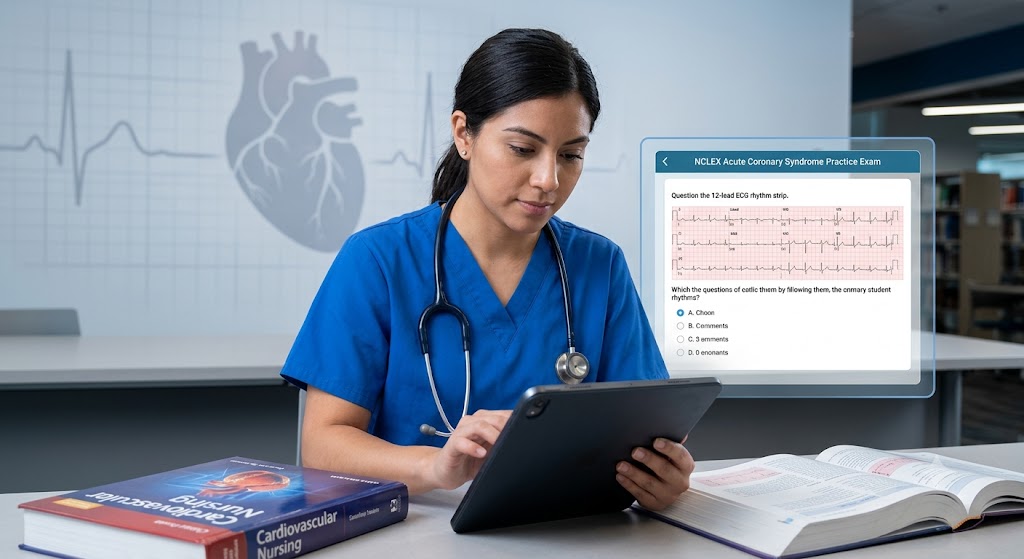
Additional Information
What the Course Entails and Exam Details
This specialized practice module covers the essential
knowledge, pathophysiology, and nursing management strategies related to Acute
Coronary Syndrome (ACS). Students will dive deep into differentiating between
Unstable Angina, NSTEMI (Non-ST-segment Elevation Myocardial Infarction), and
STEMI (ST-segment Elevation Myocardial Infarction). The content focuses heavily
on appropriate physical assessment findings, including interpreting specific
chest pain characteristics and secondary symptoms. A significant portion of the
material covers key diagnostic tools, such as cardiac biomarkers (Troponin,
CK-MB) and basic interpretation of 12-lead ECG changes associated with ACS.
Furthermore, the practice questions emphasize critical nursing interventions,
pharmacological management (including antiplatelets, anticoagulants, nitrates,
and beta-blockers), and urgent revascularization procedures like PCI or
fibrinolytic therapy.
What to Expect in
the Final Exam
While this is a practice exam, it is designed to mimic the
rigor of the actual NCLEX. The questions will primarily focus on critical
thinking and prioritizing care, utilizing standard multiple-choice formats as
well as complex Select All That Apply (SATA) questions and ordered-response
(prioritization) scenarios. The phrasing of questions often reflects real-world
clinical prioritization, such as "Which action should the nurse take
first?" or "Which client should the nurse assess immediately?"
Unlike a general test, questions about ACS will measure your ability to
synthesize assessment data with pathological principles to make safe and
effective care decisions under time constraints. Successful performance on this
practice module requires achieving a benchmark score that correlates with
NCLEX-level competency in physiological adaptation and pharmacological therapy.
How to Study and
Exam Centers
Effective preparation requires a two-pronged strategy:
content review and active question practice. Start by mastering the fundamental
pathophysiology of ACS using a reliable NCLEX review book or comprehensive
online resource. Review the different presentations of unstable angina versus
myocardial infarction and the "MONA" (Morphine, Oxygen,
Nitroglycerin, Aspirin) nursing management protocol thoroughly. Once you have a
baseline, utilize this practice exam to identify weaknesses, rather than just
using it as a test of what you already know. Review the rationale for every
answer choice, including the incorrect ones, to understand the "why"
behind the correct clinical decision.
This practice exam is typically available through
specialized online NCLEX preparation portals and nursing education platforms,
allowing you to study anytime and anywhere. Keep in mind that the actual
NCLEX examination is administered exclusively in a secure proctored setting at
Pearson VUE professional testing centers located globally. Utilizing an online
practice exam that mimics the screen layout and style of Pearson VUE can
significantly reduce test-day anxiety by increasing your familiarity with the
testing environment.
Job Opportunities from the Course
Passing the NCLEX, supported by robust preparation in
critical areas like Acute Coronary Syndrome, is the direct pathway to licensure
as a Registered Nurse (RN) or Licensed Practical/Vocational Nurse (LPN/LVN).
Strong proficiency in cardiovascular care opens numerous career opportunities
in high-acuity environments.
Here are the specific job titles and career paths available
once licensure is obtained:
- Registered
Nurse (RN) - Intensive Care Unit (ICU): Managing complex post-MI and
surgical cardiac patients.
- RN
- Cardiac Catheterization Lab: Assisting in life-saving
revascularization procedures for ACS patients.
- RN
- Telemetry/Step-Down Unit: Monitoring stable cardiac patients
recovering from ACS.
- RN
- Emergency Department: Assessing, triaging, and initiating urgent
protocols for clients presenting with chest pain.
- Cardiovascular
Nurse Specialist: Advanced practice role focusing on the holistic
management of cardiac clients (requires additional education).
- Travel
Nurse - Cardiac Specialty: Filling critical staffing needs in cardiac
units across different geographic regions.
- RN
- Cardiac Rehabilitation: Developing and implementing exercise and
education plans for post-ACS recovery.
- Licensed
Practical/Vocational Nurse (LPN/LVN) - Medical-Surgical Units:
Providing care to stable post-ACS patients within their scope of practice.
Frequently Asked Questions
Reviews
5.0
Based on 0 reviews
Leave a Review
No reviews yet. Be the first to review!