
NCLEX Cardiovascular System Practice Test
$69.00
- Buy to unlock unlimited access to all Quiz questions and Answers in this Quiz.
- After purchase you can print a PDF of the whole quiz at any point. The PDF will contain the questions and the correct answers.
About this Exam
The NCLEX (National Council Licensure Examination) is the essential licensure exam for aspiring nurses (RNs or PNs) in the United States and Canada. This focused study guide and practice material is specifically designed for nursing candidates preparing to tackle the "Cardiovascular System" section, which is a critical and often challenging component of the full NCLEX. By focusing on cardiovascular health, you are preparing to demonstrate your mastery in caring for patients with cardiac disorders, ensuring safe and effective nursing practice upon licensure. This is an indispensable step for nursing students nearing graduation or recent graduates aiming to secure their professional license and begin their careers.
Ready to test your knowledge?
Buy Now to Access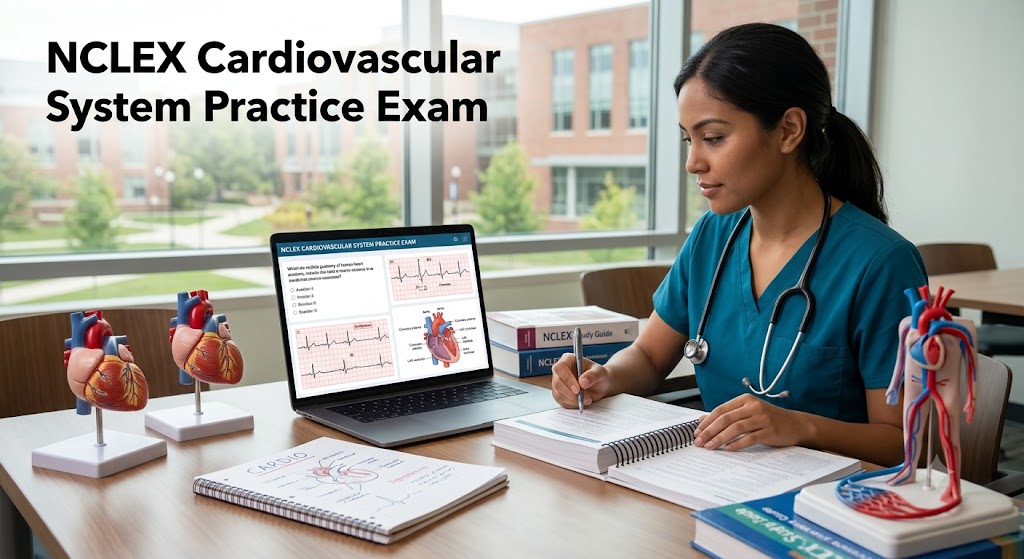
Additional Information
What the Course
Entails and Exam Details
The content focus for the Cardiovascular System section
covers a broad range of critical nursing knowledge. Candidates must demonstrate
a deep understanding of cardiovascular anatomy and physiology, including
hemodynamics, electrical conduction of the heart, and cardiac output. You will
study key cardiac disorders such as myocardial infarction (MI), heart failure
(HF), various arrhythmias, hypertension, and peripheral vascular disease. Major
focus is placed on dynamic assessment, diagnostic procedures (interpreting
ECGs, stress tests, cardiac enzymes), and the associated nursing implications.
Pharmacology related to the cardiovascular system—including anticoagulants,
antihypertensives, and antiarrhythmics—is central to this domain. Additionally,
candidates must be prepared to use critical thinking to recognize early signs
of complications, implement immediate nursing interventions, and provide vital
patient education on lifestyle management and medication compliance.
What to Expect in the Final Exam
The practice material simulates the adaptive nature and
rigorous conditions of the actual NCLEX-RN or NCLEX-PN. The actual NCLEX is a
Computerized Adaptive Test (CAT), meaning the exam dynamically adjusts to your
ability level, varying the number of questions (typically ranging from 85 to
150 for RNs) based on your responses. You must prepare for multiple question
formats, including standard multiple-choice, Select All That Apply (SATA),
drag-and-drop ordering, chart interpretation, and hot-spot questions. There is
no predetermined passing percentage; instead, you must demonstrate competence
above the minimum standard. The maximum time for the entire exam is typically 5
hours. While your practice test might have a fixed number of questions, the
official NCLEX adapts to you. Focus on maintaining a steady pace, applying
critical thinking to every scenario, and practicing endurance, as the test aims
to challenge and verify your entry-level nursing judgment.
How to Study and
Exam Centers
To master the cardiovascular section, consistent study and
strategic practice are essential. Begin with a deep review of core concepts in
a trusted nursing textbook, focusing heavily on understanding pathophysiology
and assessment techniques. Utilize comprehensive NCLEX review guides and
specialized question banks (Qbanks) that focus on cardiovascular questions. Do
not just focus on getting answers right; always read and understand the
rationales for correct and incorrect answers to strengthen your critical
thinking and clinical judgment. Practice taking simulated, timed tests to build
endurance and manage time effectively. Study groups can also provide excellent
peer support and discussion opportunities for complex topics like ECG
interpretation. When you are ready to take the official licensure exam, you
will register through your state or territorial board of nursing and schedule
your appointment with a secure testing provider, primarily Pearson VUE, which
operates numerous authorized physical testing centers. Check your board's
specific website for any other authorized centers or portals.
Job Opportunities
from the Course
Successfully passing the NCLEX, with strong performance in
critical areas like the cardiovascular system, opens the door to a wide range
of rewarding nursing career paths. This foundational knowledge is essential in
almost all acute care and outpatient settings. Licensure unlocks the
professional title and roles of Registered Nurse (RN) or Licensed
Practical/Vocational Nurse (LPN/LVN), enabling employment in various
specialties. Career paths include:
- Cardiovascular
Nurse Specialist
- Intensive
Care Unit (ICU) Nurse
- Cardiac
Catheterization Lab Nurse
- Coronary
Care Unit (CCU) Nurse
- Progressive
Care or Step-Down Unit Nurse
- Medical-Surgical
Nurse with Cardiac Focus
- Cardiac
Rehabilitation Nurse
- Nurse
Educator specializing in cardiac care
- Emergency
Room (ER) Nurse
Frequently Asked Questions
Reviews
5.0
Based on 0 reviews
Leave a Review
No reviews yet. Be the first to review!