
NCLEX Heart Failure Practice Test
$69.00
- Buy to unlock unlimited access to all Quiz questions and Answers in this Quiz.
- After purchase you can print a PDF of the whole quiz at any point. The PDF will contain the questions and the correct answers.
About this Exam
The NCLEX Heart Failure Practice Test is a targeted educational resource designed specifically for nursing students and graduate nurses preparing for the National Council Licensure Examination (NCLEX-RN or NCLEX-PN).
It provides a focused simulation of the crucial cardiovascular content area, specifically targeting the complex pathophysiology and management of heart failure.
This practice test is an essential tool for candidates seeking to validate their knowledge, identify weak areas, and build the critical thinking skills required to manage complex cardiac patients safely.
By mastering this content, aspiring nurses can significantly increase their confidence and readiness for the high-stakes licensure exam.
Ready to test your knowledge?
Buy Now to Access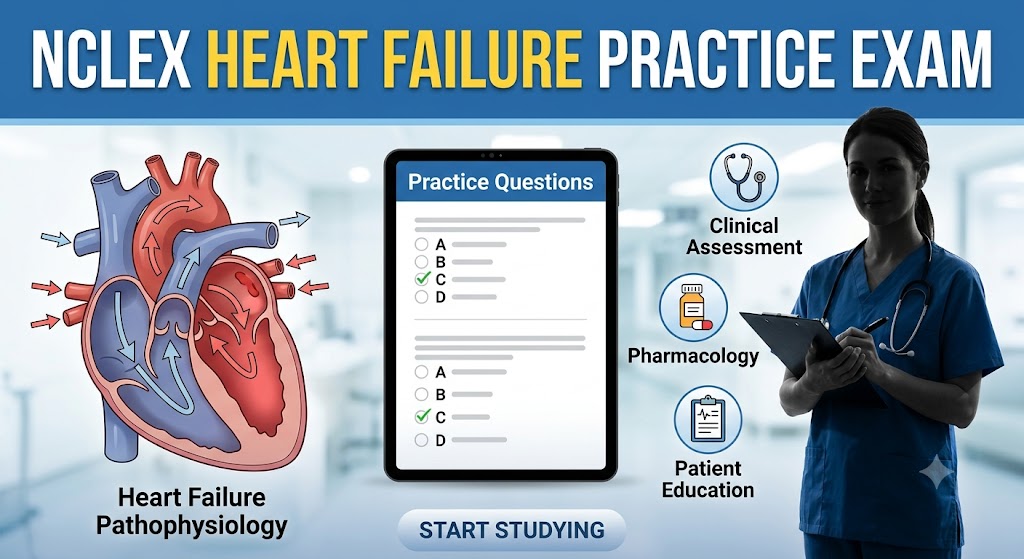
Additional Information
What the Course Entails and Exam Details
This comprehensive practice domain covers the full spectrum
of heart failure management essential for entry-level nursing practice.
Candidates must demonstrate mastery of the pathophysiology
distinguishing between systolic and diastolic heart failure, as well as
left-sided versus right-sided failure.
The syllabus details include recognizing hallmark clinical
manifestations, such as pulmonary edema, crackles, jugular venous distention
(JVD), and peripheral edema.
Key skills assessed involve the interpretation of diagnostic
data, including Brain Natriuretic Peptide (BNP) levels, echocardiogram results,
and hemodynamic monitoring values like Central Venous Pressure (CVP).
Furthermore, heavy emphasis is placed on pharmacological
therapies, requiring candidates to understand the mechanisms, side effects, and
nursing implications of diuretics, ACE inhibitors, beta-blockers, and inotropic
agents.
Finally, patient education regarding fluid restrictions,
low-sodium diets, and daily weight monitoring is a critical component of the
tested content.
What to Expect in the Final Exam
While this is a practice test, it is designed to mirror the
structure and rigor of the actual Next Generation NCLEX (NGN).
You should expect a computerized adaptive testing (CAT)
format that adjusts the difficulty of questions based on your previous answers.
The test will utilize various question types, including
standard multiple-choice, select-all-that-apply (SATA), ordered response, and
the new NGN case studies that evaluate clinical judgment.
Regarding the final scoring, like the actual NCLEX, there
isn't a set "passing score" numerical value for practice; rather, the
goal is to demonstrate competency above the required passing standard
consistently.
When taking the actual licensure exam via Pearson VUE, you
will have a total of five hours to complete between 85 and 150 questions.
How to Study and Exam Centers
Effective study for the NCLEX Heart Failure domain requires
a mix of content review and active application.
Begin by thoroughly reviewing the pathophysiology and
pharmacological interventions from your primary nursing textbooks or trusted
NCLEX review books.
You must prioritize active testing by taking this specific
Heart Failure Practice Test multiple times to familiarize yourself with how
these concepts are questioned.
Do not simply check if you got a question right or wrong;
you must read the detailed rationales for every answer option to understand the
underlying clinical judgment.
To take the actual licensure exam, you must first apply for
licensure through your state Board of Nursing and then register with Pearson
VUE.
Once you receive your Authorization to Test (ATT), you can
schedule your exam at a certified Pearson VUE professional testing center
located across the country or at authorized international locations.
Job Opportunities from the Course
Successfully mastering heart failure content is a massive
step toward passing the NCLEX and unlocking a wide array of rewarding nursing
careers.
Achieving licensure as a Registered Nurse (RN) or Licensed
Practical/Vocational Nurse (LPN/LVN) is the primary gateway to these
opportunities.
Nurses with strong cardiac knowledge are in high demand for
specialized roles.
Specific job titles and career paths available include:
Staff Nurse in Telemetry or Step-Down Units.
Critical Care Nurse in the Intensive Care Unit (ICU) or
Cardiac Care Unit (CCU).
Cardiac Catheterization Lab Nurse.
Heart Failure Clinic Nurse.
Home Health Nurse specializing in chronic disease
management.
Cardiac Rehabilitation Specialist.
Post-Anesthesia Care Unit (PACU) Nurse.
Furthermore, this strong foundational knowledge can lead to
future advancement as a Cardiac Nurse Practitioner or Clinical Nurse
Specialist.
Frequently Asked Questions
Reviews
5.0
Based on 0 reviews
Leave a Review
No reviews yet. Be the first to review!