
NCLEX Neurological Disorders Practice Test
$69.00
- Buy to unlock unlimited access to all Quiz questions and Answers in this Quiz.
- After purchase you can print a PDF of the whole quiz at any point. The PDF will contain the questions and the correct answers.
About this Exam
The NCLEX Neurological Disorders Practice Test is a crucial tool designed to help nursing students and recent graduates master the neurological portion of the National Council Licensure Examination (NCLEX).
This focused practice resource targets one of the most critical and complex subject areas on the NCLEX, providing an immersive experience with high-quality, exam-style questions.
By using this practice test, aspiring Registered Nurses (RNs) and Licensed Practical/Vocational Nurses (LPNs/LVNs) can assess their knowledge of complex neurological assessments, diagnoses, and treatments.
It is specifically tailored to mirror the depth and style of the real NCLEX, ensuring you have the confidence and knowledge needed to achieve licensure and begin your career as a nurse.
Ready to test your knowledge?
Buy Now to Access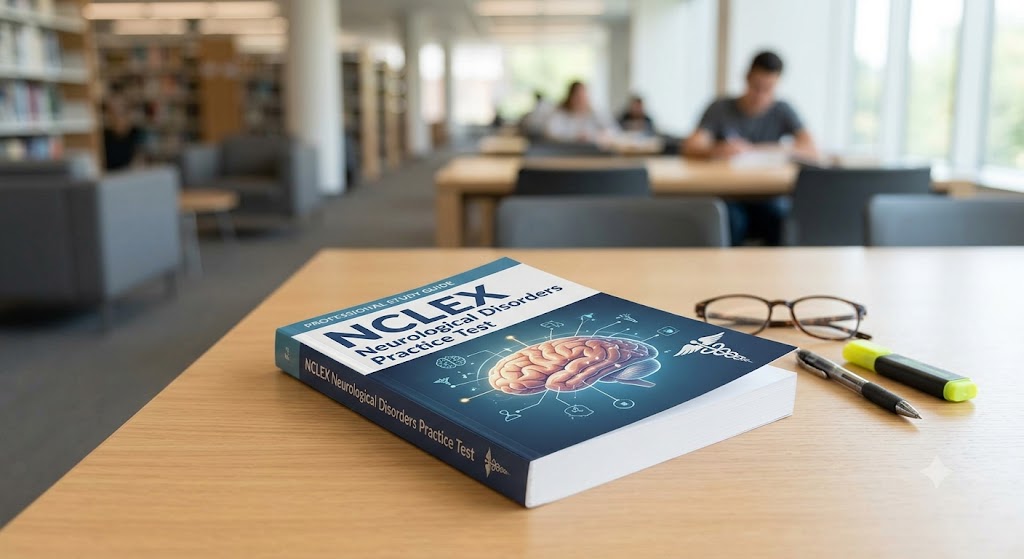
Additional Information
What the Course Entails and Exam Details
This practice test content is comprehensive, meticulously
curated to reflect the topics identified by the National Council of State
Boards of Nursing (NCSBN) for the neurological system.
Candidates using this resource will be challenged on their
understanding of essential neurological concepts, including but not limited to,
anatomy and physiology, detailed assessment techniques (such as the Glasgow
Coma Scale), and critical diagnostic tools.
A strong focus is placed on common neurological disorders
such as stroke (CVA), seizures, meningitis, multiple sclerosis, Parkinson’s
disease, spinal cord injuries, and traumatic brain injury (TBI).
You will also be tested on critical nursing interventions,
emergency management, medication administration, post-operative care for
neurosurgical patients, and patient education required for optimal outcomes in
this patient population.
What to Expect in
the Final Exam
While this is a practice resource, it prepares you for the
actual neurological component of the NCLEX-RN and NCLEX-LPN exams, which
utilize a computerized adaptive testing (CAT) format.
This means the number of questions and their specific
delivery can vary based on your performance, ranging from 75 to 145 items for
the RN exam.
The real exam includes multiple-choice questions, but you
must also be prepared for alternative item formats, including multiple-response
(select-all-that-apply), fill-in-the-blank, ordered response (drag-and-drop),
and hot spot (identifying anatomical locations).
Neurological questions are integrated into broader content
categories, such as Physiological Adaptation and Reduction of Risk Potential.
The passing score for the NCLEX is determined by a precise
logit value, reflecting minimum safe competence. There is no predetermined
percentage for a passing grade, as the focus is on whether your ability level
is above the required standard.
The total time allowed for the NCLEX is 5 hours, including
an initial tutorial and two optional breaks.
How to Study and Exam Centers
Effective preparation for this part of the NCLEX requires a
combination of content review and active practice.
Start by revisiting your nursing fundamentals in
neurological assessment and physiology from comprehensive NCLEX review guides.
When taking the NCLEX Neurological Disorders Practice Test,
focus not just on getting the correct answer but on understanding the rationale
for each correct and incorrect option.
Practice critical thinking by analyzing complex patient
scenarios rather than just memorizing facts.
Identify your weak areas and immediately target them with
deeper study or more practice questions.
As for the official NCLEX exam, you can take it at
authorized testing centers located worldwide, primarily through Pearson VUE.
After completing your nursing program and receiving your Authorization to Test
(ATT) from your State Board of Nursing, you can schedule your exam directly on
the Pearson VUE website. Ensure you select a convenient center and arrive
well-prepared on test day.
Job Opportunities
from the Course
Successfully passing the NCLEX with a strong foundation in
complex areas like neurological nursing unlocks a wide array of career
opportunities. Licensure as an RN or LPN/LVN is the single most important step
for any nursing professional.
Specific career paths this licensure and specialized
knowledge can unlock include:
- Registered
Nurse (RN)
- Licensed
Practical/Vocational Nurse (LPN/LVN)
- Neurology
Nurse (Critical Care or Progressive Care)
- Neuro
ICU Nurse (Critical Care)
- Neuro
Step-Down Unit Nurse
- Acute
Rehabilitation Nurse (specializing in neuro-recovery)
- Neurosurgical
Nurse
- Acute
Stroke Team Nurse
- Case
Manager (often specializing in complex neurological patients)
- Nursing
Educator (advanced degree required, specializing in neuro)
- Travel
Nurse (opportunities in neurology units)
Frequently Asked Questions
Reviews
5.0
Based on 0 reviews
Leave a Review
No reviews yet. Be the first to review!