
NCSF ACPT Section II: Exercise Physiology Practice Exam
$69.00
- Buy to unlock unlimited access to all Quiz questions and Answers in this Quiz.
- After purchase you can print a PDF of the whole quiz at any point. The PDF will contain the questions and the correct answers.
About this Exam
The National Council on Strength and Fitness (NCSF) Certified Personal Trainer (CPT) certification is a highly respected credential within the fitness industry, designed to equip trainers with the science-based knowledge necessary to design effective and safe training programs.
Specifically, the Section II focus on Exercise Physiology is critical, as it dives deep into the biological responses to physical activity.
This practice exam serves as a crucial preparatory tool for aspiring fitness professionals, ensuring they possess the comprehensive understanding of human movement, bioenergetics, and body systems required to pass the formal NCSF CPT certification and effectively train clients.
Ready to test your knowledge?
Buy Now to Access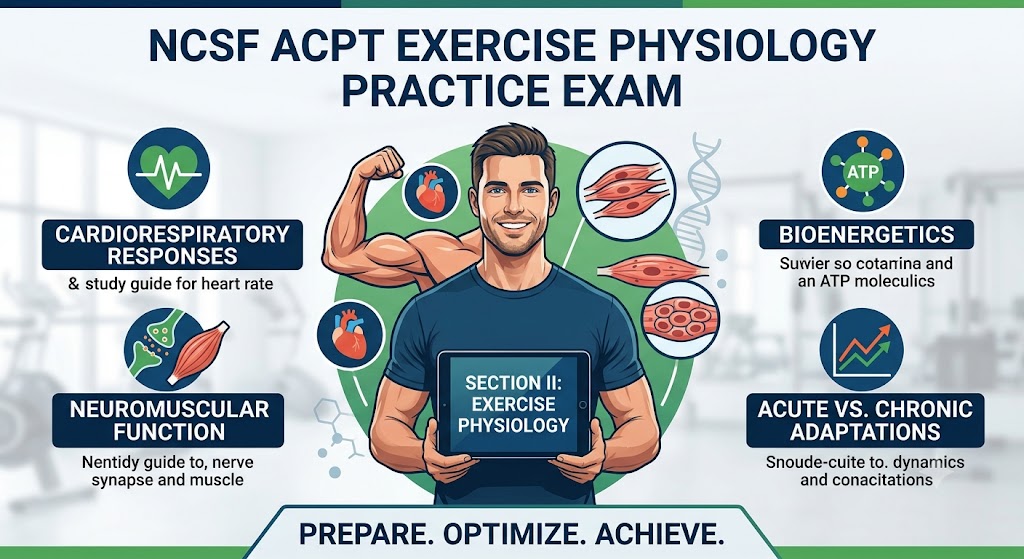
Additional Information
What the Course Entails and Exam Details
To master Section II, candidates must understand the
intricate mechanics of how the human body adapts to the stress of exercise.
The practice material focuses heavily on fundamental
physiological principles, including cellular energy production, skeletal muscle
function, and anatomical structures.
Furthermore, it covers the adaptations of major organ
systems.
Crucial areas of study include the acute and chronic
responses of the cardiovascular system, respiratory function, and metabolic
pathways essential for athletic performance and health.
You should expect significant overlap with biomechanics,
kinesiology, and fundamental scientific principles that underpin effective
training prescription.
A complete grasp of this knowledge is necessary for making
informed, science-based decisions in real-world client scenarios.
What to Expect in the Final Exam
While the exact structure of the practice exam may vary, the
standard full NCSF CPT certification exam is comprehensive and rigorously
structured.
The entire certification exam typically consists of
approximately 150 multiple-choice questions that assess various aspects of
personal training.
For the actual NCSF CPT exam, you are allotted a specific
time window, generally three hours, to complete all sections, including
Exercise Physiology.
The examination is timed, creating an environment that
test-takers must navigate efficiently.
A passing score on the official exam is typically 70 or
higher (scaled score), indicating that a broad and detailed understanding of
the material is required to achieve certification.
The practice exam for Section II mimics this structure,
focus, and rigor to properly simulate the testing experience.
How to Study and
Exam Centers
Effective study begins with a structured approach.
Candidates should start by thoroughly reviewing the NCSF
textbooks and study materials dedicated to Exercise Physiology, reinforcing
fundamental concepts, terminology, and practical applications.
Using practice exams iteratively is key; analyze your
results to identify weak points and revisit those topics for targeted study.
Flashcards are highly effective for memorizing muscle
groups, anatomical terms, and physiological processes.
Regarding the official test location, the NCSF partners with
established testing centers, most notably Prometric, allowing candidates to
schedule their exam at authorized facilities globally.
Candidates also have the option to take the exam via remote
proctoring, enabling them to complete it in the comfort of their own home,
provided they have a suitable, compliant environment.
Detailed instructions on how to locate and book your exam
are provided on the official NCSF website.
Job Opportunities from the Course
A certification from the NCSF, underpinned by a strong grasp
of Exercise Physiology, opens the doors to numerous rewarding career paths.
This certification is a vital asset in the fitness industry.
Specific job titles and career opportunities unlocked by
obtaining this certification include:
- Certified
Personal Trainer (Commercial or Private Gyms)
- Strength
and Conditioning Specialist (Sports Teams, High-Performance Centers)
- Fitness
Director or Gym Manager
- Group
Fitness Instructor
- Corporate
Wellness Coordinator
- Exercise
Physiology Technician (in clinical or research settings)
- Online
Fitness Coach and Entrepreneur
Frequently Asked Questions
Reviews
5.0
Based on 0 reviews
Leave a Review
No reviews yet. Be the first to review!