
NCTJ Court Reporting Practice Exam
$69.00
- Buy to unlock unlimited access to all Quiz questions and Answers in this Quiz.
- After purchase you can print a PDF of the whole quiz at any point. The PDF will contain the questions and the correct answers.
About this Exam
The NCTJ Court Reporting Practice Exam is designed for trainee journalists and students seeking to specialize in reporting on the legal system. It is a critical qualification within the standard NCTJ Diploma in Journalism and, increasingly, a niche skill valued in the broader media landscape. Mastering court reporting requires not only advanced news gathering and writing abilities but also a deep, precise understanding of complex legal procedures, restrictions, and ethics. This practice exam is the ideal tool for ensuring you are prepared for the rigors of the final assessment.
Ready to test your knowledge?
Buy Now to Access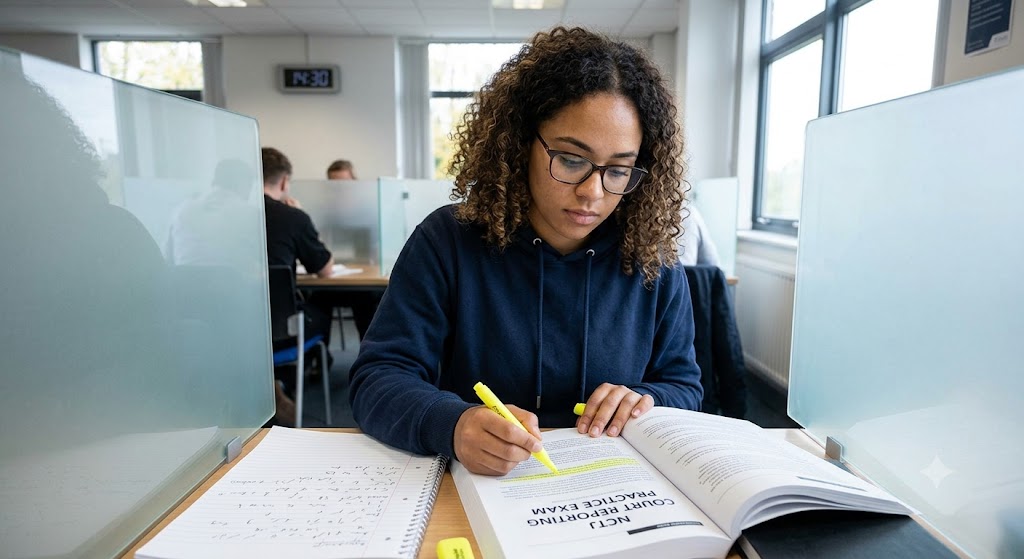
Additional Information
What the Course Entails and Exam Details
This qualification and its corresponding practice exam focus
on the core skills required for accurate and ethical court journalism. The
syllabus generally covers: Understanding the Court System: Detailed knowledge
of different court levels in the UK (e.g., Magistrates', Crown, High Courts)
and their distinct jurisdictions. Legal Restrictions and Reporting Rules:
Mastery of essential legislation such as the Contempt of Court Act 1981,
anonymity rules (for victims and minors), and specific reporting bans. Court
Procedures and Etiquette: Knowing how to access information, where to sit, when
to make applications to the court, and general courtroom decorum. Spotting and
Fact-Checking Stories: Identifying newsworthy elements in cases and ensuring
absolute accuracy. Advanced News Writing for Court: Writing balanced, accurate,
and fair court reports, often under extreme pressure.
What to Expect in the Final Exam
While "practice" exams aim to simulate the real
experience, candidates sitting the actual NCTJ Court Reporting
assessment can typically expect: Format: A combination of practical tasks and a
written, theory-based section. The practical element usually involves reporting
on a real or simulated case (often listening to audio or viewing video of
proceedings) to produce a news story that is fair, accurate, and safe from
contempt. Passing Score Requirements: The precise passing grade may vary, but
accuracy is paramount. A critical error, especially regarding reporting
restrictions, will often result in automatic failure, reflecting the real-world
risk of contempt of court. Time Limits: Strict time limits are applied to
reflect the deadline pressure of real-world journalism. A practical reporting
task might allow around 60-90 minutes for the story, while the theory paper is
also strictly timed. Specific Rules: Accuracy is key. Even minor spelling or
date errors can affect marks, and candidates must accurately state the full
details of the case, defendant, and charges.
How to Study and Exam Centers
Preparation for the Court Reporting exam relies on a strong
theoretical foundation and practical application.Actionable Study
Strategies: Master the Law: Extensively study legal guidelines and
restrictions. Memorize key acts and understand how they apply to practical
reporting scenarios. Attend Real Court Hearings: The best preparation is
witnessing actual court proceedings. Understand the flow, etiquette, and types
of cases that arise. Practice with Past Papers: Access past NCTJ practice
exams. These provide insight into the types of scenarios and questions you’ll
encounter. Simulate Exam Conditions: Set a timer and practice writing fair and
accurate news stories from provided materials or your own court observations.
Seek feedback from tutors or experienced journalists. Read Court Coverage:
Analyze high-quality court reporting in national and local newspapers to
understand style, structure, and clarity.Exam Centers: Authorized
Schools: Most candidates take the exam through NCTJ-accredited training
centers, universities, or colleges as part of their broader journalism
qualification. NCTJ Assessment Days: For those taking it as a stand-alone unit,
the NCTJ often organizes national assessment days at specific, centrally
located venues. Pearson VUE: The theoretical, knowledge-based portions are
sometimes delivered at Pearson VUE testing centers. However, always confirm the
specific exam delivery method for your current session on the official NCTJ
website.
Job Opportunities from the Course
A qualification in court reporting is increasingly valuable, demonstrating high journalistic standards and specialized knowledge. Career paths include: Court Reporter: Specializing full-time or part-time in covering court cases for local or national news organizations. News Reporter/Journalist: Employed by newspapers, websites, or broadcasting companies, with court reporting as a significant part of your portfolio. Legal Journalist: Specializing in complex legal issues and cases for trade publications, websites, or national news desks. Specialist Content Creator/Blogger: Focus on analyzing and reporting legal affairs in a specific niche. Press Officer (Legal/Court): Working within the judicial system or for related organizations on communications and media liaison. Digital/Data Journalist: Utilizing knowledge of legal systems for specialized investigative or data-driven reporting
Frequently Asked Questions
Reviews
5.0
Based on 0 reviews
Leave a Review
No reviews yet. Be the first to review!