
NDT UT Level II Practice Exam
$69.00
- Buy to unlock unlimited access to all Quiz questions and Answers in this Quiz.
- After purchase you can print a PDF of the whole quiz at any point. The PDF will contain the questions and the correct answers.
About this Exam
Nondestructive Testing (NDT) is a critical quality control method used across numerous industries to ensure the safety and reliability of materials and structures without causing damage. Within this field, Ultrasonic Testing (UT) uses high-frequency sound waves to detect internal imperfections and measure material thickness. The NDT UT Level II certification is a key step for inspectors ready to take on more responsibility in interpreting data and performing complex evaluations. This practice test is designed for technicians who have completed their initial Level I training and required field experience, and are now preparing for the challenging Level II certification exams administered by recognized bodies like ASNT. It provides a realistic simulation to gauge your readiness and identify areas where further study is needed.
Ready to test your knowledge?
Buy Now to Access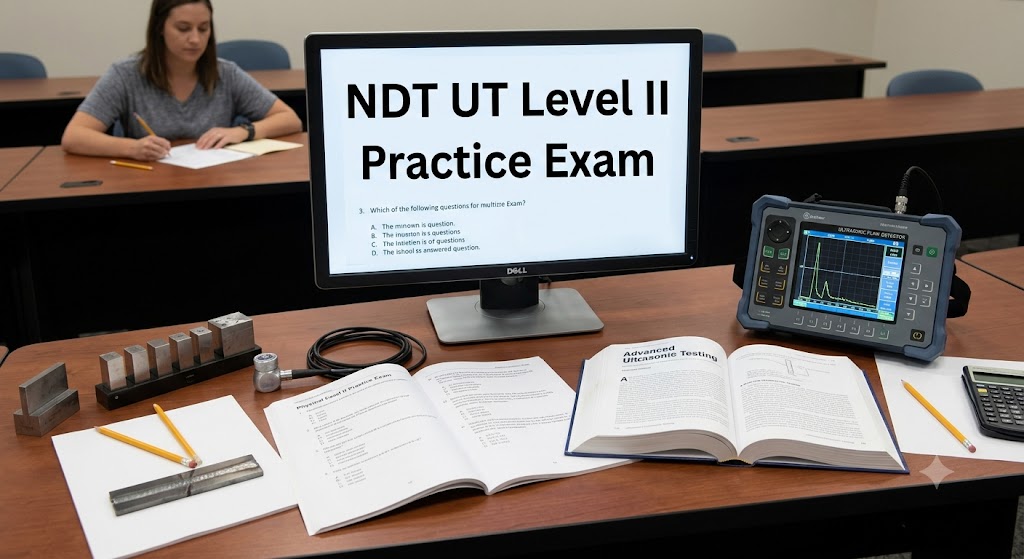
Additional Information
What the Course Entails and Exam Details
Achieving Level II certification in Ultrasonic Testing requires a deep understanding of advanced UT principles, techniques, and the associated codes and standards. The practice test covers these essential areas through multiple comprehensive sections. Expect questions on the fundamental physics of sound propagation, various wave modes (like longitudinal, shear, and surface waves), and how sound interacts with different materials. A significant focus is placed on the precise selection and application of different transducers, including contact, immersion, and phased array probes, as well as necessary calibration techniques like Distance Amplitude Correction (DAC) and angle beam calibration. The Level II professional must be skilled at interpreting signals to differentiate between relevant and non-relevant indications. This practice test challenges your ability to evaluate the sizing, orientation, and severity of discontinuities such as cracks, porosity, inclusions, and corrosion, and to apply the specific acceptance criteria outlined in industry-standard codes like ASME, AWS, and ISO.
What to Expect in the Final Exam
The official NDT UT Level II exam is typically composed of three distinct parts: a General examination, a Specific examination, and a Practical examination. The written portions (General and Specific) are most often multiple-choice, demanding both theoretical knowledge and the application of that knowledge to real-world scenarios. A passing score of 70% or higher is usually required on each separate examination to achieve certification. The General exam assesses broad knowledge of the basic principles and techniques, while the Specific exam tests your capability to apply these principles using specific codes, standards, and procedures relevant to your industry or employer. You will also be required to successfully complete a demanding hands-on Practical examination. This will involve using UT equipment to inspect flawed samples, such as weld specimens or components with known defects, and then accurately locating, sizing, and reporting these imperfections according to specified procedures. Time limits vary but are often generous, allowing for careful consideration of the questions and thorough performance during the practical inspection.
How to Study and Exam Centers
Comprehensive preparation is vital for success on the Level II exams. Start by revisiting your course materials and manuals, paying close attention to advanced UT theory and industry codes. This practice test is an invaluable tool to simulate the exam environment, manage your time, and identify knowledge gaps. Don't simply look for the correct answers; understand why each answer is correct and the underlying concepts behind it. Review key calculations for velocity, wavelength, angle selection, and signal-to-noise ratio. For the practical exam, dedication to hands-on practice is essential. If possible, arrange time in an NDT lab or work environment to practice calibrating equipment on various blocks and scanning a range of flawed samples, while carefully documenting your findings. The official examinations are administered through recognized certification bodies, such as the American Society for Nondestructive Testing (ASNT), often utilizing their network of Authorized Examination Centers (AECs). Some programs may use Pearson VUE for the written, computer-based portions, but the practical exams are typically held at dedicated facilities equipped with the necessary UT equipment and flawed samples.
Job Opportunities from the Course
Obtaining NDT UT Level II certification significantly boosts your career prospects and earning potential in several industries.
NDT Technician Level II (UT)
Ultrasonic Inspector
Quality Assurance Inspector
Non-Destructive Evaluator (NDE)
QA/QC Supervisor (with experience)
Asset Integrity Specialist
Corrosion Inspector
Project Manager (Quality Control)
Frequently Asked Questions
Reviews
5.0
Based on 0 reviews
Leave a Review
No reviews yet. Be the first to review!