
NEAT 3-1 Practice Exam
$69.00
- Buy to unlock unlimited access to all Quiz questions and Answers in this Quiz.
- After purchase you can print a PDF of the whole quiz at any point. The PDF will contain the questions and the correct answers.
About this Exam
Embarking on a career in the skilled trades with the Northeastern Apprenticeship and Training (NEAT) program is a journey filled with opportunity and challenge. The NEAT 3-1 exam marks a crucial milestone for electrical apprentices progressing through their multi-year training. It is designed to evaluate an apprentice's growing expertise, ensuring they possess the core knowledge and skills required to safely and effectively advance in their specific electrical discipline, whether that be as an Inside Wireman or another specialized role within the region. This comprehensive study guide is your essential companion, crafted to help you navigate the 3-1 level assessment with confidence. Let's delve into what this test entails and how you can prepare effectively to unlock the next chapter of your thriving career.
Ready to test your knowledge?
Buy Now to Access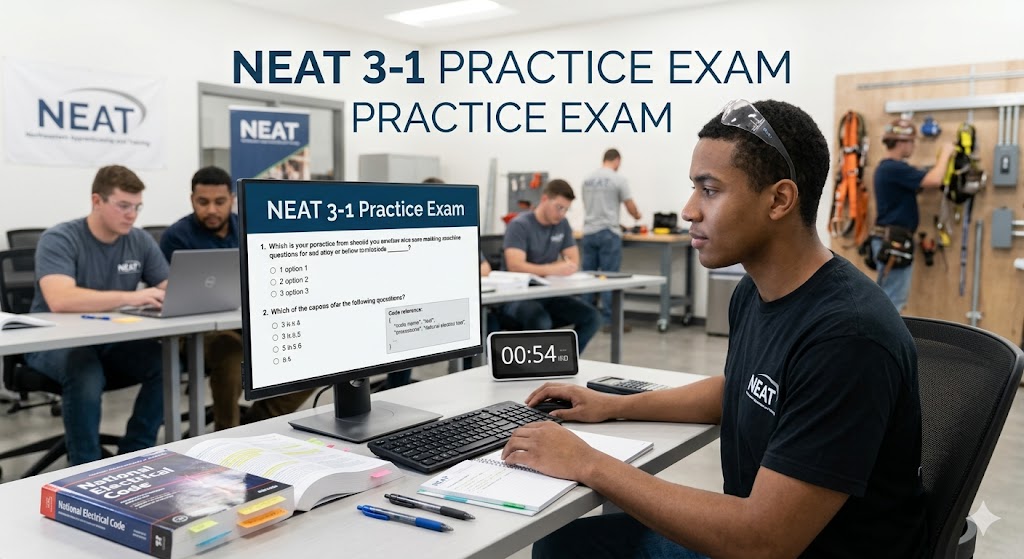
Additional Information
What the Course Entails and Exam Details
The NEAT apprenticeship is a rigorous program combining comprehensive classroom instruction with invaluable on-the-job training. As you progress to the 3-1 level, the corresponding curriculum deepens, building upon the foundational concepts established in earlier years.
Key areas often covered at this stage and reflected in the exam content include:
Advanced Safety Procedures & OSHA Compliance: Building on the basics to include more complex electrical safety in various environments, advanced personal protective equipment, and lock-out/tag-out scenarios.
The National Electrical Code (NEC) & Regulations: Rigorous study and practical application of specific NEC articles relevant to level 3 work, focusing on code interpretation and ensuring work is safe, reliable, and legally compliant.
Theoretical Concepts: Enhanced understanding of complex circuit theory, transformers, motors, and advanced grounding.
Practical Skills: While the 3-1 test is typically a theoretical knowledge assessment, the underlying course heavily integrates practical skills. This includes advanced wiring methods, equipment installation, control systems, and troubleshooting in residential, commercial, and industrial settings.
Blueprint Reading & Planning: More complex technical drawing interpretation, allowing apprentices to translate plans into reality with greater precision and independent judgment.
The NEAT 3-1 Practice Test itself serves as a vital diagnostic tool, mirroring the potential scope and format of the final level exam to help you identify strengths and areas for focused study before your official assessment. It is not the final exam, but a strategic step in ensuring your readiness.
What to Expect in the Final Exam
While the specific, minute details (exact number of questions, passing score, time limit) for each individual NEAT level exam can vary and are often proprietary to the program and year, typical level assessments like the final 3-1 exam are structured with rigour in mind. These exams generally feature a significant theoretical component:
Format: The final 3-1 exam is primarily composed of multiple-choice questions. This format effectively tests a broad range of knowledge on theory, safety, and regulations, requiring careful reading and critical thinking to select the single best answer.
Time Limits: To ensure efficiency and simulate on-the-job demands, these assessments are timed. Expect a predefined period, which can span from one to several hours, to complete all sections.
Passing Score: The competitive and safety-critical nature of the electrical trade means high standards are upheld. Candidates are typically expected to demonstrate proficiency, often requiring a minimum score equivalent to or exceeding standard pass rates for vocational or college-level coursework, to successfully progress.
Rules: Standard testing rules apply. All materials are generally collected, no external aids (aside from permitted, specified references or calculators if explicitly allowed for a given section) are typically allowed, and focus is strictly required.
Important Note: The "NEAT 3-1 Practice Test" you are using is a preparation resource that simulates a typical exam environment. Its specific structure, score, and timing may not be identical to the official NEAT level assessment but provide a valuable approximation for preparation. The descriptions in this section refer to the character of the final level exam you are striving for.
How to Study and Exam Centers
Effective preparation is the key to success in any exam, especially one determining your progress in a skilled trade. Here are actionable strategies and information on where you will eventually take your level exam:
Study Strategies:
Master the Core Material: Thoroughly review all course textbooks, provided materials, lecture notes, and, most importantly, the National Electrical Code (NEC) as it applies to your current level of training. Understand not just what the rules are, but why they exist and how to apply them.
Leverage Practice Tests: Use the "NEAT 3-1 Practice Test" frequently! Take it under timed conditions, review all incorrect answers, and understand the logic behind the correct responses. Treat it as a genuine trial run.
Active Recall & Spaced Repetition: Flashcards (physical or digital) are excellent for memorizing NEC references, theoretical terms, and safety procedures. Review material in increasing intervals to improve long-term retention.
Join Study Groups: Collaborate with your peers. Discussing complex topics, explaining concepts to others, and working through challenging practice questions together can significantly deepen your understanding.
Focus on Fundamentals & Safety: Revisit foundational math and algebra principles. Pay obsessive attention to all safety protocols and code compliance—these are non-negotiable in the electrical field.
Mock Exams & Time Management: In the final days leading up to the exam, set up mock testing environments. Replicate the pressure and time constraints to build stamina and identify any lingering weak points.
Physical Practice (if integrated): Ensure your practical skills align with the theoretical concepts. Hands-on experience in training labs and on-the-job reinforces classroom learning and prepares you for the holistic nature of being an electrician.
Rest and Well-being: Never underestimate the power of a well-rested mind and a healthy body. Get enough sleep, eat nutritious meals, and manage stress levels effectively.
Exam Centers:
NEAT level exams are not typically public or available through general testing networks like Pearson VUE. Instead, they are administered internally within the NEAT program or in collaboration with local unions and training centers.
Registration: Your progression to the 3-1 level will be managed by your local NEAT joint apprenticeship & training committee (JATC) or training director. They will inform you of your eligibility, the exam schedule, and registration procedures.
Locations: These assessments are held at designated, secure locations. This might include:
The NEAT program’s own dedicated training facilities.
A local union hall (IBEW).
An affiliated community or technical college, specifically authorized by NEAT for this purpose.
Authorized satellite training centers across the Northeastern region.
You will receive precise information about your specific exam date, time, and, most importantly, the exact address of your testing center from your local NEAT program contact. Always check for updates directly with your training director.
Job Opportunities from the Course
A NEAT apprenticeship, once successfully completed, is a valuable qualification, and milestones like the 3-1 level are critical stepping stones that solidify your skills and reputation. The program opens doors to diverse, lucrative, and rewarding careers, typically within the unionized electrical sector (often associated with the IBEW in the Northeast region).
The specific career paths and job titles you can unlock as you progress towards and upon completion of your journey-level certification include:
Electrical Apprentice (Inside Wireman or Specialized Level 3+)
Journeyman Inside Wireman
Journeyman Outside Lineman (if specific to that NEAT pathway)
Industrial Electrician
Commercial Electrician
Residential Electrician
Control Systems Technician
Specialized Roles: (e.g., in areas like high voltage, alternative energy, marine electrical, data/telecommunications)
Electrical Contractor / Business Owner (with further experience & licensure)
Job Site Foreman / Superintendent
Project Manager
Electrical Inspector / Code Official
Safety Coordinator / Director
Training Director / Instructor (within apprenticeship programs like NEAT)
Frequently Asked Questions
Reviews
5.0
Based on 0 reviews
Leave a Review
No reviews yet. Be the first to review!