
Nebraska Ag Tech & Mechanical Systems CDE Practice Exam
$69.00
- Buy to unlock unlimited access to all Quiz questions and Answers in this Quiz.
- After purchase you can print a PDF of the whole quiz at any point. The PDF will contain the questions and the correct answers.
About this Exam
The Nebraska Agricultural Technology and Mechanical Systems Career Development Event (CDE) is an exhilarating, comprehensive competition designed for high school students who possess a passion for innovation, problem-solving, and the mechanics that drive modern agriculture. This event goes far beyond simple textbook knowledge, challenging participants to apply technical concepts to real-world scenarios. It is the premier showcase for the next generation of agricultural technicians, engineers, and precision agriculture specialists, providing a platform to prove their proficiency in the essential systems that sustain the agricultural industry. Whether your interest lies in massive machinery, intricate electrical circuits, or sustainable structural design, this CDE offers a unique opportunity to turn your curiosity into a recognized skill set.
Ready to test your knowledge?
Buy Now to Access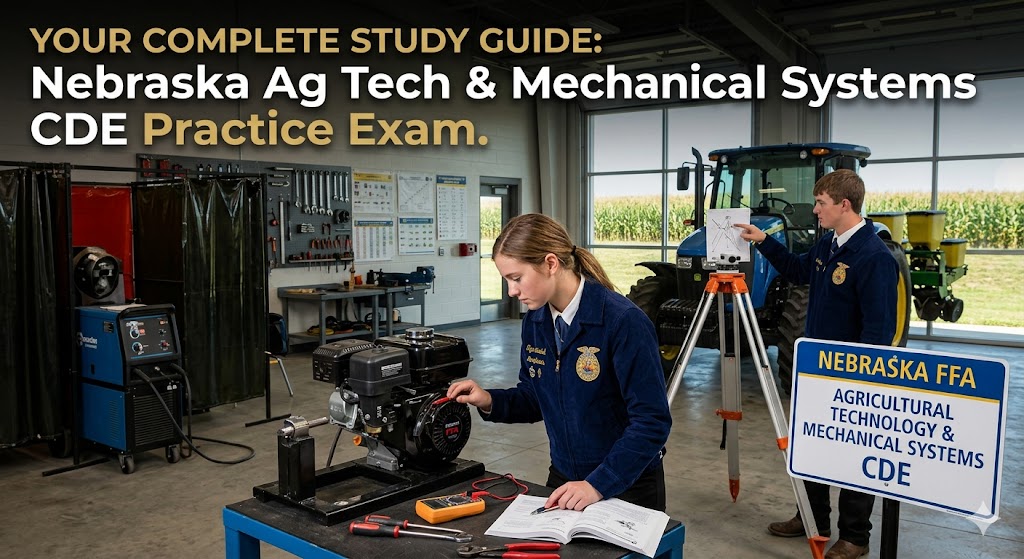
Additional Information
What the Course Entails and Exam Details
To excel in the Nebraska Ag Technology and Mechanical Systems CDE, students must master a diverse range of technical skills and theoretical concepts. The curriculum and the CDE are built around a multi-faceted "systems" approach, ensuring that participants understand how different components interact in an agricultural setting.
The core areas of focus include:
Machinery and Equipment Systems: Covering the operation, maintenance, adjustment, and repair of a wide range of agricultural machinery, including tractors, tillage equipment, and harvest loss calculations.
Electrical Systems: Focusing on the fundamentals of AC and DC power, electrical safety, sensing devices, control systems, and electronics common in agricultural applications.
Compact Equipment Systems: Specifically addressing small gas engines, hydraulic power, and the troubleshooting and repair of compact power units under 30 horsepower.
Structural Systems: Including the design, construction, and maintenance of agricultural structures, involving skills in woodworking, masonry, plumbing, and understanding building plans.
Environmental and Natural Resources Systems: Challenging students to apply technological solutions to conservation, surveying, water quality, and sustainable waste management.
The event itself is structured to evaluate both individual knowledge and team collaboration. For the complete experience, it includes:
A rigorous individual written exam.
Individual hands-on skill practicums across the five systems.
A complex, collaborative team problem-solving activity presented on the day of the event.
What to Expect in the Final Exam
The final exam for the Nebraska Agricultural Technology and Mechanical Systems CDE consists of three distinct phases.
The Written Examination: Each team member will work independently to complete a written test, which typically features approximately 25 to 50 multiple-choice or problem-solving questions. This section has a strict time limit, often around 60 minutes, and covers theoretical knowledge from all five core systems. Participants are usually permitted to use a basic, silent calculator.
The Individual Skill Activities: Students must demonstrate their practical proficiency at multiple stations, each focusing on a different system. You will face hands-on tasks such as diagnosing an engine fault, wiring a specific circuit, calculating concrete needed for a structure, or interpreting a legal land description. Each activity is timed, typically giving participants 15 to 20 minutes to complete the given task.
The Team Problem Solving Activity: This is a key differentiator of the Nebraska CDE. On the day of the competition, your four-member team will be presented with a complex, multi-system problem scenario. Your team must analyze the situation, develop a logical solution, and often produce a computer-generated report, all within a designated timeframe (often over an hour). This section is judged on teamwork, problem-solving efficiency, and the quality of the final solution.
Scoring is holistic, combining individual written exam scores, individual skill practicum results, and a quarter of the total team activity score to determine each student's final individual ranking. The team score is the sum of all individual scores and the full team activity score. While there isn't a fixed "passing score" in the conventional certification sense, students aim for the highest points to achieve individual and team recognition and qualify for national competition.
How to Study and Exam Centers
Effective preparation for this CDE demands a balance of intensive study and hands-on practice.
Actionable Study Strategies:
Reference Material is Key: Become intimately familiar with the recommended textbooks. For this event, the definitive resource is often Agricultural Mechanics: Fundamentals and Applications by Cengage. Don't just read it; understand the logic behind every process.
Practice on Past Exams: Seek out previous state and national FFA Agricultural Technology and Mechanical Systems CDE exams. This will help you get accustomed to the style of questions and the time pressure of the written exam.
Hands-on Workshops: The best way to learn mechanics is by doing. Arrange for time in your school's agricultural mechanics lab to practice welding, engine disassembly, structural framing, and circuit testing under the guidance of your instructor.
Simulate the Team Activity: Get together with your teammates and tackle hypothetical, multi-system agricultural problems. Practice delegating tasks, communicating efficiently, and developing structured solutions within a time limit.
Master the Calculator: Ensure you are highly efficient at making fast, accurate calculations for problem-solving questions.
Exam Centers:
The final Nebraska State CDE competition is held annually in a centralized location, often the University of Nebraska-Lincoln, in conjunction with other State FFA Career Development Events. Students qualify for the state competition by excelling in district-level events. While the main competition is a physical, intensive event, preliminary or practice written exams might be administered through authorized online platforms or during district competitions. Your agricultural education instructor will provide the specific details on registration and the location of your local district and the state finals.
Job Opportunities from the Course
A strong performance in the Nebraska Agricultural Technology and Mechanical Systems CDE is a significant credential, opening doors to a multitude of high-demand, high-skill career paths within the agricultural and broader technical sectors.
Here are specific job opportunities unlocked by this path:
Agricultural Technician
Precision Agriculture Specialist
Heavy Equipment Mechanic
Agricultural Engineer
Fabrication Welder
GPS/GIS Agricultural Analyst
Irrigation Specialist
Agribusiness Manager
Agricultural Structures Construction Manager
Farm and Ranch Manager
Field Service Technician
Drone Operations Specialist for Agriculture
Frequently Asked Questions
Reviews
5.0
Based on 0 reviews
Leave a Review
No reviews yet. Be the first to review!