
Nebraska Driving Test Practice Exam
$69.00
- Buy to unlock unlimited access to all Quiz questions and Answers in this Quiz.
- After purchase you can print a PDF of the whole quiz at any point. The PDF will contain the questions and the correct answers.
About this Exam
Welcome to your comprehensive guide for the Nebraska Driving Test Practice! This process is designed for anyone seeking their first Nebraska driver’s license, whether you're a teenager navigating the graduated licensing system or an adult new to the state. The ultimate goal is to ensure you possess the knowledge and practical skills required to safe, responsibly, and legally operate a motor vehicle on Nebraska's roads. Preparing with a strong focus on practice for both the written knowledge and the practical skills exams is your key to success and newfound independence. This guide will walk you through everything you need to know to prepare effectively.
Ready to test your knowledge?
Buy Now to Access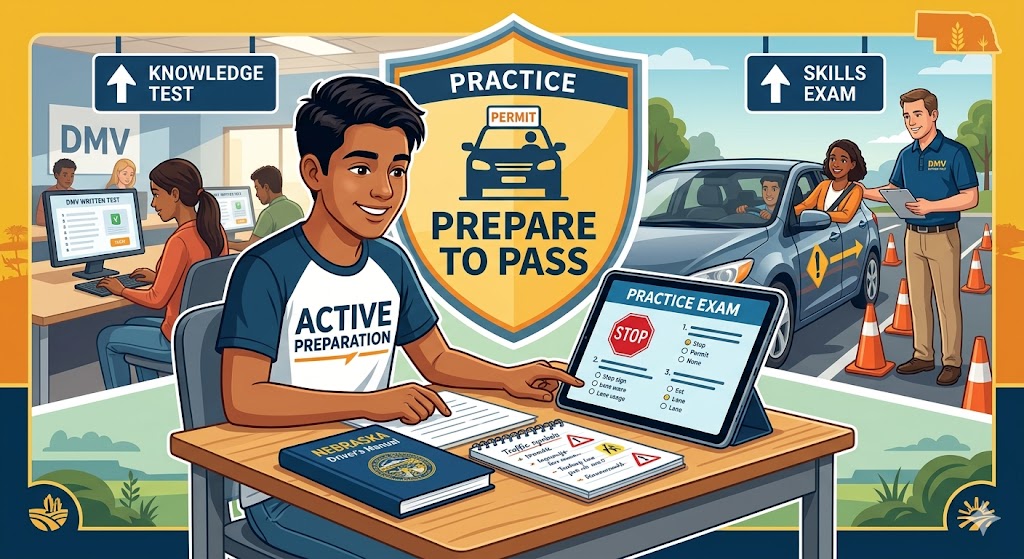
Additional Information
What the Course Entails and Exam Details
Your path to a Nebraska driver's license isn't a structured course in the traditional sense, but a crucial learning and practice journey. The two main assessments you must pass are the written knowledge test and the driving skills exam.
The Knowledge Journey:
The core of your preparation should revolve around the comprehensive Nebraska Driver’s Manual. This official document is your definitive study guide, covering critical topics such as:
Nebraska traffic laws and regulations
Road signs, signals, and pavement markings
Safe driving practices and defensive driving techniques
Rules for yielding the right-of-way
Speed limits and parking regulations
Sharing the road with other users (pedestrians, cyclists, trucks)
The effects of alcohol and drugs on driving
The written knowledge test specifically evaluates your understanding of these essential concepts. It is the first formal hurdle in the licensing process. Effective test practice involves taking representative practice tests, using flashcards, and thoroughly reviewing the official manual until you are confident in your knowledge.
The Skills Journey:
Once you have held your learner’s permit for the required duration and gained sufficient practice, you will face the driving skills exam. This practical test assesses your ability to safely apply your knowledge in real-world driving situations. The skills "course" is your extensive, supervised time behind the wheel.
Exam Details Overview:
Written Knowledge Test:
Format: Typically a multiple-choice, computer-based exam.
Content: Questions covering road signs, rules, and safe practices from the manual.
Passing Score: A strong score of 80% is required, meaning you must correctly answer 20 out of 25 questions.
Driving Skills Exam:
Format: A practical assessment conducted by a DMV examiner, who will sit in the vehicle with you.
Content: Assessment of vehicle control, observational skills, proper execution of maneuvers (turns, intersections, speed management, potentially parallel parking, etc.), and adherence to traffic laws. A pre-test vehicle inspection is also part of the process.
What to Expect in the Final Exam
The final step in achieving your license involves successfully navigating both the knowledge and skills assessments. While the actual experience might vary slightly by location, here is a general idea of what you can expect:
1. The Written Knowledge Test
Environment: Conducted at a local Nebraska DMV Driver Licensing Office. The atmosphere is quiet, and the testing area is typically comprised of computer terminals.
Process: After checking in, you will be directed to a testing station. The test is usually computer-based, displaying questions one by one. Take your time to read each question and all multiple-choice options carefully before selecting your answer.
Format and Timing: The standard Nebraska written test currently consists of 25 multiple-choice questions. While there isn't typically a strict, visible time limit on each question, the office has operating hours, so don't linger excessively. Most people complete it within 15-30 minutes.
Scoring and Results: As mentioned, you must correctly answer at least 20 questions (80%) to pass. Results are often available immediately upon completion. If you pass, you will receive confirmation and can proceed to the next step (which might involve obtaining a permit or scheduling your skills test).
2. The Driving Skills Exam
Environment: The practical test takes place on the roads around the DMV office and may include a designated skills course area. It involves driving in normal traffic conditions.
Process: You must arrive for your scheduled skills test with a vehicle that is street-legal, insured, and in good mechanical working order. The examiner will first perform a basic vehicle inspection (checking lights, signals, brakes, wipers, etc.). Once the vehicle is cleared, the examiner will join you, give you directions, and evaluate your driving.
Skills Assessment: Expect the examiner to observe and score you on various aspects, including:
Proper use of mirrors and observational techniques
Smooth acceleration, braking, and steering
Observing speed limits and traffic signals
Proper use of turn signals
Yielding right-of-way correctly
Safe lane changes and turns
Maintaining a safe following distance
Correct reactions to typical traffic scenarios
Specific maneuvers (these can include straight-line backing, parallel parking, three-point turns, and turning around in a narrow street, depending on the test requirements and location).
Passing Requirement and Rules: Safe and legal driving is paramount. Accumulating too many minor errors, committing any major traffic violation (like running a stop sign), or causing an unsafe situation can result in an automatic failure. Maintain focus and drive as you have practiced. The examiner will provide a score sheet after the test detailing any areas of concern.
How to Study and Exam Centers
Effective preparation is the foundation of a successful driving test experience. Here’s a detailed strategy to help you get ready, and information on where to take your exams:
Actionable Study Strategies for the Written Test:
The Manual is Key: Your absolute first and most important resource is the official Nebraska Driver’s Manual. Read it cover to cover, not just once, but multiple times. It contains every piece of information you might be tested on. Take notes, highlight key sections, and focus on details like specific rules, numbers (speed limits, distances), and sign meanings.
Take Practice Exams: Leverage reputable online resources for Nebraska Driving Test Practice Exams. Official DMV websites often provide sample questions. There are also numerous high-quality, free practice tests available from educational sites. These replicate the format and content, helping you gauge your knowledge and identify areas for improvement. Treat them like the real test: aim for a high pass rate consistently.
Flashcards for Signs and Rules: Create or find digital flashcards. They are particularly effective for memorizing road signs, signals, and specific, easily testable rules of the road (like BAC limits, signal distances, etc.). Repetition is a powerful learning tool.
Review Mistaken Answers: Don’t just check your practice test scores. Carefully review any questions you get wrong on practice exams and consult the driver's manual to understand why the correct answer is right. This focused correction prevents recurring mistakes.
Simulate Test Conditions: When you feel ready, take a few practice tests in a quiet, distraction-free environment, mimicking the setting of the real exam. This can help build your confidence and reduce test anxiety.
Strategies for the Driving Skills Exam:
Get a Learner's Permit First: Ensure you follow Nebraska's Graduated Licensing (or appropriate adult) process and obtain your learner’s permit before you begin practicing on public roads. This requires passing the written test first.
Practice Extensive, Supervised Driving: Once you have your permit, practice behind the wheel as much as possible. Log the required number of supervised driving hours (and significantly more, if you can!) with a licensed driver who can provide calm, constructive guidance.
Practice in Diverse Conditions: Don't just stick to the same route or time of day. Practice driving in different types of traffic, on various road surfaces, at different times, and in varied weather conditions (within reason and safe practices). This builds comprehensive driving competence.
Learn and Practice Specific Maneuvers: Dedicate specific practice sessions to mastering the maneuvers you might be asked to perform on the skills test (e.g., precise turns, parallel parking, controlled backing up). Review the skills section of your driver’s manual for guidance on proper execution.
Pre-Test Vehicle Check: Make a habit of checking your vehicle's condition (lights, signals, brakes, etc.) before every practice drive. This ensures you are familiar with the components that will be inspected during the exam and that you are always operating a safe vehicle.
Finding Exam Centers and Scheduling:
Written Knowledge Test: These are typically conducted on a walk-in basis at many local Nebraska DMV Driver Licensing Offices during regular business hours. However, it's always wise to check the official Nebraska DMV website or call ahead to verify the services and hours at your desired location. Some locations may offer appointment scheduling, so utilize that if available to minimize wait times.
Driving Skills Exam: The practical road test is usually scheduled by appointment. You can typically book your skills test online through the Nebraska DMV website or by contacting your local licensing office. Be sure to schedule in advance, especially during busy periods, and ensure your practice vehicle meets all requirements on the day of the test.
Location Finder: Use the official DMV website to find the nearest Driver Licensing Office that offers both the written and skills exams. This is essential, as not all offices may provide all services (e.g., some might only issue licenses and not conduct skills tests).
Job Opportunities from the Course
A Nebraska Driver’s License, achieved by preparing effectively and passing the required tests, isn't a job certification itself. However, it is an essential, often non-negotiable qualification that unlocks a vast array of employment opportunities. For many roles, having a valid driver's license is a fundamental prerequisite for basic operations, service delivery, or simply getting to work.
Here are some specific job titles and career paths where holding a standard Nebraska driver's license can open doors and build a successful career:
Delivery Driver:
Restaurant Delivery
Parcel & Courier Services
Specific Product Delivery (e.g., flowers, furniture, auto parts)
Rideshare Driver: Operates with companies like Uber and Lyft
Taxi and Chauffeur Services: Professional driver roles
Field Service Technician:
HVAC and Appliance Repair
Plumbing and Electrical Services
Telecommunications and Cable Installation
Sales Representative: Requires travel to meet with clients and prospects
Construction and General Contracting: Transporting tools, equipment, and materials between jobsites
Certain Security and Law Enforcement Roles: Some introductory positions may require a valid license for vehicle operation and patrolling
Public Transit Operator (Non-CDL roles): Specific transport roles for smaller vehicles not requiring a full Commercial Driver’s License (CDL) immediately, but relying on a solid driving record and a standard license as a base.
Real Estate Agent: Regularly shows properties and travels between appointments
Agriculture and Farming: Operating various farm vehicles (though specific exemptions and requirements exist for farm equipment, a standard license is often needed and beneficial).
Caregiver and Personal Assistant: Assisting clients with transportation to appointments, errands, and social activities
Frequently Asked Questions
Reviews
5.0
Based on 0 reviews
Leave a Review
No reviews yet. Be the first to review!