
NEC Article 100 Practice Exam
$69.00
- Buy to unlock unlimited access to all Quiz questions and Answers in this Quiz.
- After purchase you can print a PDF of the whole quiz at any point. The PDF will contain the questions and the correct answers.
About this Exam
Understanding the National Electrical Code (NEC) is crucial for anyone working in the electrical industry, and mastering Article 100 is the first critical step. Article 100 is the glossary of the NEC, defining the terms that are essential for the accurate interpretation and application of code rules throughout the rest of the book. Without a firm grasp of these precise definitions, misinterpretation of safety requirements can lead to dangerous installations and failed inspections.
This NEC Article 100 Practice Test is designed specifically for aspiring electricians, electrical apprentices, journeymen preparing for licensure, electrical inspectors, and engineers. It serves as a comprehensive self-assessment tool to gauge your understanding of foundation terminology. While not a certification itself, this practice test validates the foundational knowledge required to pass recognized licensing exams (such as Journeyman or Master Electrician exams) and ensures you are speaking the same technical language as industry regulators and safety professionals.
Ready to test your knowledge?
Buy Now to Access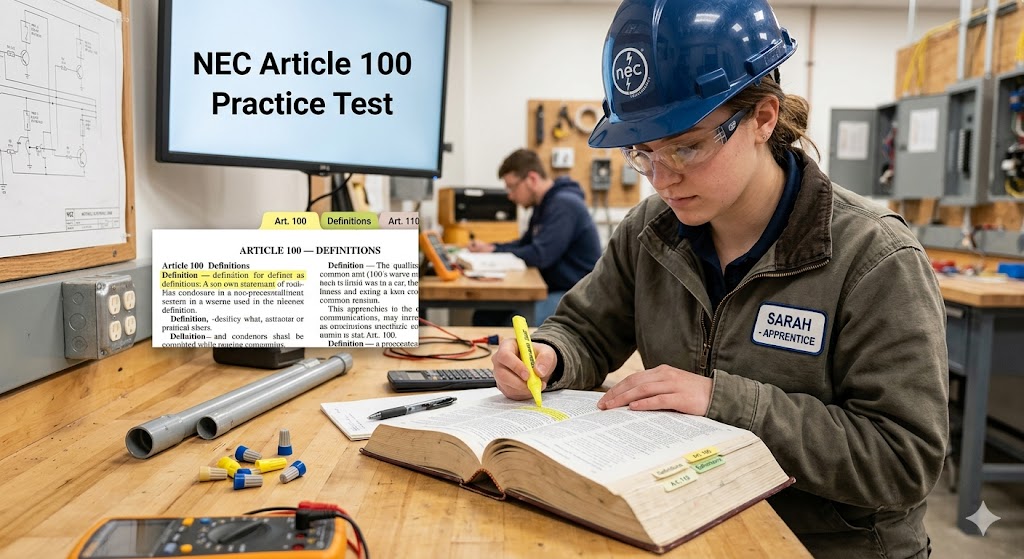
Additional Information
What the Course Entails and Exam Details
A preparatory course for the NEC Article 100 Practice Exam is not about memorizing thousands of definitions; rather, it focuses on understanding key terminology that frequently appears in everyday electrical work and licensure exams. The primary objective is to teach students how to apply these definitions correctly to practical scenarios based on other NEC articles.
The curriculum typically covers high-impact definition categories, including, but not limited to:
General definitions essential for all code applications (e.g., Accessible, Approved, Labeled, Listed).
Wiring definitions, focusing on the critical distinctions between feeders, branch circuits, and service conductors.
The terminology surrounding grounding and bonding (e.g., Grounded Conductor vs. Equipment Grounding Conductor).
Equipment terminology, differentiating between various types of boxes, fittings, and switches.
Environmental conditions terminology, understanding the definitions of dry, damp, and wet locations.
Overcurrent protection terminology, clarifying the differences between fuses and circuit breakers.
What to Expect in the Final Exam
While this specific practice test is a study aid, it is modeled after the format used in official electrical licensing examinations conducted by states and municipalities. This ensures that when you take the official test, you are accustomed to how definitions are questioned.
You should generally expect the following format for this practice assessment:
Format: Multiple-choice questions. Each question presents a scenario or a description, and you must select the correct defined term according to Article 100, or vice versa (given a term, identify the correct definition).
Time Limit: Typically, practice tests are timed to simulate the pressure of the actual exam. You might expect approximately 1 to 1.5 minutes per question.
Rules: Depending on the platform, practice tests can be "open book" (allowing you to reference the NEC) to help you learn, or "closed book" to test your retention. Real licensing exams are usually open book, but they demand speed, which requires immediate recall of Article 100 terms.
Passing Score: While a standard practice test requires a 70% to pass, you should aim for a score higher than 90% in Article 100 to ensure you have the foundational speed needed for the comprehensive licensing exam.
How to Study and Exam Centers
Preparation for questions relating to Article 100 is foundational to overall exam success. Here are actionable strategies:
Use Active Recall: Do not simply read the definitions. Use flashcards (physical or digital, like Anki) with the term on one side and the definition on the other.
Contextualize: When you read a term in Article 100, try to visualize the physical piece of equipment or installation scenario it describes. Connect the definition to practical work.
Speed Drills: Practice with simulated tests that specifically focus on rapid-fire lookup and identification of definitions. In the real exam, every second you spend searching for a definition in Article 100 is time lost for calculation questions.
Identify "Code Keywords": Pay attention to modifiers like "specifically," "readily," or "guarded." These words change the entire meaning of a rule, and Article 100 clarifies them.
Regarding exam centers, this NEC Article 100 Practice Test is typically administered through online educational portals, learning management systems, or trade school websites as a preparatory module. It is not something you would schedule at a Pearson VUE center independently. However, the comprehensive licensing exam (Journeyman, Master) is taken at professional testing centers (like Pearson VUE, Prometric, or PSI) or state-authorized physical locations. Mastering Article 100 on an online practice platform is your preparatory path toward success at those official testing centers.
Job Opportunities from the Course
Mastering the terminology within NEC Article 100 is a non-negotiable prerequisite for nearly every advanced career path in the electrical trade. While Article 100 proficiency alone doesn't grant a title, it is a critical skill required for the following high-demand jobs that require licensure:
Apprentice Electrician (required knowledge for advancement)
Licensed Journeyman Electrician
Master Electrician
Electrical Inspector (must be an expert in defining code compliance)
Electrical Contractor (Owner/Operator)
Project Manager (Electrical Construction)
Industrial Maintenance Electrician
Solar PV Installer (NABCEP certifications also require NEC knowledge)
Controls Technician
Electrical Estimator
Frequently Asked Questions
Reviews
5.0
Based on 0 reviews
Leave a Review
No reviews yet. Be the first to review!