
NEETS Module 10 Practice Exam
$69.00
- Buy to unlock unlimited access to all Quiz questions and Answers in this Quiz.
- After purchase you can print a PDF of the whole quiz at any point. The PDF will contain the questions and the correct answers.
About this Exam
The NEETS Module 10 Practice Exam is a powerful self-assessment tool meticulously crafted to empower Sailors and technical enthusiasts preparing for the official Navy Electricity and Electronics Training Series (NEETS) Module 10 assessment. This specific practice test focuses directly on the core principles and concepts essential for understanding Introduction to Wave Propagation, Transmission Lines, and Antennas. Designed for individuals looking to solidify their knowledge and build confidence before taking the formal module test, completing this comprehensive practice exam is a crucial step in ensuring mastery and achieving successful module completion within the Navy’s rigorous training framework. Use this resource to gauge your readiness, identify critical study areas, and strategically refine your understanding of these fundamental technical topics.
Ready to test your knowledge?
Buy Now to Access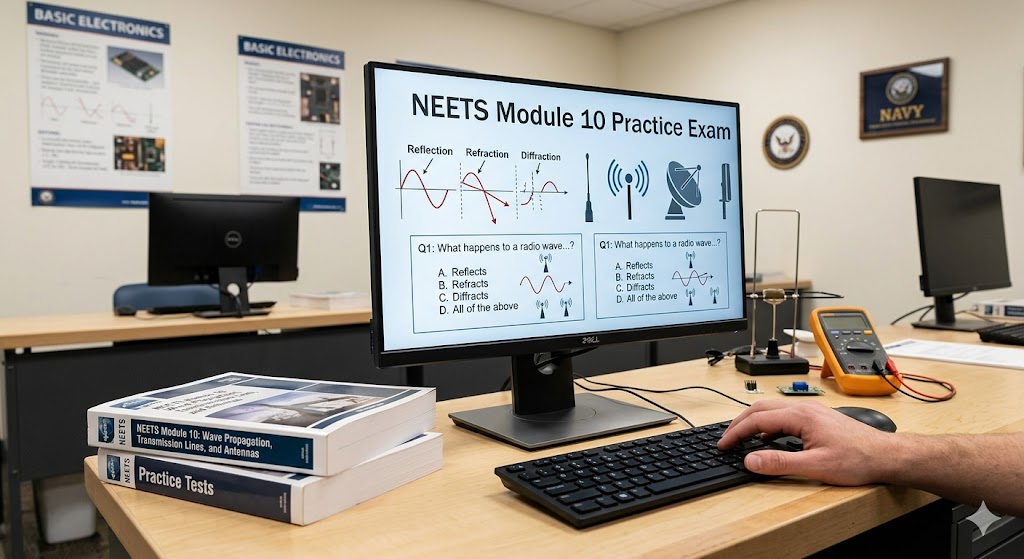
Additional Information
What the Course Entails and Exam Details
The overarching NEETS Module 10 course provides a detailed deep dive into the fascinating world of RF principles. Specifically, it covers the foundational concepts of:
Wave Propagation: You will explore how electromagnetic waves travel through different mediums, understanding the crucial processes of reflection, refraction, diffraction, and how various atmospheric conditions impact radio wave transmission. This includes detailed knowledge of ground waves, sky waves, and the critical role of the ionosphere.
Transmission Lines: The course meticulously details various types of transmission lines, including open-wire lines, coaxial cables, and waveguides. You will learn about their unique characteristics, application scenarios, and how to understand wave phenomena along these crucial conduits for radio frequency signals.
Antennas: Understanding antenna fundamentals is paramount. You will gain in-depth knowledge of antenna types, configurations, performance characteristics, radiation patterns, impedance matching, and how they efficiently convert electrical signals into radiating electromagnetic waves and vice versa.
The corresponding NEETS Module 10 Practice Exam reflects this comprehensive syllabus. Expect to encounter multiple-choice questions that thoroughly assess your theoretical understanding and practical application of every key topic detailed within the official module material. The practice test mimics the breath and depth of the actual module assessment, ensuring you grapple with realistic and challenging questions across the entire curriculum.
What to Expect in the Final Exam
While this is a practice test, it is expertly designed to accurately reflect the official NEETS Module 10 final exam experience. As you proceed to the actual final module assessment, which is required for official credit and command recognition, you can typically anticipate:
Format: The final exam predominantly consists of well-crafted multiple-choice questions. These questions are specifically designed to test not only rote memorization but also your critical thinking, understanding of complex diagrams, and ability to apply fundamental electronic and electromagnetic wave principles to practical scenarios. There might be approximately 25-50 questions, though the exact number can sometimes vary.
Passing Score: Achieving module completion usually requires a minimum score of 80% or higher. Consistently scoring well above this threshold on the practice test is an excellent indicator of readiness for the actual final.
Time Limits: While internal self-assessments might be self-paced, official command-administered NEETS exams often have reasonable time limits (e.g., 60-90 minutes). Practicing with timed practice tests can help improve your pacing and decision-making under pressure.
Rules: Official Navy testing procedures must be strictly adhered to, and no unauthorized study resources are permitted during the official exam. The practice test allows you to refine your knowledge before stepping into the formal testing environment.
How to Study and Exam Centers
Effective preparation is essential for conquering NEETS Module 10, and this practice test is a cornerstone of any successful study plan.
Diligently Study the Official Material: Thoroughly read and digest the official NEETS Module 10 curriculum. Take detailed notes, pay special attention to key terminology, equations, diagrams illustrating wave phenomena, different antenna types, and transmission line characteristics. Look for available Navy knowledge portals or authorized official documents for the official module.
Take the Practice Exam Repeatedly: Use the practice test as your primary feedback mechanism. Take it under simulated test conditions initially. When you finish, diligently review every question. For each incorrect answer, revisit the relevant section in the official module text, understand why the correct answer is right and why your choice was incorrect. Even for correct answers, ensure you can explain the underlying concepts clearly to yourself. Repeat this process until you consistently achieve a very high score on different versions of the practice test.
Utilize Flashcards: Create flashcards for crucial definitions, different types of propagation, antenna formulas, and transmission line properties to reinforce your memory.
Seek Clarification: Don't hesitate to ask experienced technicians, instructors, or peers for clarification on particularly challenging concepts. Hands-on experience with equipment can also significantly deepen your understanding.
Practice Test Accessibility: The NEETS Module 10 Practice Test is often accessible online through various educational platforms, internal Navy training websites (e.g., MyNavy Portal, or previous iterations like NKO), and dedicated study forums. It is designed as a readily available self-study resource.
Exam Centers for the Final Exam: The actual NEETS Module 10 final exam, required for official course credit, is administered internally within the Navy. There are typically no specific physical public testing centers like Pearson VUE for this internal military training. The official assessment is usually conducted:
Online through official Navy knowledge and training portals like MyNavy Portal (MNP) or previous training platforms like NKO.
Within specific Navy training commands, commands with designated testing personnel, or under the supervision of authorized instructors/personnel at your local command.
Contact your local command training officer or educational services office (ESO) to understand the exact procedures and schedule for taking the official NEETS Module 10 final exam once you are confident and fully prepared.
Job Opportunities from the Course
Successfully completing NEETS Module 10 and subsequent modules opens doors to numerous technical career paths within the Navy and provides valuable foundational knowledge applicable to numerous civilian technical roles. Here are some of the job opportunities and career paths this certification and knowledge base can directly benefit:
Electronics Technician (ET) - Crucial for various ratings and commands.
Aviation Electronics Technician (AT) - Essential for maintaining complex aircraft electronics and communication systems.
Information Systems Technician (IT) - Benefits from understanding RF communication principles for network and radio systems.
Electrician's Mate (EM) - Direct application to shipboard electrical systems and potential future transitions.
Communications Technician (CT) - Deep understanding of signal propagation and antenna principles is vital.
Broadcasting Technician - Relevant civilian role in maintaining and operating transmission equipment.
RF (Radio Frequency) Technician - Demand for skilled individuals to troubleshoot and maintain RF systems across industries.
Telecommunications Technician - Foundation for careers in designing, implementing, and supporting telecommunications infrastructure.
Antenna Technician/Engineer - Specialist roles focusing solely on the design, installation, and optimization of antennas.
Maintenance Technician - Broad applicability to maintain various electronic systems and equipment.
Frequently Asked Questions
Reviews
5.0
Based on 0 reviews
Leave a Review
No reviews yet. Be the first to review!