
NEHA Radiation Protection Practice Exam
$69.00
- Buy to unlock unlimited access to all Quiz questions and Answers in this Quiz.
- After purchase you can print a PDF of the whole quiz at any point. The PDF will contain the questions and the correct answers.
About this Exam
Unlock your potential in the critical field of environmental health and safety by mastering the principles of radiation safety. The specialized knowledge base assessed through NEHA-aligned testing is designed for environmental health professionals, sanitarians, safety officers, and public health workers who must recognize, evaluate, and control radiation hazards in the environment and workplace. This practice exam serves as an essential stepping stone, helping you gauge your readiness for advanced certifications that handle ionizing and non-ionizing radiation topics. Obtaining mastery in this area demonstrates to employers your commitment to public safety and specialized technical competence.
Ready to test your knowledge?
Buy Now to Access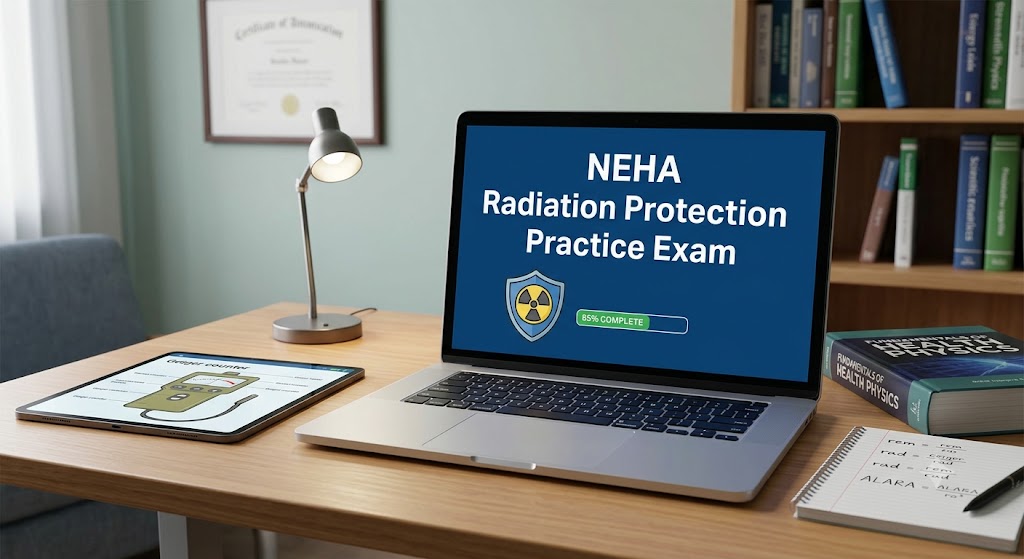
Additional Information
What the Course Entails and Exam Details
This practice guide focuses on the theoretical and practical
application of radiation protection standards across diverse settings. The core
syllabus covered by this resource includes the fundamental physics of
radiation, distinction between ionizing and non-ionizing types, and biological
effects of exposure. Candidates must understand units of measurement, such as
the rem, rad, and Sievert, alongside the principles of "As Low As
Reasonably Achievable" (ALARA). The exam details further encompass
standard shielding techniques, contamination control, and the correct operation
of radiation detection instruments like Geiger-Müller counters and dosimeters.
Regulatory standards and emergency response protocols are also significant
components of the assessed knowledge.
What to Expect in
the Final Exam
While individual certification body formats vary, most
high-stakes professional exams in this domain, including those within NEHA's
scope like the REHS/RS, utilize a strict, computerized multiple-choice format.
You should expect between 100 to 150 questions designed to test both factual
recall and your ability to apply safety principles to real-world scenarios.
Many finalized exams require a minimum scaled score, often equivalent to
roughly 70%, to pass. The time limits are usually strict, allowing approximately
2 to 3 hours for completion. The final exam is administered in a proctored
environment, where no outside study materials or specific unauthorized
electronics are permitted.
How to Study and
Exam Centers
Effective preparation requires a structured approach. Begin
by actively taking this practice exam to identify your weak areas, then use
flashcards to memorize regulatory limits, conversion factors, and key equations
like the inverse square law. We highly recommend forming study groups and
utilizing recognized environmental health textbooks that align with NEHA's
recommended reading lists. Many official certification exams are administered
globally through recognized testing networks such as Pearson VUE, which provide
standardized physical testing centers. Alternatively, some organizations offer
live, remotely proctored online portals, allowing you to take the exam from a
secure location at home or work.
Job Opportunities
from the Course
Mastery of radiation protection principles significantly
enhances your marketability in the environmental health sector. This
specialized knowledge unlocks numerous distinct career paths and job titles
across government agencies, healthcare facilities, and private industry.
Here are specific job opportunities unlocked by this
competency:
- Radiation
Safety Officer (RSO)
- Environmental
Health Specialist (EHS)
- Health
Physics Technician
- Industrial
Hygienist
- X-Ray
Technician / Nuclear Medicine Technologist
- Public
Health Inspector (specializing in radiological health)
- Occupational
Health and Safety Manager
- Radiological
Emergency Response Coordinator
Frequently Asked Questions
Reviews
5.0
Based on 0 reviews
Leave a Review
No reviews yet. Be the first to review!