
NEIEP Hoistway Maintenance (555) Practice Test
$69.00
- Buy to unlock unlimited access to all Quiz questions and Answers in this Quiz.
- After purchase you can print a PDF of the whole quiz at any point. The PDF will contain the questions and the correct answers.
About this Exam
The NEIEP Hoistway Maintenance (555) Practice Exam is a vital educational resource designed for elevator apprentice mechanics enrolled in the National Elevator Industry Educational Program (NEIEP). This specific examination focuses exclusively on the critical skills and knowledge required to safely and efficiently maintain the entire elevator hoistway system. It serves as both a review tool and a performance benchmark, ensuring that future Journeyman Elevator Mechanics can verify the integrity of the structures that support and guide elevator cars. This test is essential for those advancing through the NEIEP curriculum, particularly within the Installation and Maintenance semesters.
Ready to test your knowledge?
Buy Now to Access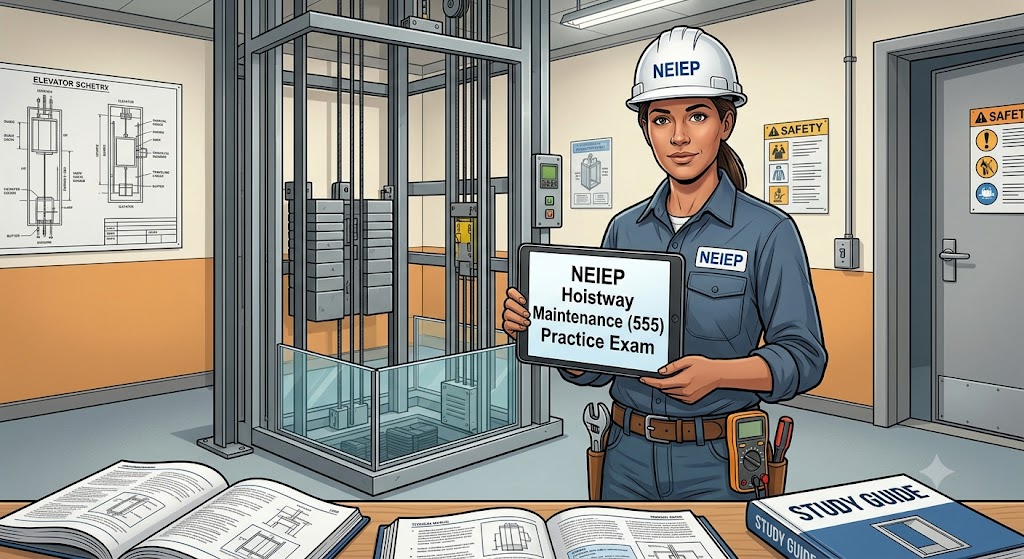
Additional Information
What the Course Entails and Exam Details
The comprehensive study guide for this exam covers a broad
spectrum of technical and safety topics essential for hoistway maintenance.
Students are expected to demonstrate proficiency in identifying, inspecting,
lubricating, and adjusting all physical components within the hoistway. Core
areas included in the syllabus and covered by the practice test are: Hoistway
Structures and Pit Structures; Guide Rail Installation, Alignment, and
Maintenance; Machine, Sheave, and Governor Installation and Service; Car and
Counterweight Assembly Maintenance; Suspension Means, including Wire Rope and
Aramid Fiber Belts, including Inspection and Replacement Criteria; Passenger
and Freight Elevator Door and Entrance Installation and Operation; Hoistway
Access, Interlocks, and Gate Switch Maintenance; and Machine Room Maintenance
as it pertains to hoistway equipment. Interwoven throughout all topics are
stringent safety protocols, including proper use of tools, rigging, and
scaffolding, and mandatory adherence to the National Electrical Code (NEC) and
ASME A17.1/CSA B44 safety codes.
What to Expect in
the Final Exam
This practice exam is explicitly structured to mimic the
format and rigor of the final capstone examination for the Hoistway Maintenance
module. Students should expect a challenging assessment, typically delivered in
a multiple-choice format, designed to test both theoretical understanding and
practical application scenarios. The test will focus on safety-critical
information, technical specifications, and regulatory compliance. The practice
version allows students to become familiar with the types of questions,
difficulty level, and time management required for the official NEIEP final.
Treating this practice exam with the same seriousness as the actual final is
highly recommended to accurately assess readiness and identify areas needing
further review.
How to Study and
Exam Centers
Effective preparation requires a dedicated approach that
combines theoretical study with practical review. Students should extensively
review all NEIEP Course 555 modules, textbooks, and personal notes. Actively
utilizing the official NEIEP online portal for practice quizzes, interactive
labs, and virtual simulations is essential. Hands-on experience gained during
on-the-job learning (OJL) should be recalled and mentally applied to
theoretical concepts. Form study groups with fellow apprentices to discuss complex
scenarios and safety regulations. Focus significantly on understanding the ASME
A17.1 code book sections relevant to hoistway components. For the official
final exam, NEIEP typically administers it through a secure online platform
within authorized testing centers, often located at NEIEP local training sites
or authorized union halls across the United States. Practice exams are usually
accessible directly through the apprentice's NEIEP online learning account from
any computer.
Job Opportunities
from the Course
Mastering the material for the NEIEP Hoistway Maintenance
(555) exam is a major milestone on the path to becoming a licensed Journeyman
Elevator Mechanic. Successfully completing the overall NEIEP curriculum and the
final capstone exam unlocks numerous specialized and high-paying career
opportunities within the International Union of Elevator Constructors (IUEC).
Specific job titles and career paths this certification
sequence enables include:
- Journeyman
Elevator Mechanic
- Elevator
Service Mechanic
- Elevator
Repair Mechanic
- Elevator
Installation Mechanic
- Elevator
Modernization Mechanic
- Elevator
Adjuster
- Maintenance
Supervisor
- Qualified
Elevator Inspector (QEI)
- Elevator
Consultant
- NEIEP
Instructor or Training Coordinator
Frequently Asked Questions
Reviews
5.0
Based on 0 reviews
Leave a Review
No reviews yet. Be the first to review!