
NEIEP Piping and Wiring the Machine Room and Hoistway (510) Practice Test
$69.00
- Buy to unlock unlimited access to all Quiz questions and Answers in this Quiz.
- After purchase you can print a PDF of the whole quiz at any point. The PDF will contain the questions and the correct answers.
About this Exam
The NEIEP Piping and Wiring the Machine Room and Hoistway (510) exam is a critical milestone for apprentices enrolled in the National Elevator Industry Educational Program (NEIEP).
This academic unit bridges the gap between mechanical structure and electrical operation, focusing on the safe and professional installation of the "circulatory system" of an elevator.
It is specifically designed for elevator constructor apprentices who have mastered fundamental mechanics and basic electricity and are now moving into the specialized phase of field installation.
Passing this unit demonstrates that the apprentice possesses the knowledge required to install complex electrical raceways, pull conductors, and connect vital control devices in the most demanding spaces of an elevator system.
Ready to test your knowledge?
Buy Now to Access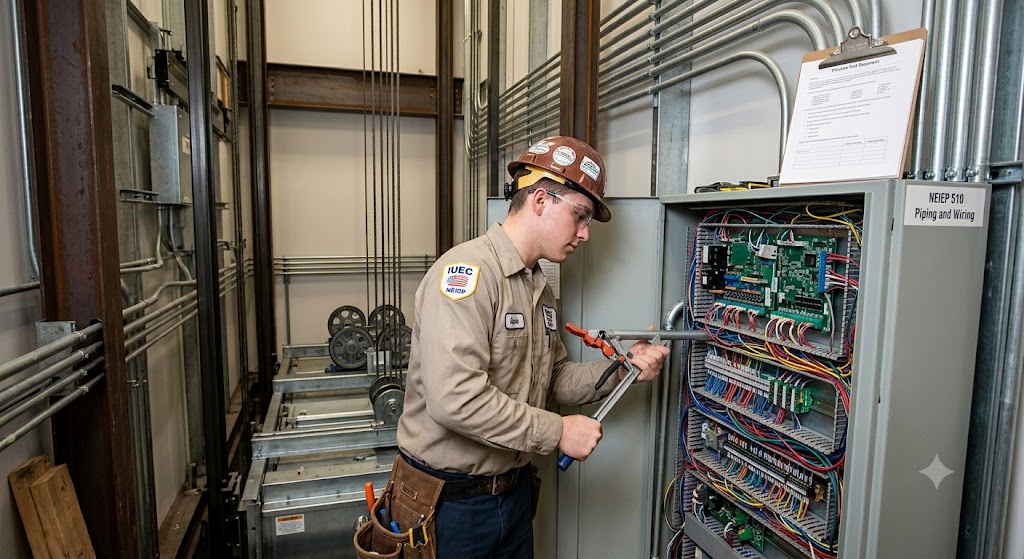
Additional Information
What the Course Entails and Exam Details
The NEIEP 510 course provides comprehensive instruction on
how to lay out, prepare, and install the electrical infrastructure within the
hoistway and the machine room.
The curriculum is rigorous, focusing on both the mechanical
skills of conduit bending and the technical knowledge of circuit connections.
Key topics covered within the course and addressed in the
final exam include:
- Raceway
Installation: Detailed procedures for installing various types of
electrical raceway, including rigid conduit, Electrical Metallic Tubing
(EMT), flexible metal conduit, and wireways.
- Layout
and Planning: Interpreting layout drawings to efficiently plan piping
runs in the machine room and hoistway, ensuring code compliance and
accessibility.
- Wire
Pulling Techniques: The professional methods for pulling conductors
through raceways without damaging insulation, including proper
wire-lubrication use.
- Conductor
Termination: Techniques for making secure and safe electrical
connections to devices and switches located in the hoistway and machine
space.
- Grounding
and Bonding: Understanding the essential safety principles and
procedures for effective grounding and bonding of all electrical
components.
- Device
Installation: Installing and wiring critical safety switches, sensors,
limit switches, and the main elevator controller.
- Startup
Procedures: Introduction to the basic startup procedures for both
traction and hydraulic elevators that are necessary to complete the wiring
process.
What to Expect in the Final Exam
The NEIEP Piping and Wiring (510) Final Exam is a technical
assessment designed to test both theoretical knowledge and practical
understanding.
While parts of the NEIEP program are hands-on, this specific
unit final is a written (or computer-based) examination that focuses on your
ability to apply concepts, codes, and procedures to scenario-based questions.
The exam format is primarily multiple-choice. These
questions are not designed to be trick questions, but they will require you to
understand specific codes (National Electrical Code - NEC) and NEIEP standard
operating procedures (SOPs).
A strong emphasis is placed on safety. You must know the
procedures that prevent electrical hazards, including Lock-Out/Tag-Out (LOTO)
and proper grounding techniques, as they apply to installation work.
You should expect questions regarding conduit fill
capacities, minimum bending radii for different types of conduit, and the
specific sequence of wiring for key components.
To pass this unit, you typically must achieve a score of 70%
or higher, which is standard for the NEIEP apprenticeship curriculum.
How to Study and
Exam Centers
Preparation for the NEIEP 510 exam requires a balanced
approach of reviewing the official text and applying that knowledge through
practice.
Actionable Study Strategies:
- Master
the Official Manual: Your primary resource is the NEIEP Installation
510 textbook. Do not just read it; study it. Highlight key procedures,
code definitions, and wiring diagrams.
- Utilize
Practice Tests: Taking a practice test is essential. Practice exams
help you identify gaps in your knowledge, familiarize yourself with the
phrasing of NEIEP questions, and build your stamina for the actual test.
- Review
NEC Code: Pay special attention to Articles 620 (Elevators) and 300
(Wiring Methods) of the National Electrical Code. While you may not need
to memorize the entire code book, you must understand how these articles
apply to machine rooms and hoistways.
- Focus
on Diagrams: Practice interpreting the wiring and piping diagrams
provided in the course materials. Be able to trace a circuit from the
controller to a device in the hoistway.
Exam Centers and Logistics:
NEIEP exams are proprietary and administered through the
official NEIEP learning management system.
The tests are usually taken within the official classroom
setting of your local Area Committee (LAC) or specified training center. In
some modernization contexts, the classroom component may be held online, with
the proctored final exam completed in person at your local union hall or
associated facility.
You must be an apprentice registered with the International
Union of Elevator Constructors (IUEC) to take this exam. Consult your NEIEP
instructor or LAC Coordinator for your local examination schedule.
Job Opportunities
from the Course
While NEIEP Unit 510 is a required component of the
four-year apprenticeship journey to become an IUEC Mechanic, successful
completion unlocks significant progress and confirms your specialized field
skills.
Completing this unit makes you a more valuable asset to your
employer and Local. Here are the job roles and specializations that rely on the
mastery of piping and wiring the machine room and hoistway:
- Elevator
Constructor Apprentice (Levels 3-4): This certification is a necessary
hurdle to advance through the apprenticeship tiers, leading to increased
pay and responsibility.
- Elevator
Installation Specialist: Focused on the new construction of elevators,
where piping and wiring form a major part of the field workflow.
- Elevator
Modernization Specialist: Modernization jobs heavily rely on removing
old wiring systems and installing new ones, requiring expert knowledge of
raceway layout and controller connections.
- Authorized
IUEC Mechanic: Successfully completing Unit 510 is a requirement for
eventually sitting for the Mechanic's Exam, the final step to full
journeyman status.
- Maintenance
or Service Technician (Future Path): Understanding the installation
layout is crucial for troubleshooting electrical issues. While maintenance
focuses on diagnostics, the foundational knowledge of how the system was
piped and wired is invaluable for efficient repairs.
Frequently Asked Questions
Reviews
5.0
Based on 0 reviews
Leave a Review
No reviews yet. Be the first to review!