
NEIEP Power and Logic (700) Practice Test
$69.00
- Buy to unlock unlimited access to all Quiz questions and Answers in this Quiz.
- After purchase you can print a PDF of the whole quiz at any point. The PDF will contain the questions and the correct answers.
About this Exam
Prepare effectively for your upcoming NEIEP Power and Logic (700) certification with this comprehensive practice guide.
This NEIEP exam is a critical certification for professionals advancing within the elevator industry.
Specifically focusing on power distribution and control logic systems, this exam validates knowledge crucial for installing, maintaining, and troubleshooting complex elevator controls.
It is designed for elevator constructors (apprentices, mechanics, technicians) looking to demonstrate proficiency in these foundational and advanced technical areas, paving the way for career advancement and specialization.
Mastering these concepts is essential for ensuring the safe and reliable operation of elevator systems across various applications.
Ready to test your knowledge?
Buy Now to Access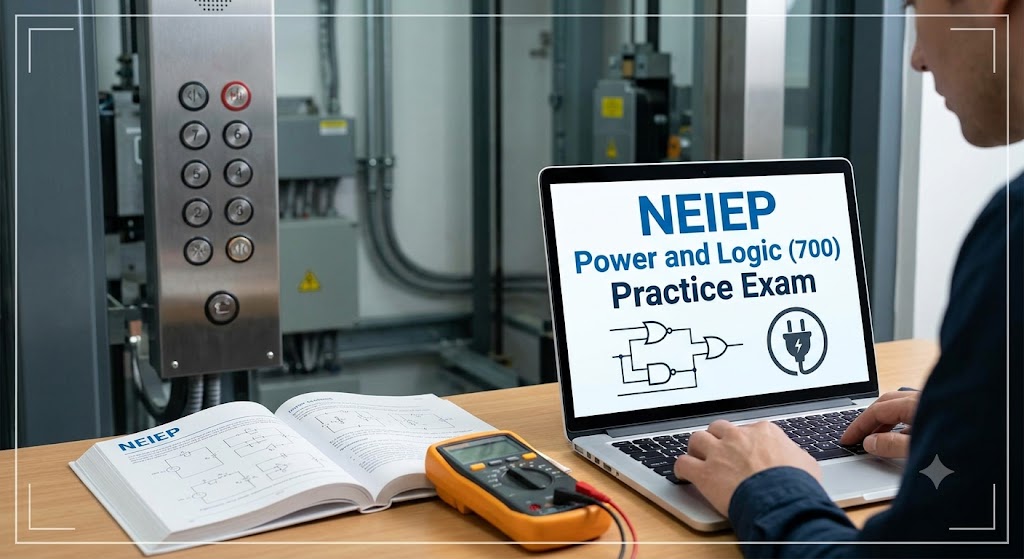
Additional Information
What the Course Entails and Exam Details
The NEIEP Power and Logic (700) curriculum and subsequent
exam delve deeply into the core electrical and logic systems powering modern
elevator installations.
Topics typically include advanced electrical theory,
intricate power circuit analysis, understanding logic controllers (both
relay-based and modern solid-state/programmable logic controllers),
interpreting complex electrical schematics specific to the elevator industry,
and adhering to strict safety standards and relevant codes (like ASME A17.1).
Preparing for this test signifies proficiency in navigating
the intricate electrical backbone of moving people safely and efficiently.
The corresponding course material provides the theoretical
foundation and practical insights needed to successfully complete the
assessment and excel in the field.
What to Expect in the Final Exam
While specific formats can evolve, you can generally
anticipate the NEIEP Power and Logic (700) final exam to be a comprehensive
assessment.
It will likely consist primarily of multiple-choice
questions, though it might incorporate short-answer or scenario-based
problem-solving.
This computerized or paper-based test typically sets a
passing score (often around 70-80%, but verify with official NEIEP
guidelines).
Expect a significant time limit, requiring you to work
efficiently under pressure.
The exam is typically closed-book, focusing purely on your
retained knowledge and practical understanding.
Be prepared for strict proctoring procedures.
Ensure you are familiar with exam regulations and time
management before sitting for the actual test.
How to Study and Exam Centers
Success requires a dedicated approach.
Utilize official NEIEP resources extensively: review course
manuals, complete all assigned homework and projects, and engage actively in
any classroom or online training provided.
Supplement this by deep-diving into schematic reading,
practicing logic circuit troubleshooting scenarios, and solidifying your
understanding of power dynamics through hands-on experience on actual elevator
systems under supervision.
Practice is key! Actively seek out or create practice
questions, simulating exam conditions.
Form study groups to discuss complex topics and teach/learn
from peers.
Repeat practice exams multiple times, focusing on
understanding the rationale behind each correct answer, not just memorization.
NEIEP exams are typically administered through their network
of local union-affiliated training centers, JATC (Joint Apprenticeship and
Training Committee) locations, or approved educational facilities.
The specific exam centers and registration processes (online
portal, coordinator-led) will be communicated through your local NEIEP
coordinator or union representatives.
Be proactive in registering and identifying your assigned
location well in advance.
Some modern certifications might offer secure online
proctoring, but physical testing centers linked to the industry remain the
primary standard for NEIEP.
Job Opportunities
from the Course
Achieving NEIEP Power and Logic (700) certification
significantly bolsters your qualifications within the elevator industry,
opening doors to numerous specialized roles and career advancements:
- Elevator
Mechanic (Certified): A core role, with validation in key areas for
enhanced responsibility and recognition.
- Service
Technician (Control Systems): Specialized focus on maintaining and
repairing complex electrical and logic systems in elevators.
- Modernization
Technician: Expertise in upgrading older elevator controls to modern,
efficient, and code-compliant systems.
- Elevator
Adjuster: Crucial role in calibrating and fine-tuning elevator systems
post-installation or during major maintenance.
- Troubleshooting
Specialist: A go-to expert for diagnosing and resolving persistent or
complex system issues within power and logic circuits.
- Elevator
Inspector (potentially): While specific inspector qualifications
exist, this knowledge base enhances candidacy for such regulatory roles.
- Foreman/Supervisor:
Demonstrating deep technical knowledge is often a precursor and asset for
leadership and supervisory positions.
<!--[if mso & !supportInlineShapes & supportFields]> SHAPE \* MERGEFORMAT <![endif]--><!--[if gte vml 1]>
This certification not only enhances your current role but
positions you for high-demand specializations and leadership within this
critical, safety-focused industry.
Frequently Asked Questions
Reviews
5.0
Based on 0 reviews
Leave a Review
No reviews yet. Be the first to review!