
Neonatal Resuscitation Program NRP Practice Exam
$69.00
- Buy to unlock unlimited access to all Quiz questions and Answers in this Quiz.
- After purchase you can print a PDF of the whole quiz at any point. The PDF will contain the questions and the correct answers.
About this Exam
The Neonatal Resuscitation Program (NRP) certification represents the gold standard in evidence-based care for newborn infants at the time of delivery.
Developed by the American Academy of Pediatrics (AAP) and the American Heart Association (AHA), this program is designed to teach a systematic approach to the resuscitation of newborns.
It is specifically designed for healthcare professionals who are involved in the delivery and immediate care of neonates.
This includes doctors, nurses, respiratory therapists, and emergency medical personnel who must possess the skills to act quickly and decisively in critical situations.
Passing the NRP exam is not merely an academic requirement; it is a vital step in ensuring the safety and positive outcomes of the tiniest patients.
Ready to test your knowledge?
Buy Now to Access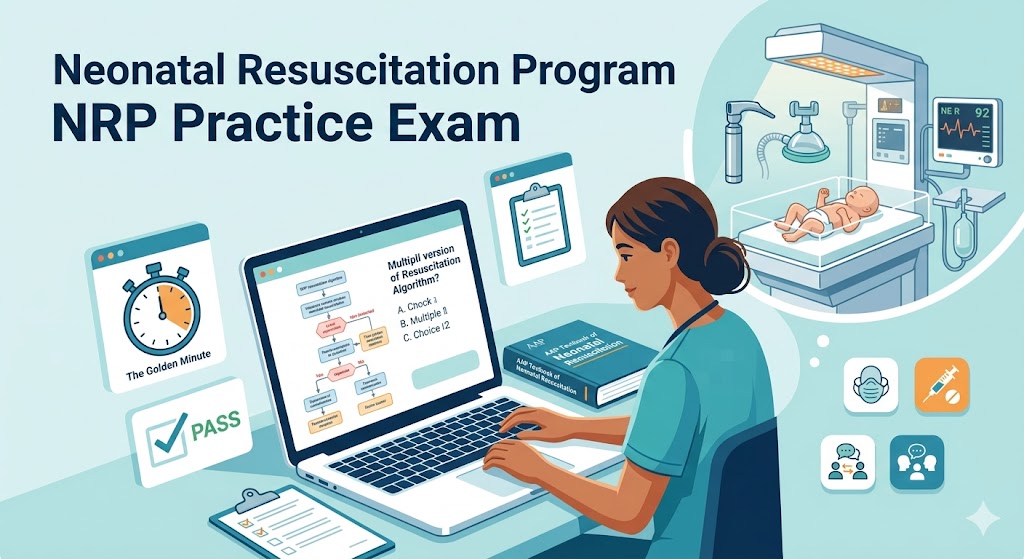
Additional Information
What the Course Entails and Exam Details
The NRP course focuses on the crucial "Golden Minute" of a newborn's life and follows a strict algorithm for care.
The curriculum is heavily based on the latest Guidelines for Cardiopulmonary Resuscitation and Emergency Cardiovascular Care of the Neonate.
Core topics covered in the course material and evaluated by the exam include:
Preparation: Assembling the resuscitation team and checking equipment before delivery.
Initial Steps: Drying, stimulating, and warming the infant, as well as clearing the airway if necessary.
Positive-Pressure Ventilation (PPV): The most important skill in neonatal resuscitation, including proper mask fit and ventilation rate.
Advanced Airway Management: Mastery of endotracheal intubation and the use of laryngeal mask airways.
Chest Compressions: The correct technique, depth, and ratio when coordinated with ventilation.
Medications: Understanding indications, dosages, and routes for emergency drugs like epinephrine.
Team Dynamics: Emphasizing leadership, communication, and effective teamwork during a crisis.
What to Expect in the Final Exam
Preparing for the NRP "final exam" now involves a dual-part process, moving away from a traditional single written test.
It is crucial to understand that there are two distinct phases to gaining certification, and an NRP practice test is vital for the first phase.
Part 1: The Online Provider Exam (Adaptive Learning)
The modern NRP evaluation uses an adaptive learning model (often hosted through HealthStream or RQI Partners).
You do not take a test with a fixed number of multiple-choice questions; instead, the system adapts to your knowledge level, providing education and assessment simultaneously.
You must navigate through various modules and scenarios, demonstrating mastery of the cognitive material.
There is no strict passing score as you must continue until you achieve 100% mastery within the learning platform to unlock the completion certificate for this section.
This online portion is self-paced but must be successfully completed before you are permitted to attend the practical session.
Part 2: The Instructor-Led Hands-On Session (Megacode)
Once you have completed the online portion, you must attend an in-person, hands-on performance checklist and simulation.
This is not a written test, but a practical evaluation where you must demonstrate the resuscitation algorithm without errors.
You will be asked to manage a simulated neonatal emergency (often called a "Megacode"), performing actions such as PPV, compressions, and intubation on a high-fidelity manikin while an authorized NRP Instructor observes and grades your proficiency.
How to Study and Exam Centers
Successfully passing the NRP requirements demands a blend of rigorous theoretical study and hands-on practice.
The cornerstone of your preparation should be the official AAP Textbook of Neonatal Resuscitation (currently the 8th Edition).
You must study the textbook thoroughly, focusing specifically on the diagrams, key points, and the resuscitation flowchart algorithm.
Utilizing an NRP practice test is an invaluable strategy for reinforcing your cognitive knowledge and preparing for the logic used in the adaptive online exam.
Repetitive practice with these tests helps you recognize the correct sequencing of actions based on the infant's heart rate and respiratory effort.
Regarding exam centers, the process is decentralized:
Online Components: You complete the adaptive online learning portion via the official learning management systems (like HealthStream or RQI) accessible from any computer.
Practical Components: To complete your certification, you must locate and register for an in-person, instructor-led session.
These sessions are typically held within hospitals for employees, at medical schools, or through authorized training centers specializing in life-support certifications (such as those offering ACLS and PALS).
Job Opportunities from the Course
Maintaining current NRP certification is not just optional for many healthcare roles; it is a mandatory condition of employment.
Possessing this certification directly unlocks career paths and roles in acute care settings, including:
Labor and Delivery Nurse (L&D RN)
Neonatal Intensive Care Unit Nurse (NICU RN)
Postpartum/Mother-Baby Nurse
Registered Respiratory Therapist (RRT) specializing in Neonatal/Pediatric care
Pediatrician
Neonatologist
Nurse Practitioner (specifically Neonatal NP or Family NP in rural settings)
Midwife (CNM or CM)
Obstetrician (OB/GYN)
Flight Nurse or Paramedic involved in neonatal transport
Anesthesiologist or CRNA specializing in obstetric anesthesia
Emergency Room Physician (who may need to stabilize a precipitous delivery)
Frequently Asked Questions
Reviews
5.0
Based on 0 reviews
Leave a Review
No reviews yet. Be the first to review!