
NERC Electric Power Research Institute (EPRI) Practice Exam
$69.00
- Buy to unlock unlimited access to all Quiz questions and Answers in this Quiz.
- After purchase you can print a PDF of the whole quiz at any point. The PDF will contain the questions and the correct answers.
About this Exam
The NERC Electric Power Research Institute (EPRI) Practice Exam is an essential diagnostic tool designed for professionals striving to become certified NERC System Operators. The North American Electric Reliability Corporation (NERC) mandatory certifications are the industry standard for personnel responsible for the real-time operation, reliability, and security of the Bulk Electric System (BES). EPRI, a leader in energy research, provides this rigorous practice environment to simulate the final NERC credentialing exams. This tool is designed primarily for current utility operators, balancing authorities, transmission personnel, and students entering the power industry who need a realistic assessment of their preparedness. By utilizing this practice exam, candidates can bridge knowledge gaps, reduce test anxiety, and validate their understanding of crucial reliability standards before taking the high-stakes final test
Ready to test your knowledge?
Buy Now to Access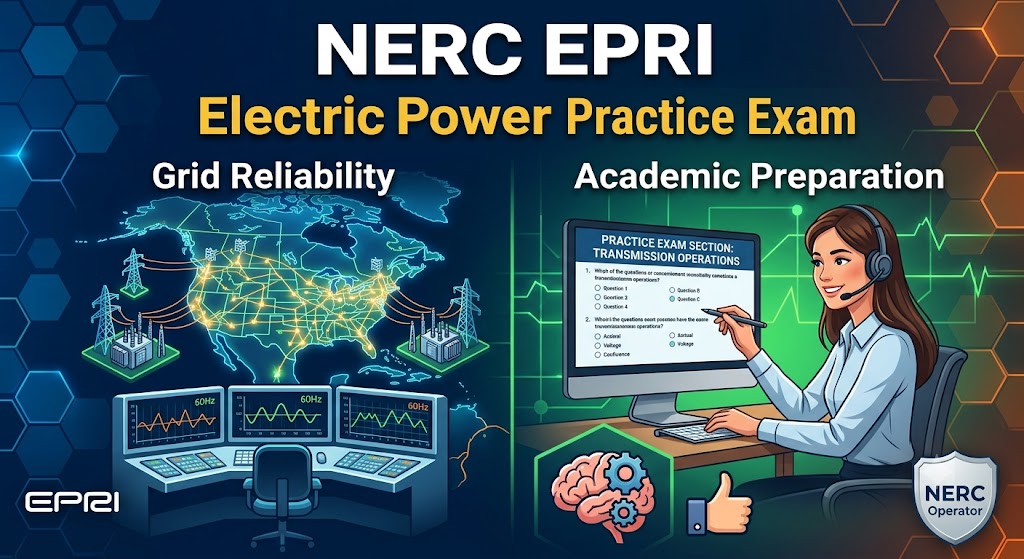
Additional Information
What the Course
Entails and Exam Details
This practice resource mirrors the depth and breadth
required by the actual NERC System Operator Certification Exams. The course
materials and exam questions focus heavily on the formal NERC Reliability
Standards and the fundamental principles of interconnected power system
operations. Students can expect comprehensive coverage across the four primary
NERC credential zones. Key areas of focus include power system fundamentals,
such as voltage control, reactive power, and frequency regulation. A significant
portion covers the specific duties of Reliability Coordinators, Transmission
Operators, and Balancing Authorities. Furthermore, the exam entails critical
training on emergency procedures, system restoration (blackstart), interchange
monitoring, and the technical aspects of relay schemes and protective
operations. The specific details of the practice test aim to familiarize the
user with the linguistic style and cognitive demands of the actual
qualification standards.
What to Expect in
the Final Exam
While the practice exam is a diagnostic tool, it is
structured to prepare you for the format of the official NERC Certification
Exam. The final NERC exam is a computer-based, proctored test comprised
entirely of multiple-choice questions. Depending on the specific credential you
are pursuing—such as Reliability Coordinator or Transmission Operator—the final
exam typically ranges from 100 to 140 questions. You will generally have a time
limit of three to nine hours to complete the test. The passing "cut score"
varies slightly by credential, but usually requires a score in the range of 70%
or higher, determined by a panel of subject matter experts. Prior to starting
the actual exam, you must read and accept a strict NERC Non-Disclosure
Agreement (NDA); declining this agreement will terminate your session and
forfeit your fees.
How to Study and Exam Centers
Effective preparation requires a structured study plan that
includes, but does not rely solely on, practice questions. Your strategy should
start with a thorough review of the current NERC Reliability Standards content
outlines provided by NERC. Combine your theoretical study with immersive
simulation-based training if your organization provides it, as this develops
necessary situational awareness. Maintain a consistent study routine, focusing
on high-weighted topics, and avoid last-minute cramming. Use the EPRI practice
exam strategically: take it initially to identify weak points, and then again
after focused study to measure improvement and practice time management. To
take the official NERC final certification exam, you must first create an
account and register within the SOCCED database (System Operator Certification
Continuing Education Database). NERC exams are administered globally at
authorized, secure proctored testing centers managed by Pearson VUE.
Job Opportunities
from the Course
Successfully passing the EPRI practice exam proves you are
ready for the final NERC Certification, which is mandatory for the most
critical roles within the power grid operations sector. Earning your NERC
credential unlocks a highly stable, technical, and remunerative career path.
Key job opportunities enabled by this preparation include:
- Reliability
Coordinator
- Transmission
Operator
- Balancing
Authority Operator
- Interchange
Operator
- Power
System Dispatcher
- Grid
Control Room Operator
- System
Operations Trainer
- Power
Plant Control Operator
Frequently Asked Questions
Reviews
5.0
Based on 0 reviews
Leave a Review
No reviews yet. Be the first to review!