
NERC Electric Power Sector Reform (EPSR) Practice Exam
$69.00
- Buy to unlock unlimited access to all Quiz questions and Answers in this Quiz.
- After purchase you can print a PDF of the whole quiz at any point. The PDF will contain the questions and the correct answers.
About this Exam
Welcome to your comprehensive guide to the NERC Electric Power Sector Reform (EPSR) Practice Exam. This is a crucial assessment designed to evaluate a professional's understanding of the legal, regulatory, and technical landscape of the Nigerian Electricity Supply Industry (NESI). Following the major reforms initiated by the EPSR Act, the Nigerian Electricity Regulatory Commission (NERC) instituted rigorous standards for operators across the entire energy value chain. This practice exam is designed for engineers, lawyers, finance managers, policymakers, and compliance officers who need to prove their expertise in Nigeria’s evolving energy sector. It acts as a mandatory stepping stone for many seeking to advance their careers within utility companies, regulatory bodies, or specialized legal firms.
Ready to test your knowledge?
Buy Now to Access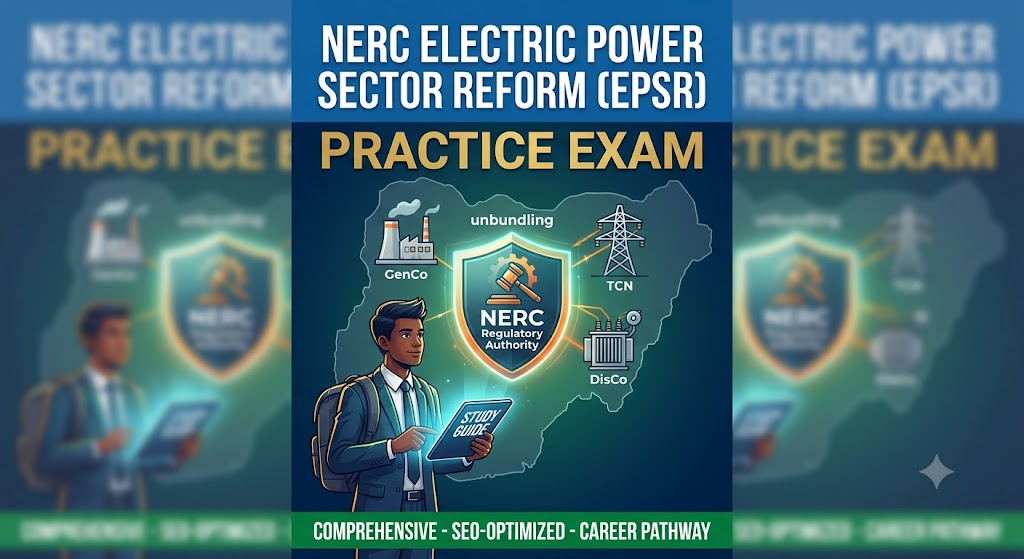
Additional Information
What is the Course Entails and Exam Details
The full certification course associated with this practice
exam covers the complete transformation of Nigeria's power industry. It entails
deep dives into the unbundling of the legacy Power Holding Company of Nigeria
(PHCN). You must understand the resulting formation of successor companies,
including Generation Companies (GenCos), Transmission Company of Nigeria (TCN),
and Distribution Companies (DisCos). Key technical and economic concepts are
central to the syllabus, including the Multi-Year Tariff Order (MYTO)
methodology. You will learn about market operations, grid codes, licensing
procedures, health and safety standards, and consumer protection protocols.
Special attention is paid to the ongoing electricity market stages and
compliance with NERC’s directives. The practice exam itself is designed to test
how well you have grasped these detailed regulatory and economic frameworks.
What to Expect in the Final Exam
Candidates should expect a challenging and comprehensive
test of their knowledge. The actual final exam is typically delivered as a
Computer Based Test (CBT). It primarily features multiple-choice questions that
require not only the recall of technical definitions but also analytical
reasoning. You will face scenario-based questions that test your ability to
apply regulations to real-world power sector problems. While the official
number of questions and exact time limit may vary by diet, the passing score is
set high to ensure competent professionals are managing the sector. The exam requires
a serious time commitment and a solid grasp of both technical electricity
concepts and the specific regulatory law governing Nigeria. A solid performance
on the NERC EPSR Practice Exam is highly indicative of potential success on the
final day.
How to Study and Exam Centers
Successful candidates emphasize consistent, focused study
rather than cramming. You should begin your preparation by downloading the
primary Electric Power Sector Reform Act and recent NERC regulatory orders
directly from the official website. Do not just skim these documents; you must
understand the implications of each section on daily market operations. The
most effective study strategy is to integrate these primary texts with repeated
attempts at the NERC EPSR Practice Exam. Taking practice tests allows
you to identify your specific knowledge gaps and familiarize yourself with the
unique style of questioning used in the assessment.
Where to take the exam depends on the official NERC
directives for the current diet. Often, the main testing center is located at
the NERC Head Office in Abuja. However, for wider accessibility, the commission
may utilize authorized Computer Based Test (CBT) centers or partner tertiary
institutions located in major regional hubs such as Lagos, Kaduna, Enugu, and
Port Harcourt. Always verify the designated testing center location through the
official registration portal before finalizing your study plan.
Job Opportunities from the Course
Earning this certification marks you as an authority in the
Nigerian power sector and opens significant career paths. It is highly valued
across multiple professional services. It unlocks roles such as: Regulatory
Compliance Officer within DisCos or GenCos. Power Market Analyst for private
energy firms. Energy Law Consultant or Attorney. Tariff Specialist focusing on
MYTO. Power Utility Project Manager. Policy Advisor within energy ministries or
government agencies. Grid Operation Auditor. Facility Manager at power
generation plants. And specialized roles in utility customer relations
management.
Frequently Asked Questions
Reviews
5.0
Based on 0 reviews
Leave a Review
No reviews yet. Be the first to review!