
NERC System Operator Practice Exam
$69.00
- Buy to unlock unlimited access to all Quiz questions and Answers in this Quiz.
- After purchase you can print a PDF of the whole quiz at any point. The PDF will contain the questions and the correct answers.
About this Exam
A NERC (North American Electric Reliability Corporation) System Operator certification is a prestigious and essential credential for professionals aiming to work in the heart of North America's power grid. This program is designed for current and aspiring System Operators, Grid Dispatchers, and control room personnel who are responsible for the reliable, efficient, and secure operation of the bulk electric system. Achieving NERC certification ensures you possess the critical knowledge required to maintain grid stability, manage power flows, and respond to complex electrical emergencies.
NERC offers multiple certification paths, primarily tailored to specific operational roles. These include Reliability Coordinator (RC) for high-level regional overviews, Balancing Authority Operator (BAO) for managing energy supply and demand, and Transmission Operator (TO) for maintaining the integrity of the power lines. Preparing for these rigorous exams often starts with practice tests, making a NERC Practice Exam a vital step in gauging your readiness and understanding the exam format.
Whether you are already employed by an electric utility or transmission provider, or are looking to start your career in grid operations, this article will guide you through the certification journey and explain how a NERC Practice Exam fits into your study plan.
Ready to test your knowledge?
Buy Now to Access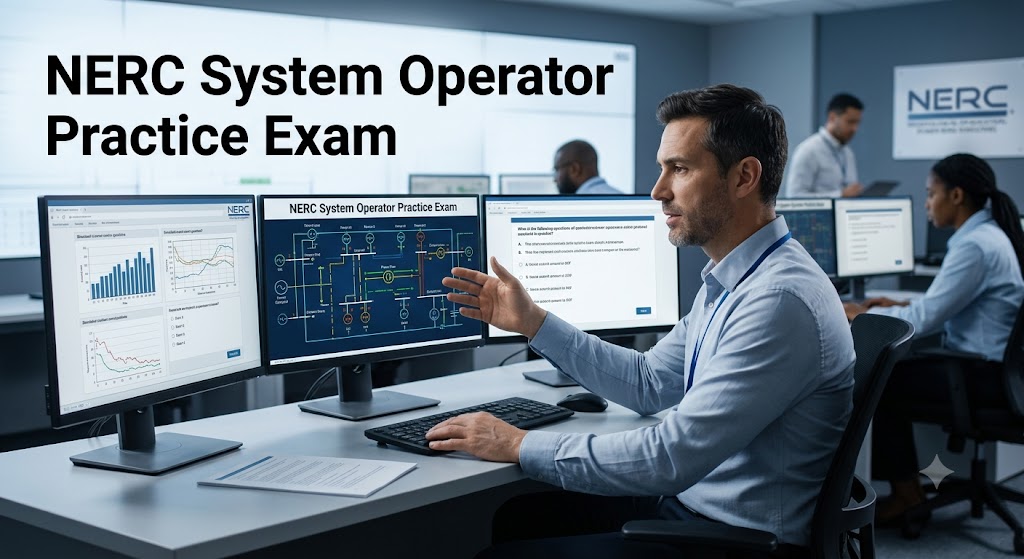
Additional Information
What the Course Entails and Exam Details
The content covered by NERC System Operator certifications is extensive and focuses heavily on the operational knowledge and procedures required for grid reliability. While the specific syllabus varies slightly between the different tracks (RC, BIT, BI, TO), they all share a robust foundation.
Here is an outline of the core topics and skills you will encounter:
NERC Reliability Standards: Detailed understanding and interpretation of the relevant NERC Standards that govern all bulk electric system operations. This is the cornerstone of the certification.
Power System Dynamics: Fundamental principles of AC circuits, including real and reactive power, voltage and frequency control, and power factor.
Contingency Analysis & Management: Techniques for anticipating single and multiple failure events, assessing their potential impact on the grid, and executing mitigative actions to prevent cascading outages.
Emergency Operations: Protocols and decisive actions for managing serious grid disturbances, blackouts, and other emergencies (e.g., severe weather).
System Protection: Awareness of protective relaying systems, their operation, and coordination in isolating faulty equipment.
Communications: Standards for professional and unambiguous operational communication during both normal and emergency situations.
Operating Procedures: Mastery of company-specific and regional operating protocols, including switching and clearing procedures.
The specific "exam details" will depend on the practice exam you choose. A high-quality practice test will simulate the full experience, matching the topic breakdown and question style of the real exam. We will cover the specific details of the final, official exams in the next section.
What to Expect in the Final Exam
The official NERC certification exams are known for being demanding, designed to ensure that only qualified individuals operate the continent's critical power infrastructure. Here is what you can generally expect:
Exam Format: All NERC certifications are computer-based, multiple-choice exams. The questions are designed to test not only your memorization of standards but also your ability to analyze complex situations and apply that knowledge correctly.
Exam Duration: The time limit varies by certification but is usually between two and four hours. For example, the RC exam is often four hours long with 100 questions.
Passing Score: The actual raw score required to pass fluctuates based on the psychometric evaluation of the exam. Instead, NERC reports a "scaled score" where 200 is typically the threshold. This usually corresponds to correctly answering approximately 70-80% of the scored questions.
Special Rules: The exams are highly secure. Proctors ensure that no reference materials, smartphones, or external notes are allowed. Scientific calculators (without programmable functions) are typically permitted and may be provided by the testing center. A significant number of questions are "unscored" pilot questions, which NERC uses to test new exam items for future use, and they will not count towards your final score (but you won't know which ones they are).
It is crucial to approach the exam with an understanding of this structure, making NERC practice exams that simulate these exact conditions incredibly valuable.
How to Study and Exam Centers
Successfully passing a NERC certification exam requires a structured and rigorous approach. Combine these effective study strategies with dedicated practice.
How to Study Effectively:
Start with the Standards: Read and thoroughly understand the active NERC Reliability Standards. Pay close attention to the "Requirements" and "Measures" sections, as these are the core areas where questions are derived. You can download these directly from the NERC website.
Utilize NERC Reference Materials: NERC often provides candidate handbooks, reference manuals, and other official study aids that list the key topics and recommended reading. Always check the official NERC website for the most current resources.
Engage in Self-Directed Study: Create a structured study plan that covers all domains. Supplement official documents with industry publications, power engineering textbooks, and utility training materials.
Emphasize Practical Application: Try to connect theoretical standards with practical grid operational scenarios. Consider how you would apply a specific standard when responding to a system outage or a sudden loss of generation.
Focus on NERC Practice Exams: This is a critical component. Use high-quality practice tests repeatedly. This will not only test your knowledge but also help you manage your time, get comfortable with the exam interface, and identify weak areas that require additional study. Review your answers carefully, understanding why a choice was correct or incorrect.
How to Take the Exam and Exam Centers:
To sit for an official NERC exam, you must first create an account on the NERC website and submit an application for the specific certification you intend to pursue. Once approved, you can register and pay for the exam.
NERC uses an external testing vendor (currently PSI, but this is subject to change) to administer its exams. This allows candidates to schedule their exam at a convenient location:
Authorized Testing Centers: You can select a physical, proctored testing center operated by the official vendor. These centers are located across North America and, for some certifications, even globally.
Online Remote Proctoring: In recent years, NERC has increasingly offered the option of remote, live proctoring. This allows you to take the exam from the comfort of your own home, provided your computer meets strict security and technical requirements.
When choosing a NERC practice exam provider, check for their reputation and the alignment of their materials with current NERC standards.
Job Opportunities from the Course
Achieving a NERC certification is a powerful way to advance your career in the electric utility industry. It unlocks high-demand, stable, and well-compensated positions within the operation of the electrical grid.
Here are specific job titles and career paths this certification enables:
Transmission System Operator (TSO): Manages the physical movement of high-voltage power across lines and through substations.
Balancing Authority Operator (BAO): Ensures real-time matching of power generation with customer load.
Interchange Operator: Coordinates the buy-sell agreements and energy schedules between different regions.
Reliability Coordinator (RC): Provides high-level operational oversight for a wide geographic area, preventing wide-scale grid failure.
Power Grid Dispatcher: Controls and monitors grid equipment to maintain optimal conditions.
Power System Trainee/Junior Operator: An entry-level path into grid operations, where NERC certification is often a mandatory step.
Ops Center Supervisor/Manager: Oversees a team of operators and ensures a control room functions reliably.
Real-Time Energy Trader: Leverages grid operational knowledge to make complex energy trading decisions.
Reliability Compliance Analyst: Helps utilities and other entities ensure they are meeting all NERC standard requirements.
Frequently Asked Questions
Reviews
5.0
Based on 0 reviews
Leave a Review
No reviews yet. Be the first to review!