
NERC System Operator (SOS) Reliability Practice Test
$69.00
- Buy to unlock unlimited access to all Quiz questions and Answers in this Quiz.
- After purchase you can print a PDF of the whole quiz at any point. The PDF will contain the questions and the correct answers.
About this Exam
The North American Electric Reliability Corporation (NERC) System Operator Certification program is designed to ensure that the personnel responsible for operating the bulk electric system in North America possess the requisite knowledge, skills, and abilities. This certification is crucial for maintaining the safety, adequacy, and reliability of the bulk power grid, which is essential for national security and economic stability. The exams validate that operators understand the complex NERC Reliability Standards and can apply basic power system principles under both normal and emergency conditions. This comprehensive guide and the associated practice test are tailored for both new candidates and experienced operators preparing for any of the four distinct NERC System Operator certification examinations.
Ready to test your knowledge?
Buy Now to Access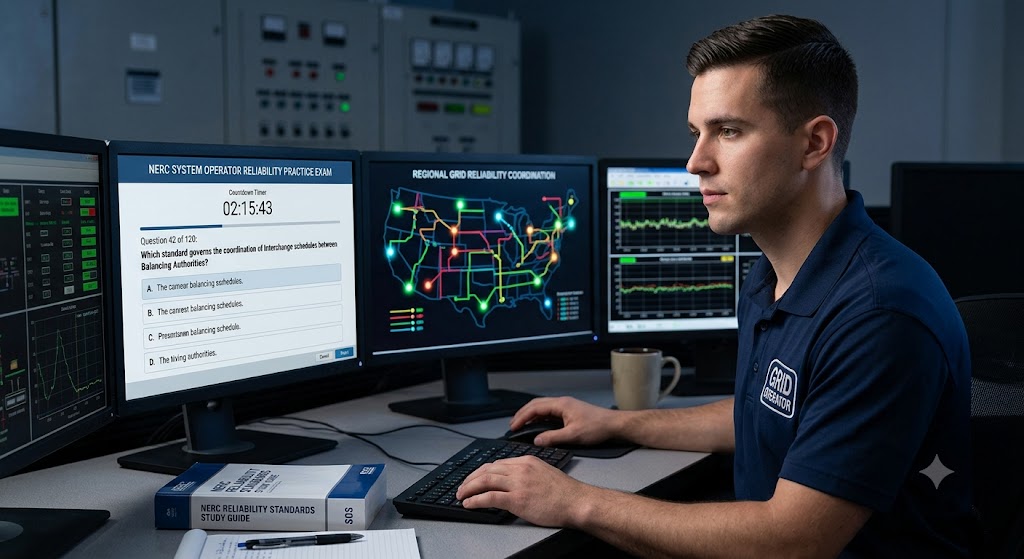
Additional Information
What the Course
Entails and Exam Details
Preparation for the NERC certifications is not a single
course, but a rigorous study of industry principles and mandatory standards.
The NERC program offers four role-specific certifications: Reliability
Coordinator (RC), Balancing, Interchange, and Transmission Operator (BIT),
Transmission Operator (TOP), and Balancing and Interchange Operator (BI).
Regardless of the specific path, candidates must master core domains. These
fundamental areas include: (1) Resource and Demand Balancing, where operators learn
to manage generation resources to match real-time load requirements and
maintain system frequency; (2) Transmission Operations, focusing on monitoring
and controlling the flow of power and voltage levels to keep the system within
safe limits; (3) Emergency Operations, which covers the crucial protocols and
actions required to respond to and recover from system disturbances, including
restoration and blackstart procedures; and (4) Reliability Standards and
Compliance, emphasizing deep knowledge and strict adherence to the binding NERC
standards (such as BAL, COM, PRC, and TOP) that govern grid operations.
What to Expect in
the Final Exam
The actual NERC certification examinations are rigorous,
computer-based tests administered globally through NERC's authorized testing
vendor, Pearson VUE. Candidates are allowed three hours (180 minutes) to
complete the examination. The format consists entirely of multiple-choice
questions, which test recall, application, and analysis skills. The number of
scored questions varies slightly by exam type, generally ranging from 100 to
120 questions. In addition to the scored items, exams often include a small number
of unscored pre-test questions that do not impact your score but are used for
future test development. The passing score for NERC exams is unweighted, and
the specific cut score required is determined by NERC; it is typically around
70-75% correct answers, but this can fluctuate. It is vital to note that these
are closed-book exams; candidates are not permitted to bring any reference
materials, personal calculators, or mobile devices into the testing room.
to Study and Exam Centers
Effective preparation requires a structured and dedicated
study plan. First, candidates must obtain the official NERC Exam Content
Outlines for their specific desired certification from the NERC website; these
documents are the blueprint for the exam and list every topic that can be
tested. Study the official NERC Reliability Standards themselves, focusing on
the "Requirements" sections of key standards. Supplement this with
industry reference manuals, such as those from EPRI (Electric Power Research
Institute). Utilizing a dedicated resource like the NERC System Operator
Reliability Practice Test is an absolute requirement. Repetitive practice with
mock exams helps develop crucial time management skills, familiarizes you with
the question format, and highlights specific areas where you need additional
study. Many prospective operators find great success by enrolling in
comprehensive initial operator training programs offered by accredited
educational vendors. To take the exam, candidates must first create an account
in the NERC System Operator Certification and Continuing Education Database
(SOCCED). Once authorized, you can schedule your exam directly with Pearson VUE
at one of their extensive networks of physical testing centers, which are
located in major cities and at authorized military sites worldwide.
Job Opportunities from the Course
A NERC System Operator Certification is a powerful
credential that unlocks a wide range of specialized, high-responsibility, and
often lucrative career paths within the bulk electric industry. The knowledge
gained prepares you to manage the complexity of the power grid, and many
organizations require or strongly prefer this certification for operations
personnel. The career opportunities enabled by this certification include, but
are not limited to, the following positions:
- Transmission
System Operator
- Balancing
Authority Operator
- Reliability
Coordinator
- Power
Dispatcher
- Generation
Dispatcher
- Load
Forecast Analyst
- Grid
Operations Supervisor
- Control
Center Manager
- NERC
Compliance Specialist
- Operations
Training Specialist
- Generation
Shift Supervisor
- Market
Operations Analyst
Frequently Asked Questions
Reviews
5.0
Based on 0 reviews
Leave a Review
No reviews yet. Be the first to review!