
NES Professional Knowledge Practice Exam
$69.00
- Buy to unlock unlimited access to all Quiz questions and Answers in this Quiz.
- After purchase you can print a PDF of the whole quiz at any point. The PDF will contain the questions and the correct answers.
About this Exam
The National Evaluation Series (NES) Assessment of Professional Knowledge (APK) is a suite of tests designed to assess the pedagogical knowledge and skills of prospective teachers. This certification is a critical step for educators seeking to become licensed and teach in several states across the United States. The exam evaluates a candidate's understanding of key principles of teaching and learning, student development, instruction, and professional responsibilities, ensuring they are classroom-ready. It is available in two versions: Elementary (for those aiming to teach grades K–6) and Secondary (for those aiming to teach grades 7–12).
Ready to test your knowledge?
Buy Now to Access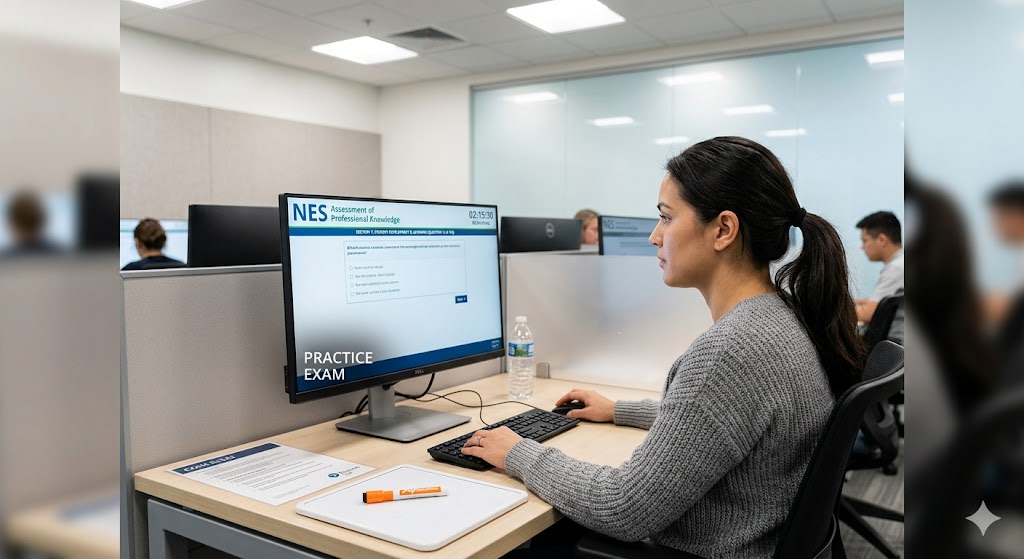
Additional Information
What the Course Entails and Exam Details
While not a conventional "course," preparing for the NES APK involves studying a comprehensive syllabus of educational theory and practice. The exam is divided into core content domains, which are further broken down into specific competencies.
The primary domains covered are:
I. Student Development and Learning (Approx. 24% of the exam): Understanding of student development processes, variations, learning processes, and the factors that influence learning.
II. Assessment, Instruction, and the Learning Environment (Approx. 50% of the exam): Knowledge of how to plan and deliver effective instruction, use varied assessments to monitor progress, and create a positive, inclusive, and safe learning environment.
III. The Professional Environment (Approx. 26% of the exam): Understanding of professional roles and responsibilities, legal and ethical guidelines, and effective collaboration with families, colleagues, and the community.
Both the Elementary (051) and Secondary (052) exams consist of 100 multiple-choice questions and two constructed-response (written) assignments.
What to Expect in the Final Exam
The final NES Assessment of Professional Knowledge is a computer-based, proctored exam.
Exam Format: Candidates will face 100 multiple-choice questions. In addition, there are two constructed-response assignments (a case study and a work product/response), which require candidates to apply their pedagogical knowledge to a specific classroom scenario.
Time Limit: You will be given a total of 3 hours (180 minutes) to complete the entire exam, including both multiple-choice and written sections. Effective time management is crucial to ensure you finish all components.
Passing Score: The NES APK is scored on a scaled range from 100 to 300. The passing score required to achieve certification is 220 for each version of the test.
How to Study and Exam Centers
Preparation is the key to passing the NES APK. Here are actionable study strategies and information on testing.
Actionable Study Strategies:
Take a Diagnostic Practice Test: Start with a full-length NES Assessment of Professional Knowledge Practice Test. This will help you understand the format, manage your time, and identify your specific strengths and weaknesses across the different domains.
Use Official Preparation Materials: Utilize the official study guides, full-length practice tests, and test frameworks provided on the official NES website. These are the most accurate reflection of the actual exam content.
Master Educational Vocabulary: The exam frequently uses specialized pedagogical terms (e.g., formative assessment, differentiated instruction, zone of proximal development). Create flashcards to memorize these key definitions.
Practice Written Responses: The constructed-response assignments are a unique challenge. Allocate time to practice outlining and writing logical, evidence-based responses to sample prompts, ensuring you address all parts of the question within the time limits.
Taking the Exam:
Exam Centers: The NES APK is administered via computer at numerous authorized Pearson VUE testing centers throughout the United States and internationally.
Scheduling: Tests are offered by appointment year-round, Monday through Saturday. You can locate your nearest testing center and schedule your specific exam date and time directly through the NES or Pearson VUE websites. Ensure you meet all state-specific eligibility requirements before registering.
Job Opportunities from the Course
Successfully passing the NES Assessment of Professional Knowledge is a prerequisite for teacher licensure in many states. Achieving this certification unlocks a wide range of rewarding career opportunities within the education sector.
Elementary School Teacher (Grades K–6)
Secondary School Teacher (Grades 7–12, in a wide range of subject areas)
Special Education Teacher (often requires additional endorsements)
Title I Teacher or Reading Specialist
Middle School Teacher
Curriculum Development Specialist
Instructional Coordinator
Educational Consultant
Frequently Asked Questions
Reviews
5.0
Based on 0 reviews
Leave a Review
No reviews yet. Be the first to review!