
NET Nursing Practice Exam Guide
$69.00
- Buy to unlock unlimited access to all Quiz questions and Answers in this Quiz.
- After purchase you can print a PDF of the whole quiz at any point. The PDF will contain the questions and the correct answers.
About this Exam
The Nursing Entrance Test (NET) is a critical gateway for aspiring nursing professionals. This comprehensive exam is designed to assess a candidate's readiness and foundational knowledge, ensuring they possess the core academic skills necessary to succeed in a demanding nursing program. If you are aiming to enter a nursing school to become a Licensed Practical Nurse (LPN), Licensed Vocational Nurse (LVN), or a Registered Nurse (RN), this test is your first significant challenge. A dedicated practice exam, such as the one described in this guide, serves as an indispensable tool, helping you familiarize yourself with the type of questions, level of difficulty, and common content areas you will encounter. It's an opportunity to gauge your strengths, identify areas needing improvement, and build the confidence required for the actual entrance exam.
Ready to test your knowledge?
Buy Now to Access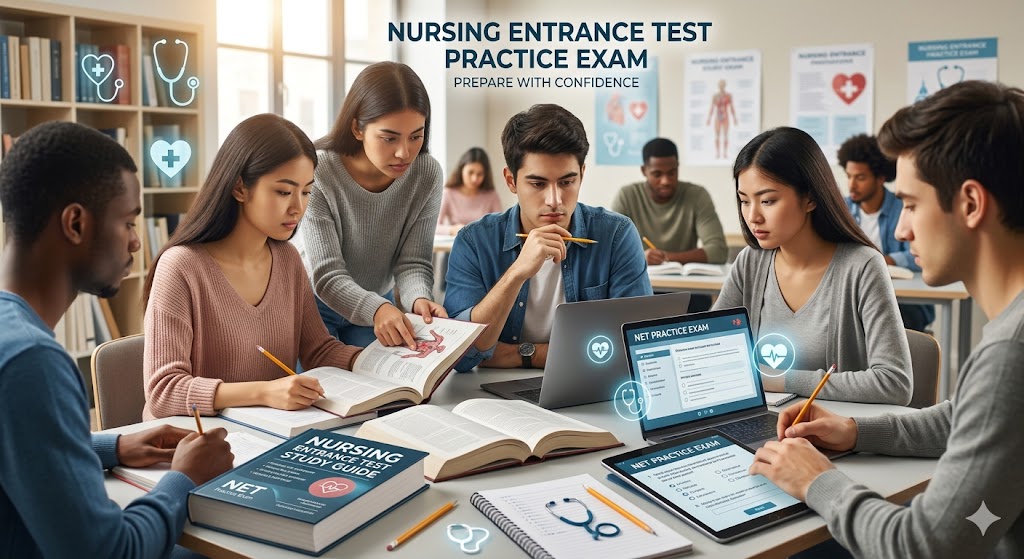
Additional Information
What the Course Entails and Exam Details
A proper study course or practice exam for the Nursing Entrance Test (NET) should mirror the actual exam's focus on key foundational subjects. The core topics generally included are:
Mathematics: This section typically evaluates basic arithmetic, algebra, percentages, ratios, fractions, and sometimes data interpretation and basic statistics. Problem-solving speed and accuracy are crucial here.
Reading Comprehension: Here, you will encounter diverse passages and be asked to answer questions that test your ability to understand main ideas, make inferences, determine authorial tone, and analyze information. Critical reading skills are key.
Science: Often focusing heavily on biology, human anatomy, and physiology, this area might also include foundational concepts in chemistry and basic physical sciences relevant to health. Familiarity with standard science terminology and processes is expected.
English Language Use and Grammar: This component tests your grasp of correct grammar, punctuation, sentence structure, spelling, and vocabulary. Clear communication skills are essential for both nursing studies and practice.
The practice exam aims to provide a representative sampling of questions within these domains, helping you structure your study efforts effectively and refine the specific skills tested in each area.
What to Expect in the Final Exam
It is important to remember that the exact format, scoring requirements, time limits, and specific rules of the final Nursing Entrance Test can vary significantly depending on the individual nursing school or institution administering the test. However, you can generally expect the following for the final exam:
Multiple-Choice Questions: The vast majority, if not all, of the questions will be presented in a multiple-choice format, often covering the domains of math, reading, science, and English.
Timed Sections: The final exam is typically divided into sections for each subject area, each with its own specific time limit. Total testing time can range from two to four hours.
Passing Scores: Each nursing program determines its own benchmark for a "passing" or competitive score. Some institutions might require minimum scores in each section, while others might focus on an overall composite score. Researching the specific requirements of your target schools is critical.
Testing Rules: Expect strict proctoring, whether the exam is taken in person or online. Standard rules, such as not using specific types of calculators (or calculators at all in some sections), having proper identification, and adhering to strict anti-cheating protocols, will be enforced. The practice exam will mimic this structure to prepare you for this level of discipline.
How to Study and Exam Centers
Effective preparation is the cornerstone of success on any nursing entrance exam. Here are actionable study strategies:
Take Multiple Practice Tests: Engage with several comprehensive practice exams to experience different question styles and build stamina.
Identify Weak Areas: Use the results of your practice tests to pinpoint subjects where you struggle. Dedicate extra study time to these areas.
Review Core Concepts: Brush up on fundamental math, science, English grammar, and reading comprehension principles. Use study guides, online resources, and flashcards.
Simulate Exam Conditions: When taking practice tests, time yourself and adhere to a quiet environment to replicate the experience of the actual exam.
Check Official Resources: If possible, obtain study materials or content outlines directly from the organization administering your specific NET or the nursing school you hope to attend.
Regarding Exam Centers:
Practice Exams: These are typically available online through various study guide providers, educational websites, and sometimes through specific testing vendors. You can usually take them on any device with internet access at your convenience.
Final Exams: The actual test is typically administered in one of a few ways:
In-Person at specific Testing Centers: Your chosen nursing school may have its own testing facilities, or they may utilize authorized external testing centers (such as specific Pearson VUE or other large testing network locations).
Online Proctored Exams: Some institutions offer the option to take the exam remotely under the supervision of an online proctor.
Direct Administration: Some nursing programs administer the test directly on their campus.
Always check with the specific nursing school you are applying to for precise details on how and where to register for and take the actual Nursing Entrance Test.
Job Opportunities from the Course
Successfully passing the Nursing Entrance Test is the first essential step, not directly granting a job or a license, but unlocking admission to a crucial next stage: a comprehensive nursing program. Upon completing that accredited nursing course and passing subsequent licensure exams, you open the door to a diverse and rewarding range of career paths and job opportunities:
Licensed Practical Nurse (LPN) / Licensed Vocational Nurse (LVN)
Registered Nurse (RN)
Nurse Practitioner (NP) (after further advanced education and certification)
Critical Care Nurse (ICU, ER)
Pediatric Nurse
Obstetric/Labor and Delivery Nurse
Surgical/Operating Room (OR) Nurse
Home Health Nurse
Public/Community Health Nurse
Geriatric Nurse
Psychiatric/Mental Health Nurse
Nurse Educator (after gaining experience and often further degrees)
Travel Nurse
Frequently Asked Questions
Reviews
5.0
Based on 0 reviews
Leave a Review
No reviews yet. Be the first to review!