
Networking Essentials Version A LE Practice Exam
$69.00
- Buy to unlock unlimited access to all Quiz questions and Answers in this Quiz.
- After purchase you can print a PDF of the whole quiz at any point. The PDF will contain the questions and the correct answers.
About this Exam
The Networking Essentials certification pathway is designed to provide students with a foundational understanding of networking concepts, configurations, and troubleshooting. It is specifically created for individuals who are new to the field of Information Technology (IT) and aspire to build a career in network administration, support, or security. The "Networking Essentials – Version A LE Practice Exam" is a crucial preparatory tool. This practice exam simulates the actual testing environment, allowing candidates to assess their knowledge gaps, become familiar with the question formats, and build the confidence needed to succeed in the final official certification exam. It is ideal for vocational students, IT beginners, and professionals looking to cross-train in networking.
Ready to test your knowledge?
Buy Now to Access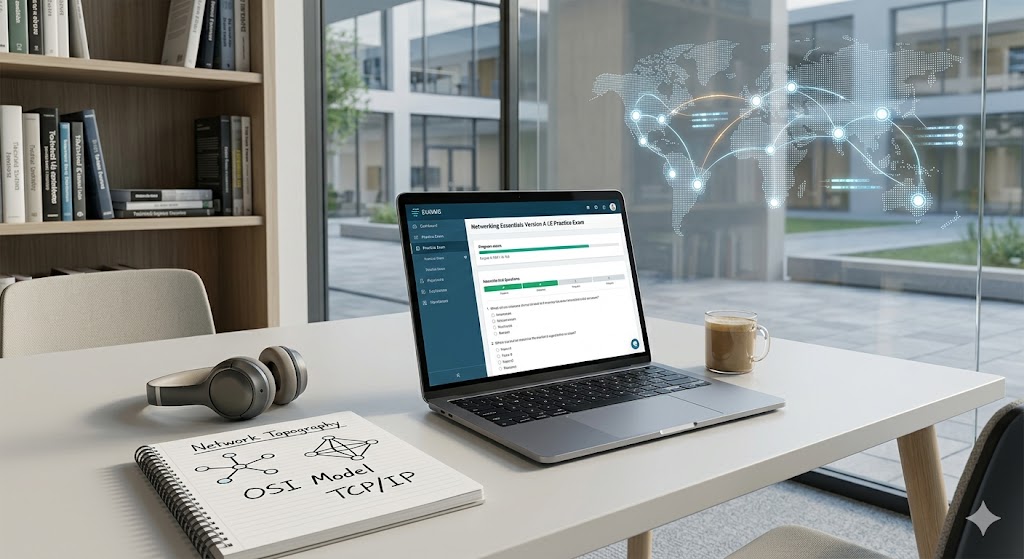
Additional Information
What the Course Entails and Exam Details
This course provides a thorough introduction to the core pillars of modern networking. Candidates are expected to master foundational concepts such as the OSI model and TCP/IP model layers, understanding how data flows across a network. The curriculum covers fundamental hardware components, including the roles and configurations of routers, switches, access points, and standard cabling types (Fiber, Cat5e/6). A significant portion of the course is dedicated to IP addressing, requiring students to demonstrate proficiency in IPv4 subnetting and a foundational understanding of IPv6. Furthermore, students will learn the basics of network security, common protocols (DHCP, DNS, HTTP/S), basic command-line troubleshooting tools (ipconfig, ping, tracert), and essential wireless networking principles.
What to Expect in the Final Exam
While this LE Practice Exam is a preparatory tool, it closely mirrors the format of the official final certification exam to provide an accurate simulation.
Format: The exam typically consists of multiple-choice questions (single and multiple answer), drag-and-drop matching scenarios, and may include performance-based simulations that test your ability to configure or troubleshoot a network in a virtual environment.
Time Limit: Candidates are usually allotted between 60 to 90 minutes to complete the exam.
Question Count: The actual exam generally contains between 50 and 75 questions.
Passing Score: The required passing score is typically set around 70% to 80%, though this can vary slightly depending on the specific vendor or educational institution administering the test. It is essential to manage your time wisely during the exam, ensuring you review your answers if time permits, and approach simulation questions with care as they often carry higher point values.
How to Study and Exam Centers
Effective preparation for this exam requires a mix of theoretical study and practical application.
Review Course Materials: Re-read the primary course textbooks or official student guides, focusing heavily on sections where you feel least confident.
Utilize the Practice Exam Thoroughly: Take the Networking Essentials – Version A LE Practice Exam multiple times. Do not simply memorize the answers; instead, understand why the correct answer is right and why the other options are wrong.
Hands-on Labs: Networking is a practical skill. Use network simulation tools like Cisco Packet Tracer or set up simple virtual machines to practice basic router and switch configurations, IP addressing, and troubleshooting commands.
Flashcards and Mnemonics: Create flashcards for common port numbers (e.g., HTTP 80, SSH 22, DNS 53) and the layers of the OSI model to aid memorization.
Create Study Groups: Reviewing challenging concepts with peers can offer new perspectives and reinforce your own understanding through teaching.
Exam Center Information:
The Networking Essentials final exam is typically administered through unauthorized testing pathways. Depending on your specific program, this may include:
Official Testing Centers: Such as Pearson VUE or Prometric, which offer secure proctored environments.
Online Proctoring: Many vendors now offer the ability to take the exam remotely from your home or office, subject to strict environment and hardware requirements.
Authorized Academic Institutions: If you are taking this as part of a high school or college curriculum, the exam might be administered directly within your school's testing facility or via their designated online learning portal. Check with your instructor or program coordinator for the specific testing procedures applicable to your course.
Job Opportunities from the Course
Successfully passing the Networking Essentials exam and obtaining the associated certification is a significant step toward a rewarding career in IT. This foundational knowledge is prerequisite for many entry-level roles.
Potential job opportunities and career paths unlocked by this certification include:
IT Help Desk Technician: Providing initial technical support, including basic network troubleshooting, to end-users.
Network Support Specialist: Assisting network engineers in maintaining, monitoring, and troubleshooting network infrastructure.
Entry-Level Network Administrator: Managing smaller networks, handling user accounts, and performing basic hardware configurations.
Junior Systems Administrator: While focused on servers, this role requires a strong understanding of networking to manage connectivity and active directory services.
Field Service Technician: Traveling to client sites to install, configure, and repair networking hardware and workstation connectivity.
Data Center Technician: Providing physical support and monitoring for servers and networking equipment within a data center environment.
Frequently Asked Questions
Reviews
5.0
Based on 0 reviews
Leave a Review
No reviews yet. Be the first to review!