
Neuroanatomy Practice Exam Study Guide
$69.00
- Buy to unlock unlimited access to all Quiz questions and Answers in this Quiz.
- After purchase you can print a PDF of the whole quiz at any point. The PDF will contain the questions and the correct answers.
About this Exam
The Neuroanatomy Practice Test is a crucial self-assessment tool designed for students and healthcare professionals aiming to master the complexities of the human nervous system.
It is specifically tailored for individuals enrolled in medical school, nursing programs, neuroscience undergraduates, and allied health courses like physical therapy or speech-language pathology.
This practice exam serves as a bridge between theoretical knowledge and clinical application, helping learners gauge their understanding of the brain’s structure and function before facing high-stakes academic or licensing examinations.
Whether you are preparing for a course final, the USMLE Step 1, or a neurology rotation board review, this comprehensive practice test provides the structured review necessary to excel.
Ready to test your knowledge?
Buy Now to Access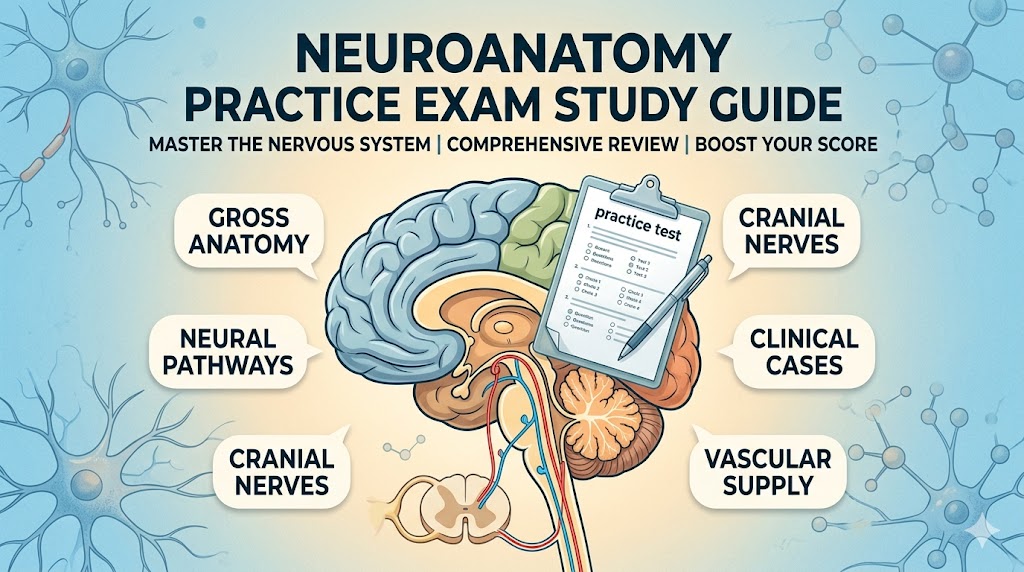
Additional Information
What the Course Entails and Exam Details
This examination covers the essential syllabus of a robust neuroanatomy curriculum.
Candidates must demonstrate proficiency across several core domains, starting with gross anatomy, including the lobes of the cerebrum, cerebellum, brainstem, and spinal cord.
Detailed knowledge of internal structures is required, focusing on the basal ganglia, thalamus, limbic system, and ventricular system, along with associated cerebrospinal fluid flow circulation.
A significant portion of the test evaluates your understanding of major ascending and descending neural pathways, such as the corticospinal tract and the dorsal column-medial lemniscus system.
Furthermore, the exam tests knowledge of the cranial nerves, their nuclei, functions, and clinical presentation of palsies.
Finally, you will be expected to understand the vascular supply to the brain, including the Circle of Willis, and the physiological consequences of strokes in different arterial territories.
What to Expect in the Final Exam
The Neuroanatomy Practice Test generally follows a rigorous, standardized format often seen in medical and graduate physiology assessments.
Candidates should expect a multiple-choice question (MCQ) format, which may include matching and true/false sections.
Many questions are presented as clinical vignettes, requiring you to diagnose a neurological lesion based on a set of presenting symptoms, thereby testing your ability to apply neuroanatomy practically.
Visual identification is key, so expect high-resolution diagrams of brain cross-sections, MRIs, CT scans, and histological slides where you must identify specific labeled structures.
While timing can vary depending on the specific provider of the practice test, you are typically given a time limit equivalent to approximately 60 to 90 seconds per question to simulate real exam conditions.
A passing score is generally set around 70-75%, though the goal should always be mastery rather than just passing.
How to Study and Exam Centers
Effective studying for neuroanatomy requires a combination of rote memorization, spatial visualization, and active recall.
Utilize active learning techniques by drawing out neural pathways using different colored pens to represent different tracts, sensory inputs, and motor outputs.
We highly recommend using spaced repetition systems (like Anki decks) for memorizing cranial nerve functions, names of specific nuclei, and Brodmann areas.
Supplement your textbook reading with a high-quality neuroanatomy atlas to fix visual landmarks in your mind, and view 3D brain models online to understand spatial relationships.
Taking this practice test repeatedly under timed conditions is essential to improve your speed and stamina for the actual exam day.
Regarding exam centers, because this is a practice examination, it is primarily administered online through educational portals, university learning management systems (like Canvas or Blackboard), or specialized medical test prep websites.
This allows you the flexibility to take the test from your home computer, library, or testing center within your educational institution.
Job Opportunities from the Course
While this practice test is a study tool and not a terminal certification, mastering neuroanatomy is a critical step toward career paths and advanced roles such as:
Neurologist
Neurosurgeon
Neuroscientist / Research Scientist
Frequently Asked Questions
Reviews
5.0
Based on 0 reviews
Leave a Review
No reviews yet. Be the first to review!