
Neurosensory AI Practice Exam
$69.00
- Buy to unlock unlimited access to all Quiz questions and Answers in this Quiz.
- After purchase you can print a PDF of the whole quiz at any point. The PDF will contain the questions and the correct answers.
About this Exam
Welcome to your essential resource for the Neurosensory AI certification journey. The field of Neurosensory AI is rapidly advancing, fusing cutting-edge neuroscience with advanced artificial intelligence to create revolutionary interfaces between biological systems and digital intelligence. This exam, and the comprehensive certification it supports, is designed for visionary professionals including AI Engineers, Neuroscientists, BCI Developers, and Research Scientists who aim to master this critical intersection. By passing this practice exam, you demonstrate foundational and intermediate expertise in interpreting neural signals and building intelligent systems that can process, decode, and even enhance human sensory perception and motor control.
Ready to test your knowledge?
Buy Now to Access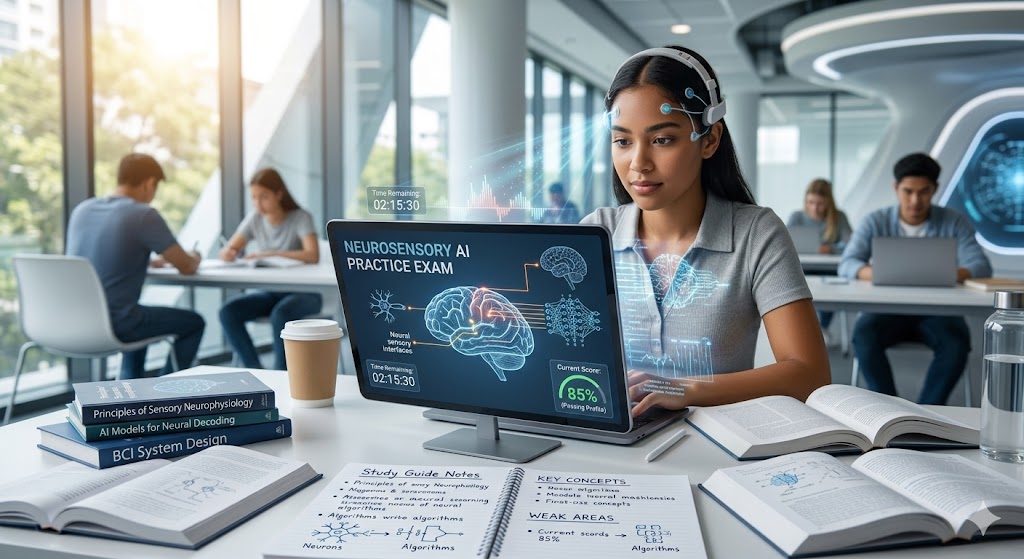
Additional Information
What the Course Entails and Exam Details
The underlying course for the Neurosensory AI certification encompasses a rigorous and interdisciplinary syllabus, carefully structured to bridge biology and computing. Key core topics you will master include:
Fundamentals of Sensory Neurophysiology: In-depth understanding of how human visual, auditory, somatosensory, olfactory, and gustatory systems function and encode information.
Principles of Artificial Intelligence & Machine Learning: Review of deep learning architectures, convolutional neural networks (CNNs) for vision, recurrent neural networks (RNNs) for temporal data, and reinforcement learning relevant to adaptive systems.
Neurosensory Data Acquisition & Signal Processing: Techniques for capturing high-quality neural data using technologies like EEG, ECoG, EMG, and invasive microelectrode arrays.
Neural Decoding and Encoding Models: Developing and implementing mathematical models to decode brain activity into intent (e.g., motor control for prosthetics) or encode sensory input back into the nervous system.
Brain-Computer Interface (BCI) Architecture: Designing and integrating the full BCI pipeline from signal acquisition to real-world control or feedback.
Ethics and Regulation in Neurotechnology: Critical analysis of privacy, consent, safety, and regulatory frameworks (e.g., FDA, MDR) concerning neural implants and data.
What to Expect in the Final Exam
The official Neurosensory AI Certification Final Exam is a rigorous and thorough assessment of your theoretical and practical knowledge. The exam format typically consists of approximately 60-90 questions, which may include a mix of multiple-choice, multiple-select, and scenario-based questions that test your ability to apply concepts in realistic situations. A passing score is generally around 70-75%, depending on the specific exam body and version. You will usually have between 120 and 180 minutes to complete the test, ensuring ample time to carefully consider each question. The exam is typically proctored and taken under strict "closed-book" conditions, where external aids and reference materials are not permitted. The practice exam serves as an invaluable simulation of this structure, helping you build confidence and identify areas for further study.
How to Study and Exam Centers
Successfully passing this advanced certification requires a dedicated and effective study strategy. Start by thoroughly reviewing the official course syllabus and recommended textbooks in both neuroscience and artificial intelligence. Use this practice exam as a core tool: take it multiple times, treat each attempt like the real test, and critically analyze your mistakes. Supplement your learning with research papers on Brain-Computer Interfaces, visual or auditory prosthetics, and advanced neural decoding techniques. Engage in practical work, perhaps through open-source BCI projects or simulation environments, as hands-on experience often clarifies complex concepts. Forming study groups with peers from both fields can also offer fresh perspectives and support.
When you are ready, the official exam is typically administered through authorized online proctoring portals or globally recognized professional testing centers like Pearson VUE. These systems ensure the security and integrity of the certification. Some advanced certification bodies may also offer testing through specific physical centers at universities or dedicated neurotechnology research institutes. You will need to register and schedule your exam slot well in advance through the official certification website.
Job Opportunities from the Course
Achieving certification in Neurosensory AI significantly elevates your professional standing in one of the most exciting and impactful areas of technology. Graduates from this path have successfully transitioned into dynamic roles such as:
Neurosensory AI Engineer
Brain-Computer Interface (BCI) Developer
Neural Data Scientist
Research Scientist in Neurotechnology
Neural Prosthetics Designer
Deep Learning Engineer (with a focus on neural applications)
Neuroinformatics Specialist
Medical Device Software Engineer (Neurology)
Regulatory Affairs Specialist for Neurotechnology
Frequently Asked Questions
Reviews
5.0
Based on 0 reviews
Leave a Review
No reviews yet. Be the first to review!