
Nevada Water Well License Practice Exam
$69.00
- Buy to unlock unlimited access to all Quiz questions and Answers in this Quiz.
- After purchase you can print a PDF of the whole quiz at any point. The PDF will contain the questions and the correct answers.
About this Exam
The Nevada Water Well License is a mandatory requirement for individuals who intend to construct, alter, or plug water wells within the state of Nevada.
This licensure is overseen by the Nevada Division of Water Resources (NDWR) and the Office of the State Engineer to protect Nevada’s vital groundwater resources and ensure public safety.
The official exam is a rigorous test designed for experienced drilling professionals and pump installers transitioning into well-construction management or ownership.
This practice exam is an essential preparatory tool, designed to help candidates review the technical material and regulatory framework necessary to pass the state examination and obtain their professional license.
Ready to test your knowledge?
Buy Now to Access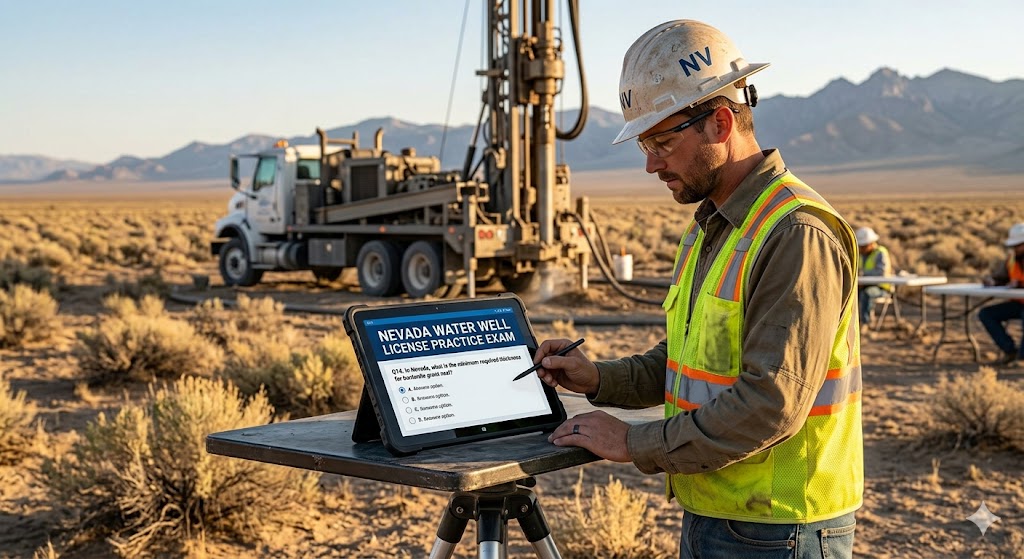
Additional Information
What the Course Entails and Exam Details
The path to licensure and the scope of the examination cover a mixture of technical engineering principles, geological understanding, and strict regulatory knowledge.
The material focuses heavily on Nevada-specific statutes, particularly Nevada Revised Statutes (NRS) Chapter 534 (Underground Water and Wells) and Nevada Administrative Code (NAC) Chapter 534.
Key areas of study include the legal definitions surrounding water rights, the specific protocols for the appropriation of underground water, and the detailed regulations for well-drilling permits.
You must also master technical well-construction standards, including specifications for casing, sealing (grouting) procedures, and the prevention of pollution or contamination between aquifers.
Additional subjects cover basic hydrogeology, understanding the types of water-bearing formations in Nevada, well-log reporting requirements, and comprehensive safety practices at the drilling site.
What to Expect in the Final Exam
The final state examination is a formalized, proctored test that combines theoretical knowledge with applied practical scenarios.
The exam usually follows a structured format consisting of multiple-choice and true/false questions, designed to evaluate your competency without requiring lengthy essay responses.
Candidates must be prepared for a duration of approximately three to four hours to complete the comprehensive assessment.
A passing score is typically set at 70% or higher, reflecting a strong grasp of both the technical math and the regulatory framework.
Specific portions of the exam, particularly those regarding the Nevada Revised Statutes and Nevada Administrative Code, are often open-book, allowing you to reference the regulations during the test.
However, the technical principles section, involving calculations and general well-construction knowledge, may be closed-book, demanding a deep understanding of the material.
How to Study and Exam Centers
Effective preparation requires a combination of studying official regulations, technical review, and practical practice.
Start by obtaining and thoroughly reading the Nevada Well Drilling Regulations handbook provided by the Nevada Division of Water Resources.
Utilize the Nevada Water Well License Practice Exam repeatedly, as these simulated tests are critical for familiarizing yourself with the specific phrasing of questions and identifying your knowledge gaps.
Work through the practice questions under timed conditions to improve your pacing and decision-making for the actual state exam day.
Focus on mastering the required mathematical formulas for determining well volumes, grouting requirements, and groundwater flow rates.
The official licensure examinations are usually administered by the NDWR or an authorized third-party testing agency with physical centers in key areas like Carson City and Las Vegas.
Candidates must contact the NDWR directly to register for an upcoming exam date and confirm the specific testing location, as walk-ins are generally not permitted.
Job Opportunities from the Course
Successfully obtaining your Nevada Water Well License unlocks a variety of career opportunities within the essential water infrastructure and construction sectors.
Below are specific job titles and career paths available to licensed professionals:
Licensed Water Well Driller
Journeyman Well Driller
Well Construction Manager
Pump Installation Contractor (for large-scale systems)
Geotechnical Drilling Operator
Environmental Drilling Specialist (Groundwater Monitoring)
Public Works Water Operator (focusing on supply)
Well Rehabilitation Technician
Private Water System Consultant
Field Hydrogeologist AssistantHere is your optimized study guide article and a conceptual image to accompany it.
Frequently Asked Questions
Reviews
5.0
Based on 0 reviews
Leave a Review
No reviews yet. Be the first to review!