
New Hampshire Boating Certification Study Guide
$69.00
- Buy to unlock unlimited access to all Quiz questions and Answers in this Quiz.
- After purchase you can print a PDF of the whole quiz at any point. The PDF will contain the questions and the correct answers.
About this Exam
The New Hampshire Boating Education Certificate is the mandatory safety credential required for the vast majority of motorized boaters operating on New Hampshire’s diverse public waterways. Administered in partnership with the New Hampshire Marine Patrol, this certification is designed to provide operators with the foundational knowledge needed to reduce accidents, protect natural resources, and ensure all boaters can share the water responsibly.
The primary audience for this certification includes all individuals aged 16 and older who wish to operate any motorboat over 25 horsepower on New Hampshire waters. This includes residents and non-residents alike, making it a critical requirement for anyone enjoying New Hampshire's lakes, ponds, and rivers from the helm of a powerful vessel.
Ready to test your knowledge?
Buy Now to Access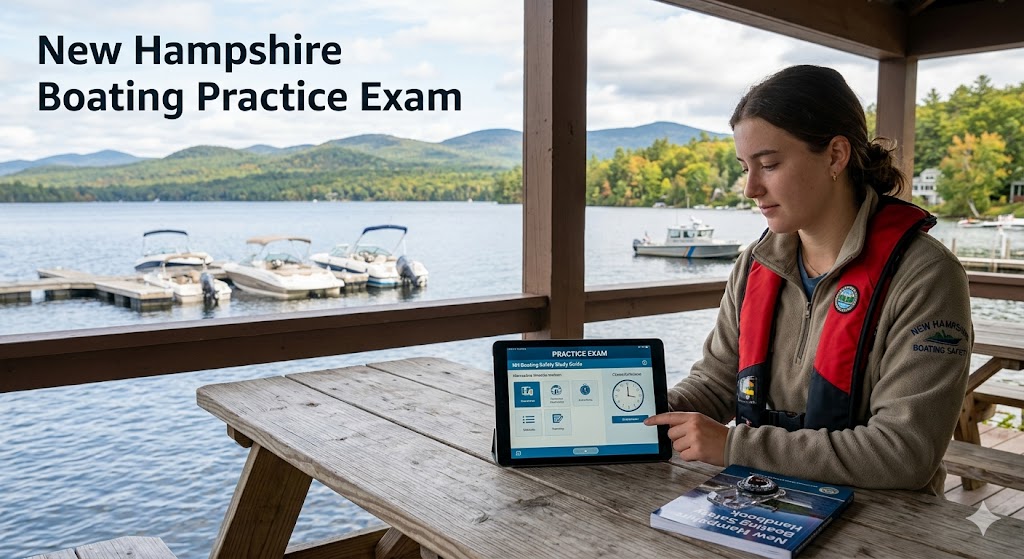
Additional Information
What the Course Entails and Exam Details
This comprehensive boating safety course is structured around the standards set by the National Association of State Boating Law Administrators (NASBLA) and is specifically tailored to incorporate New Hampshire's unique state laws. The course, available through multiple approved online providers, requires a minimum of three hours to complete and is designed to build confidence in multiple key areas.
The core syllabus and exam cover the following domains:
Vessel Basics: Proper naming conventions, types of hulls, and engine maintenance.
Navigation Rules: The "rules of the road" for the water, including determining who has the right of way, understanding navigation lights, and correctly interpreting buoys and markers.
Night Operation: Specific safety requirements, lighting, and hazards unique to operating after dark.
New Hampshire State Laws: Crucial local regulations regarding registration, towing, personal watercraft (PWC) operation, and environmental protections.
Safety Equipment: State and federal requirements for life jackets, fire extinguishers, sound signals, and visual distress signals.
Emergency Procedures: How to respond to critical situations like capsizing, swamping, fires, and person-overboard incidents.
Operational Safety: Safe fueling procedures, developing a float plan, docking techniques, and understanding weather hazards.
Special Operations: Regulations specific to towing (water skiing) and personal watercraft (PWC) or ski craft.
What to Expect in the Final Exam
While the exact number of questions can vary slightly by vendor, a typical exam consists of approximately 75 multiple-choice questions that cover all aspects of the NASBLA-approved curriculum and New Hampshire state specific laws.
Passing Score: To obtain your New Hampshire Boating Education Certificate, you must achieve a passing score of at least 80% or higher.
Exam Formats and Rules: The exam process differ significantly based on the operator's age:
For Operators Aged 18 and Older: Most approved online course providers offer a single final exam attempt immediately after completing the online course. Students 18 and over can take this final exam online. If you pass, you can print a temporary certificate immediately, which is valid for 365 days. If you fail, you must locate and register for an in-person, proctored exam ($10 fee).
For Operators Aged 16 and 17: New Hampshire law requires all operators in this age range to complete the online course, and then take their final exam in person at an official proctored testing location. The temporary certificate cannot be printed until the in-person, proctored exam is passed.
There is typically no strict time limit for the online portion of the final exam (which saves progress), but in-person proctored exams may have time constraints administered by the Marine Patrol officer on site. Regardless of format, you must bring a valid photo ID and, for those 16 and 17, your Temporary Safe Boating Certificate, confirming your completion of the online course.
How to Study and Exam Centers
Effective study requires a mixture of active engagement with the course material and dedicated practice. Follow this strategy for success:
Step 1: Complete an Approved Course. Start by registering with a state-approved online provider (e.g., Boat Ed, BOATERexam). These courses are often broken into units with mandatory study times and end-of-unit quizzes. Take these quizzes seriously, as they mirror the difficulty and format of the final exam.
Step 2: Utilize the Official Handbook. Many course providers include access to the comprehensive New Hampshire Boating Safety Handbook. This resource is invaluable for looking up specific legal definitions, buoy configurations, and navigation rules.
Step 3: Simulate the Exam. Use the final unit of your course, which typically includes a practice exam, and utilize independent practice resources. Treat these practice exams as the actual final: create a quiet, distraction-free environment and complete them without looking up answers to gauge your true readiness. Identify your weak areas and re-review those units.
Exam Centers:
Online Portal: For adults 18+, the primary exam center is the approved online learning management system where you complete the course (e.g., Boat Ed).
Physical Proctored Locations: If you are 16 or 17, or an adult who failed the initial online attempt, you must register for an in-person, proctored exam. These are managed by the New Hampshire Marine Patrol and held at various authorized sites throughout the state, including community centers, schools, and safety training facilities. You must pre-register for these sessions.
Job Opportunities from the Course
While this certificate is a mandatory safety requirement for recreational boaters, it also serves as a fundamental credential for multiple entry-level career paths on the water.
This certification unlocks the following career opportunities in New Hampshire:
Motorboat Operator
Launch Operator (Yacht Club/Marina)
Water Taxi Operator
Harbor Patrol Assistant
Fishing Guide (Requires additional licenses)
Tour Boat Operator
Boat Rental Staff
Marina Deckhand
Vessel Crew Member
Dock Master
Frequently Asked Questions
Reviews
5.0
Based on 0 reviews
Leave a Review
No reviews yet. Be the first to review!