
New Hampshire Cosmetology Practice Exam Guide
$69.00
- Buy to unlock unlimited access to all Quiz questions and Answers in this Quiz.
- After purchase you can print a PDF of the whole quiz at any point. The PDF will contain the questions and the correct answers.
About this Exam
The New Hampshire Cosmetology licensing examination is the definitive milestone required to become a licensed beauty professional within the Granite State. This examination process is designed to thoroughly evaluate the competency and safety knowledge of individuals who have successfully completed their required cosmetology training hours. Achieving a passing score is a mandatory prerequisite for state licensure, ensuring that every practicing cosmetologist possesses the skills necessary to protect public health while delivering high-quality beauty services. Whether you are a recent beauty school graduate or an out-of-state professional seeking reciprocity, this guide is an essential tool to help you navigate and master the exam.
Ready to test your knowledge?
Buy Now to Access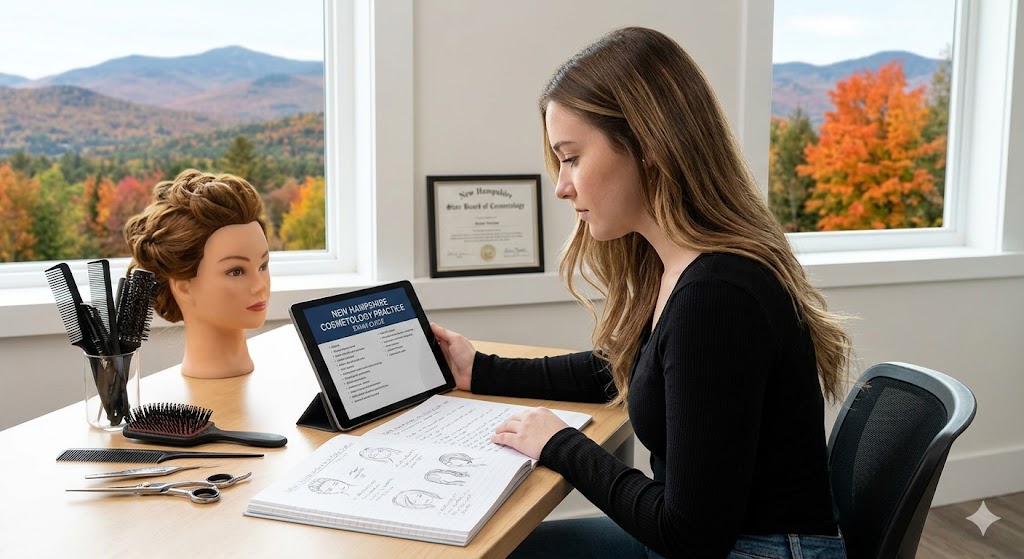
Additional Information
What the Course Entails and Exam Details
Preparation for the New Hampshire licensure examination requires mastering a wide-ranging curriculum that blends scientific theory with practical, hands-on skills. The core topics covered in standard beauty school curricula, and which form the basis of the exam, include rigorous safety and infection control protocols. You will be tested on your knowledge of anatomy and physiology, chemistry as it applies to products and treatments, and electricity regarding salon tools. Furthermore, the exam evaluates technical skill proficiency in all major areas of cosmetology services, including comprehensive hair care and styling, skin care treatments and makeup, and professional nail services. The examination utilizes testing standards from the National Interstate Council of State Boards of Cosmetology (NIC) to ensure standardized evaluation.
What to Expect in the Final Exam
In New Hampshire, the licensure process is divided into two distinct parts: a written (theory) examination and a practical, hands-on examination. The theory portion is a computer-based test that features multiple-choice questions covering scientific concepts, salon safety standards, and state regulations, which you must complete within a specific time limit. The practical examination is a physical assessment where you are required to perform specific services on a mannequin before a proctor. For the practical portion, you are solely responsible for bringing your own fully supplied and properly labeled examination kit according to NIC specifications. To qualify for licensure, you must typically achieve a passing score of 75 percent or higher on both the theory and practical sections, demonstrating your readiness to safely practice in the industry.
How to Study and Exam Centers
Successfully passing the New Hampshire Cosmetology exam requires a strategic combination of diligent theoretical study and consistent practical practice. The most effective strategy for the written portion is to frequently use a high-quality New Hampshire Cosmetology Practice Exam to become familiar with the question formatting and time constraints. You should also deeply review the Candidate Information Bulletins provided by the testing administrator and study your core beauty school textbooks, paying particularly close attention to infection control and safety procedures. For the practical examination, it is imperative to set up a mock exam station and rehearse the required procedures exactly as outlined in the examination guidelines, focusing on strict sanitation and proper tool handling throughout every step. In New Hampshire, examination scheduling and administration are typically handled by an outside vendor like DL Roope Administration, Inc., or Prometric, which provide various physical testing locations across the state.
Job Opportunities from the Course
Passing the New Hampshire Cosmetology examination and securing your state license immediately unlocks a vast array of exciting career opportunities within the booming beauty industry. This valuable certification provides the legal credential necessary to work as a licensed hair stylist in high-end salons or exclusive spas throughout New Hampshire. With experience, you can pursue leadership roles as a salon owner or manager. Licensed professionals are also qualified to work as makeup artists for bridal, fashion, or editorial events, or specifically as manicurists and nail technicians focusing solely on nail artistry. Furthermore, your license can lead to specialized roles such as a platform artist, a beauty product sales representative for major cosmetic brands, or, with additional training, a cosmetology instructor at a beauty institute.
Frequently Asked Questions
Reviews
5.0
Based on 0 reviews
Leave a Review
No reviews yet. Be the first to review!