
New Hampshire MPJE Practice Exam
$69.00
- Buy to unlock unlimited access to all Quiz questions and Answers in this Quiz.
- After purchase you can print a PDF of the whole quiz at any point. The PDF will contain the questions and the correct answers.
About this Exam
The Multistate Pharmacy Jurisprudence Examination (MPJE) is a cornerstone of the pharmacist licensure process, and the New Hampshire MPJE is your essential final step to practicing in the Granite State. This examination is designed for aspiring pharmacists who have completed their education and are seeking to demonstrate their comprehensive understanding of both federal and state-specific pharmacy laws and regulations. Our "New Hampshire MPJE Practice Exam" is the definitive tool to help you master these critical concepts, ensuring you approach test day with confidence and the legal acumen required to protect public health.
Ready to test your knowledge?
Buy Now to Access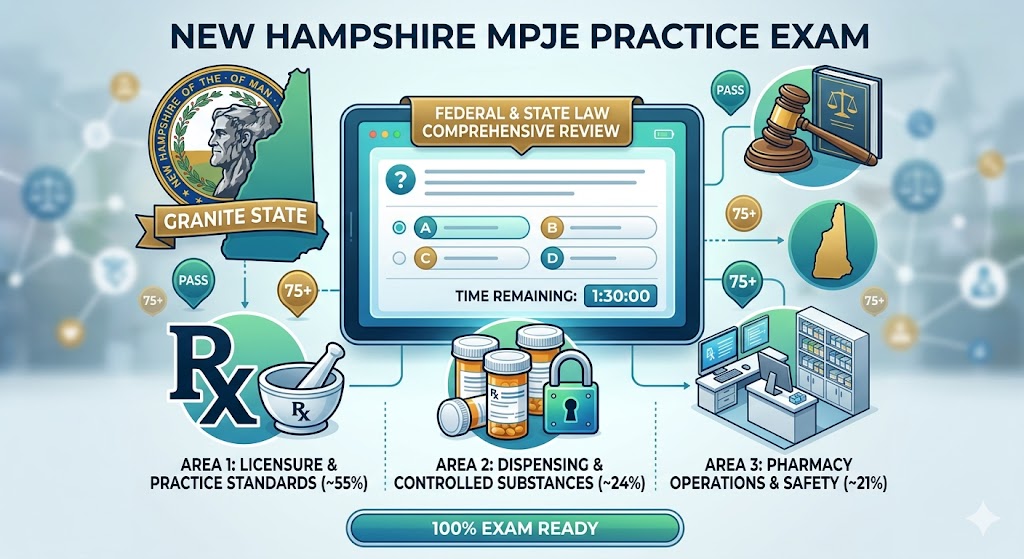
Additional Information
What the Course Entails and Exam Details
This comprehensive practice exam rigorously covers the multi-faceted landscape of pharmacy law that you will encounter on the official New Hampshire MPJE. It is meticulously structured to align with the National Association of Boards of Pharmacy (NABP) competency statements, ensuring you are tested on the most relevant and up-to-date information. The practice exam provides a realistic simulation of the actual test, focusing on four primary competency areas:
Area 1: Licensure, Registration, Certification, and Operational Requirements (~22%). This section evaluates your knowledge of the legal requirements for individuals and facilities in New Hampshire, including pharmacist licensure, technician registration, and pharmacy permits.
Area 2: Pharmacy Practice (~33%). Here, you will be tested on the legal standards for dispensing medications, patient counseling, drug utilization review, and the scope of practice for pharmacists, interns, and technicians.
Area 3: Dispensing Requirements (~24%). This domain focuses on the intricate laws governing the entire prescription process, including electronic prescriptions, controlled substance regulations, refills, labeling, and record-keeping in accordance with both New Hampshire and Federal law.
Area 4: Pharmacy Operations (~21%). This section assesses your understanding of the regulations concerning pharmacy security, storage, compounding, handling of hazardous drugs, and manufacturing/wholesale distribution within the state.
Our practice exam not only helps you identify your strengths and weaknesses across these areas but also explains the application of specific New Hampshire regulations, which often differ from or add to federal requirements.
What to Expect in the Final Exam
The official New Hampshire MPJE is a modern, computerized adaptive test (CAT), which means the difficulty of the questions adjusts based on your previous answers. This format requires you to carefully consider each question, as you cannot skip or return to a previous question. The exam consists of 120 multiple-choice questions in total, though only 100 will contribute to your final score. You are given 2.5 hours to complete the examination, along with an additional 20 minutes for a tutorial and a post-exam survey.
A crucial rule to remember is that you must answer at least 107 questions for the exam to be scored. There are no scheduled breaks during the 2.5-hour testing period; if you choose to take a break, the exam clock will continue to run. The primary score result is now reported as a simple "pass" or "fail," indicating whether you have met the competency standard established by the NABP and the New Hampshire Board of Pharmacy.
How to Study and Exam Centers
Effective preparation for the New Hampshire MPJE requires a dedicated study plan that balances federal and state law review. We recommend a 2 to 4-week period of focused study. Your primary resources should be the official New Hampshire Board of Pharmacy laws and regulations (specifically, New Hampshire Revised Statutes Annotated and the Board's administrative rules, often labeled Ph 100-800). Additionally, the NABP provides the "Pre-MPJE," which is the only official practice exam and uses questions from previous test administrations.
Actionable study strategies include creating flashcards for key numerical details (such as controlled substance refill limits, prescription expiration dates, and timeframes for reporting information), utilizing the NABP Competency Statements to ensure full topic coverage, and taking multiple practice exams to get used to the computer-adaptive format and question types, which frequently use negative wording like "which of the following does NOT" or "ALL of the following EXCEPT."
To take the final exam, you must first register with the NABP and submit an application to the New Hampshire Board of Pharmacy to confirm your eligibility. Once eligible, you will receive an Authorization to Test (ATT) letter, which enables you to schedule your appointment. The MPJE is administered via Pearson VUE, which operates numerous secure testing centers throughout New Hampshire and across the country.
Job Opportunities from the Course
Successfully passing the New Hampshire MPJE and obtaining your pharmacist license unlocks a diverse range of rewarding career paths in healthcare. With this credential, you are authorized to practice as a licensed pharmacist within the state. Job opportunities include:
Licensed Pharmacist in New Hampshire: The foundational role, which can lead to various specializations.
Community (Retail) Pharmacist: Providing direct patient care, dispensing medications, and offering health advice in local pharmacies.
Hospital Pharmacist: Working as part of a healthcare team to manage medication therapy in an inpatient setting.
Clinical Pharmacist: Specializing in optimizing medication use in specific therapeutic areas, such as oncology, infectious disease, or critical care.
Pharmacy Manager: Overseeing the operations, staff, and compliance of a pharmacy department.
Consultant Pharmacist: Providing expertise to nursing homes, long-term care facilities, or other healthcare organizations.
Industry Pharmacist: Working in areas like drug development, medical affairs, or regulatory compliance for pharmaceutical companies.
Regulatory Pharmacist: Working for state or federal agencies to enforce pharmacy laws and protect public health.
Frequently Asked Questions
Reviews
5.0
Based on 0 reviews
Leave a Review
No reviews yet. Be the first to review!