
New Hampshire Security Guard Practice Exam: Your Key to Success
$69.00
- Buy to unlock unlimited access to all Quiz questions and Answers in this Quiz.
- After purchase you can print a PDF of the whole quiz at any point. The PDF will contain the questions and the correct answers.
About this Exam
The New Hampshire Security Guard Practice Exam is an essential study tool for individuals aspiring to work as security guards in the Granite State. Security work in New Hampshire requires adhering to specific state laws and regulations, and ensuring you are well-prepared is the first step towards a rewarding career. This guide and associated practice materials are designed for candidates for both unarmed and armed security positions, though the specific requirements for licensure, training, and examination differ significantly between the two paths. By practicing with realistic exam scenarios, you can build confidence, master key security concepts, and ensure you are ready for the actual knowledge and skills you will need on the job and throughout the official licensing process. Investing time in targeted practice now will significantly increase your chances of success in your initial training and help you excel in the diverse roles the security industry offers.
Ready to test your knowledge?
Buy Now to Access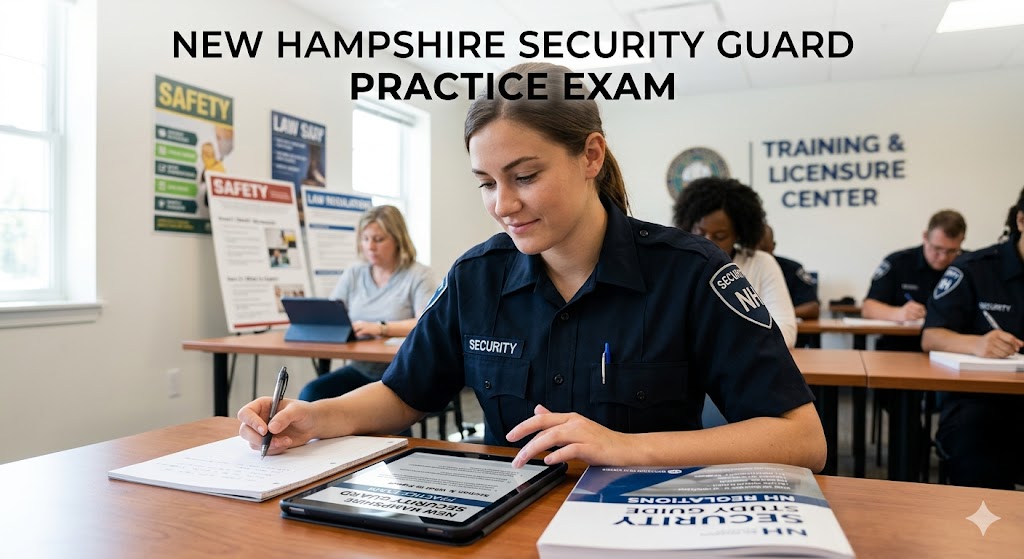
Additional Information
What the Course Entails and Exam Details
While there is not a single, standardized state-wide "practice exam" required for licensure, the knowledge base required to work as a security guard and excel in the roles is comprehensive. The areas covered in security guard preparation and common practice exams reflect the critical skills and knowledge points essential in New Hampshire, including:
New Hampshire Laws & Regulations: Deep understanding of relevant RSA statutes (RSA 106-F for the industry), administrative rules, and specific state laws regarding security services, legal authority, and private property.
Legal Powers & Limitations: Detailed knowledge of a security guard's powers of arrest (different from law enforcement) and limitations on their authority.
Use of Force: Critical understanding of legal, moral, and ethical issues concerning the use of force, including the use of force continuum and state-specific justification laws.
Conflict Resolution & De-escalation: Mastering techniques to manage conflicts calmly and safely, prioritizing non-violent communication.
Report Writing & Documentation: Skills in creating accurate, detailed, and professional incident reports and maintaining daily logs.
Emergency Response: Understanding protocols for various emergencies, including fire, medical incidents, and active shooter situations (which search results indicate is a common training area).
Communication & Public Interaction: Effective communication with employers, the public, emergency services, and colleagues, always maintaining professionalism.
Observation & Patrol Techniques: Developing situational awareness and executing effective patrol procedures to detect and deter security breaches.
Ethics & Discretion: Applying strong ethical principles and exercising sound judgment in various challenging scenarios.
Additional Requirements for Armed Security Guards:
Advanced Training: Armed guards must complete specific qualifying courses, both initially and annually.
Firearms Technique & Safety: This training includes hands-on instruction in safe handling, shooting techniques, and firearm safety.
Legal & Ethical Use of Force: Intensive instruction focusing on the legal, moral, and ethical considerations specific to carrying and using a firearm on duty.
What to Expect in the Final Exam
The actual assessment and requirements for security guard roles in New Hampshire differ between unarmed and armed positions. It's important to understand the typical nature of assessments to maximize your preparation.
Unarmed Security Guards: According to search results, there is typically no formal state-administered exam for the individual unarmed security guard license itself. The process primarily focuses on comprehensive background checks and agency-based sponsorship. However, as search results also indicate, training and continuing education are required (sometimes specific to state laws/regulations) and are often provided by agencies or private schools. These individual training courses may conclude with their own exams or assessments to verify knowledge. A general security guard practice exam can help you prepare for these course evaluations and ensure you possess the core knowledge.
Armed Security Guards: There is a specific, state-required firearms qualification exam.
Format: This generally consists of a written examination (covering safety, laws, and ethical issues) and, most importantly, a practical firearms qualification.
Passing Score: For the practical shooting qualification, search results indicate a required score of 75%. Expect the written component to have its own pass/fail criteria set by the certified training entity and approved by the state.
Time Limits & Rules: Specific details on time limits for both written and practical components are managed by the authorized training schools/instructors (e.g., NRA, SIG Sauer, Police Standards and Training Council, etc.) and must comply with state standards. For the practical qualification, anticipate specific courses of fire, distances, and safety protocols which are strictly enforced. Annual requalification is also required for armed guards.
How to Study and Exam Centers
Effective study and targeted practice are your keys to successfully navigating the preparation and licensing journey.
Leverage Study Guides & Resources: Thoroughly review any study materials provided by your agency, private security training schools, or reliable security industry websites. Search results highlight courses that focus on New Hampshire-specific content.
State Law Review: Access and study the specific New Hampshire RSA statutes (like 106-F) and administrative rules related to private security services and the use of force. This state-specific knowledge is critical.
Utilize Dedicated Practice Tools: Make full use of the New Hampshire Security Guard Practice Exam or similar practice tools. Treat practice tests like the real assessment – timing yourself if possible, mimicking exam conditions, and carefully reviewing all correct and incorrect answers to understand the why behind each response. Consistent practice with multiple-choice questions on diverse topics will solidify your knowledge.
Scenario-Based Learning: Practice thinking through realistic security scenarios. Apply legal knowledge, de-escalation techniques, and reporting skills to varied situations to build practical problem-solving abilities.
For Armed Guards:
Attend a Certified Training Course: This is mandatory. You must complete a qualification course from an accepted instructor/organization (examples in search: NRA, SIG Sauer, Smith & Wesson, Police Standards and Training Council, FBI, or other Commissioner-approved programs).
Firearms Proficiency Practice: Consistent and supervised practice on a firing range under the guidance of a qualified instructor is essential to achieve and maintain the necessary shooting proficiency for qualification. Focus on accuracy, safe handling, and following range procedures.
Where and How to Take the Exam / Complete Licensure:
Study Materials & Practice Exams: Are typically accessed online through study platforms or private test preparation services.
Agency & Private School Training/Assessments: Training courses (which may include assessments/exams) for both unarmed and initial armed training are held at various approved private locations, certified schools, or provided directly by security agencies.
Armed Guard Firearms Qualification: This practical component occurs at specific, authorized firing ranges or training facilities associated with the certified instructor/organization you choose (e.g., SIG Sauer Academy, NRA instructors, state police facilities, etc.).
Licensure Application (Permits and Licensing Unit, NH State Police): The overall licensure/registration process, including submitting forms and fingerprinting (especially critical for armed guards), is administered by the Permits and Licensing Unit of the New Hampshire State Police. Their physical public counter is located at 33 Hazen Drive, Room 106, in Concord, NH. You are required to present all forms and potentially fingerprints in person at this location. While training courses and individual assessments happen elsewhere, the state licensing body is central to the process. Be sure to check the exact location and requirements for fingerprinting appointments as directed by the Licensing Unit.
Job Opportunities from the Course
Successfully preparing with the New Hampshire Security Guard Practice Exam and completing the required steps positions you for diverse career opportunities in the vibrant security sector across the state. Potential job titles and career paths include:
Unarmed Security Officer
Armed Security Officer
Corporate Security Specialist
Retail Asset Protection
Healthcare/Hospital Security Officer
Government Facility Security (armed and unarmed)
Residential Security Agent
Event Security Personnel
Patrol Officer
Security Supervisor or Manager (with experience and further development)
Frequently Asked Questions
Reviews
5.0
Based on 0 reviews
Leave a Review
No reviews yet. Be the first to review!