
New Jersey Jurisprudence Practice Exam
$69.00
- Buy to unlock unlimited access to all Quiz questions and Answers in this Quiz.
- After purchase you can print a PDF of the whole quiz at any point. The PDF will contain the questions and the correct answers.
About this Exam
The New Jersey Jurisprudence Practice Exam isn't a single standardized test, but a essential concept representing the jurisprudence assessment required by numerous professional licensing boards across the state. Designed for individuals seeking initial licensure, or sometimes license renewal, in diverse fields – ranging from physical therapy and nursing to engineering, dentistry, and even law – these exams verify your practical understanding of the specific state laws, administrative rules, and ethical principles that govern professional practice within New Jersey. Successfully navigating this assessment is a critical step towards legally and ethically practicing your profession in the Garden State, ensuring you can deliver high-quality services while upholding the public's trust and safety. This guide and practice resource are designed to empower you with the knowledge and confidence to ace your specific New Jersey jurisprudence exam.
Ready to test your knowledge?
Buy Now to Access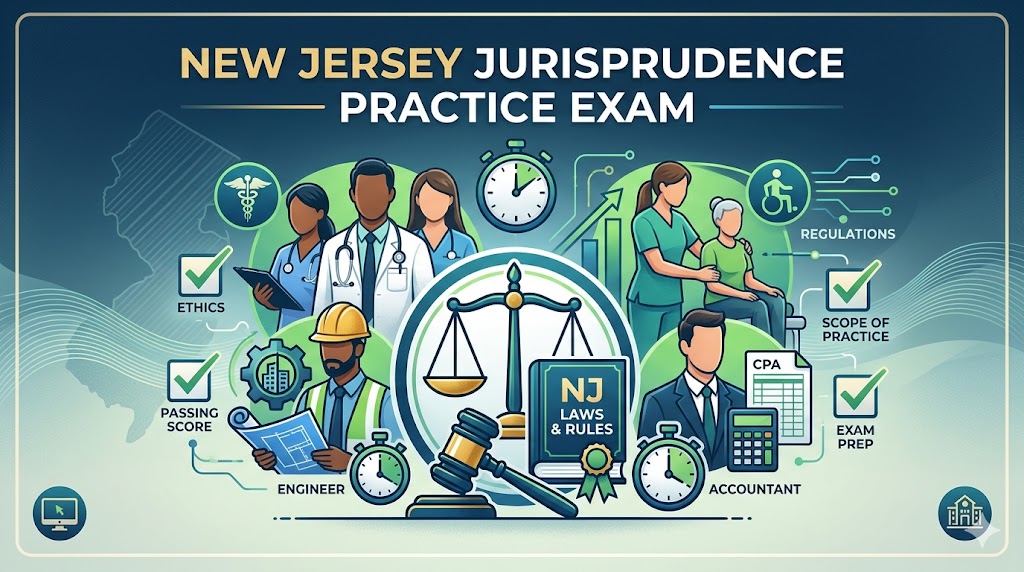
Additional Information
What the Course Entails and Exam Details
While the exact content is tailored precisely to each individual profession, a comprehensive preparation course or well-structured set of practice exams will cover essential foundational areas:
New Jersey Statutes: Relevant state laws enacted by the legislature, outlining the overarching legal framework and scope of practice for your profession.
New Jersey Administrative Code: Detailed rules and regulations adopted by your specific licensing board, providing specific guidance on professional conduct, licensing requirements, and practice standards.
Professional Scope of Practice: A clear delineation of the actions, procedures, and processes a licensed professional is permitted to undertake.
Ethical Guidelines and Conduct: Principles governing honesty, integrity, and client/patient care within your field.
Record Keeping and Confidentiality: Rules regarding proper documentation and protection of sensitive information, potentially including laws like HIPAA where applicable in healthcare.
Disciplinary Procedures and Sanctions: Understanding potential consequences and the board’s authority regarding professional misconduct.
Consumer Protection: Regulations designed to safeguard the public during interactions with licensed professionals.
Exam details themselves are equally diverse. Some exams, like the Physical Therapy Jurisprudence Assessment Module (NJ JAM), are convenient online assessments consisting of a specific number of questions (e.g., 50) and a set time limit (e.g., 90 minutes), accessible on-demand. Others, like the Nursing Jurisprudence Examination, are also online but might allow access to specific resource materials during the exam, reflecting a different philosophy in testing knowledge application over pure recall. Be sure to check with your specific board for the exact content outline and structure of your jurisprudence exam.
What to Expect in the Final Exam
While specific formats and rules vary significantly by professional board, here are common aspects you can expect:
Format: Most New Jersey jurisprudence exams are multiple-choice, often taken electronically either via a secure online portal or at a designated testing center. Some may include scenario-based questions that test your ability to apply regulations to real-world situations. A notable exception to strict closed-book policies exists, for example, in nursing, where specific resource access is explicitly permitted.
Passing Score Requirements: Boards typically set a challenging passing score, often requiring you to answer correctly a significant percentage of questions, commonly in the range of 70% to 80% or even higher for certain professions or specific assessment formats.
Time Limits: You will generally be allotted a specific timeframe to complete the exam, which varies depending on the number of questions and exam design, ranging from an hour to several hours.
Specific Rules: Expect to present valid identification for any in-person testing. Online exams may utilize proctoring software or other security measures. Closed-book rules are common, requiring you to rely solely on your knowledge, although checking your specific board's instructions for any allowed resources is crucial. Policies on retaking the exam after a failure also vary by board.
Always refer to the official instructions and information provided by your professional licensing board for the most accurate and up-to-date details regarding your jurisprudence exam.
How to Study and Exam Centers
Effectively preparing for your unique New Jersey Jurisprudence Exam requires a multi-faceted approach:
Actionable Study Strategies:
Prioritize Official Materials: The absolute most critical step is to obtain and meticulously review the relevant New Jersey Statutes and Administrative Rules directly from your specific licensing board’s official website. These are the primary sources of truth the exam is based upon. Look for any content outlines or study guides the board might also provide.
Utilize Practice Exams: Incorporate high-quality, relevant practice exams into your study routine, simulating exam conditions to build familiarity with question types and timing, and to identify your weak areas. Focus on resources that are tailored towards the type of content you will encounter.
Active Learning: Don't just passively read. Create flashcards for crucial regulations, scope of practice details, and ethical principles. Use the detailed score reports provided by practice assessments to laser-focus your revision on challenging topics.
Simulate Exam Conditions: For strict timed, closed-book exams, practice taking full-length, uninterrupted practice tests. For open-resource formats, practice navigating and referencing materials efficiently.
Focus on Real-World Application: Think about how the legal and ethical rules you learn would apply to common scenarios in your practice, reinforcing practical understanding over rote memorization.
Exam Centers and Locations:
Online Portals & On-Demand: Many New Jersey jurisprudence exams are administered entirely online through secure board portals or approved third-party vendors, providing flexibility to take the exam at your convenience. (e.g., Physical Therapy and Nursing)
Vendor-Administered Centers: Some professions utilize large, established testing center networks like Pearson VUE, which have multiple locations throughout New Jersey and nationwide for in-person testing.
Board-Specified Locations: Occasionally, examinations might be scheduled at specific board offices, authorized schools, or other government-designated physical locations.
Again, the method and location for taking your jurisprudence exam are strictly determined by your individual professional board. Thoroughly check their website or contact them directly for definitive guidance on where and how to schedule your examination.
Job Opportunities from the Course
Passing the relevant New Jersey Jurisprudence Exam, as a mandatory component of professional licensure, unlocks a vast array of impactful career paths within the state for qualified individuals. While the exam doesn’t directly lead to a specific job title, satisfying all licensure requirements, including jurisprudence, allows you to practice in roles such as:
Physical Therapist
Physical Therapist Assistant
Registered Nurse (RN)
Licensed Practical Nurse (LPN)
Physician
Surgeon
Dentist
Dental Hygienist
Pharmacist
Psychologist
Veterinarian
Social Worker
Engineer (various disciplines)
Architect
Certified Public Accountant (CPA - requires specific coursework and potentially other ethics assessments depending on exact timing and rules, but part of overall regulatory understanding)
Many other licensed professionals within the state.
Frequently Asked Questions
Reviews
5.0
Based on 0 reviews
Leave a Review
No reviews yet. Be the first to review!