
New Jersey MVC Knowledge Practice Exam
$69.00
- Buy to unlock unlimited access to all Quiz questions and Answers in this Quiz.
- After purchase you can print a PDF of the whole quiz at any point. The PDF will contain the questions and the correct answers.
About this Exam
The New Jersey MVC Knowledge Practice Test is a crucial stepping stone for aspiring new drivers in the Garden State.
It serves as an engaging, realistic simulation of the official written knowledge exam required by the New Jersey Motor Vehicle Commission (MVC).
This comprehensive practice resource is designed specifically for teenagers eager to earn their first permit, as well as new residents and adults who need to master New Jersey’s rules of the road before taking the actual test.
By familiarizing users with the format and content, it helps build confidence and ensure exam readiness.
Ready to test your knowledge?
Buy Now to Access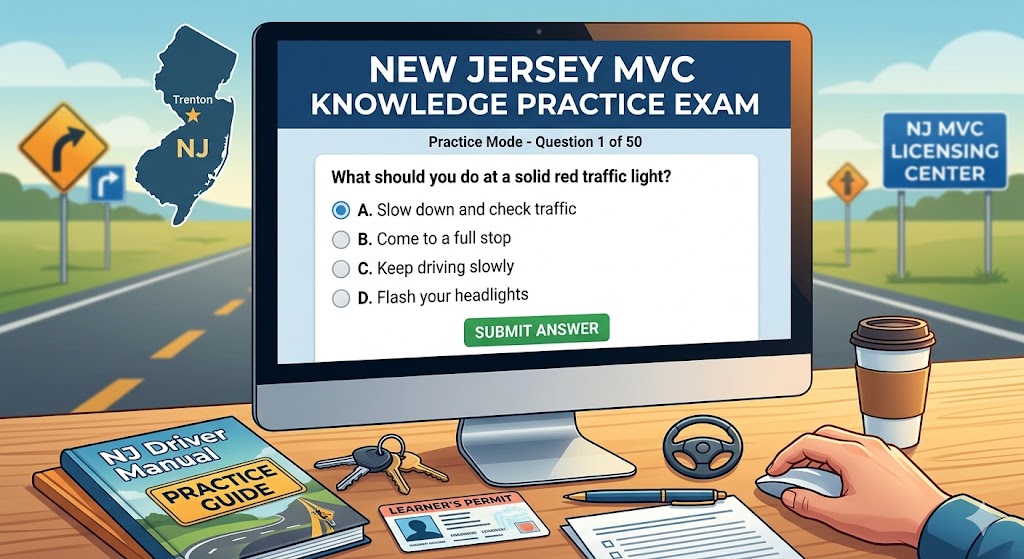
Additional Information
What the Course Entails and Exam Details
While not a structured "course" with a formal syllabus, preparation for the New Jersey knowledge test (and thus the focus of high-quality practice tests) centers entirely on the official NJ Driver Manual.
The core topics, syllabus, or skills covered are vast and include:
Understanding diverse traffic signs and signals.
New Jersey's specific rules of the road for right-of-way, speeding, and parking.
Detailed information on driver responsibility and safety regulations.
Laws regarding driving under the influence of alcohol and drugs.
Defensive driving techniques and general vehicle control.
Information essential for special populations, including teenage drivers.
Procedures for obtaining and maintaining a driver's license.
Sharing the road with pedestrians, cyclists, and other vehicles.
What to Expect in the Final Exam
The actual New Jersey MVC knowledge exam is a standardized test, typically multiple-choice and computer-based.
Students should be prepared for the following exam format details and general guidelines:
The test usually consists of 50 comprehensive multiple-choice questions directly pulled from the NJ Driver Manual.
To achieve a passing score, you must answer at least 80% (40 out of 50) of the questions correctly.
The exam environment is controlled and monitored at specific MVC locations.
While there may not be a strict, universally-announced time limit, standard test conditions mean you will need to answer questions within a reasonable period, and once a question is answered and submitted on the computerized system, it cannot typically be revisited.
You are not permitted to use any notes, manuals, or electronic devices during the exam.
Make sure you have all required documentation, including proper identification, when you arrive for your scheduled appointment.
How to Study and Exam Centers
For actionable study strategies, the first and most vital resource is the official NJ Driver Manual; read it thoroughly, multiple times if possible.
Consistently practice using various reputable New Jersey MVC practice tests. This helps identify weak areas and get accustomed to the question phrasing.
Try different types of practice, including timed sessions, and focus on both official and diverse, high-quality third-party resources.
Create flashcards for tricky road signs, specific legal limits, and common rules.
Join study groups or discuss driving scenarios with experienced drivers.
When it comes to the real thing, the final knowledge test is administered only at specific physical MVC testing centers and authorized driver licensing agencies throughout New Jersey. You cannot take the initial knowledge test online from home.
You must make an appointment for your knowledge test through the official MVC website and ensure you bring required items such as your examination permit, appropriate 6 Points of ID, and proof of social security.
Job Opportunities from the Course
While the New Jersey MVC Knowledge Practice Test itself isn't a professional certification, successfully passing the actual knowledge exam is the very first critical requirement for obtaining a New Jersey learner's permit, eventually a probationary license, and finally, a basic driver's license.
Having a valid, unrestricted driver's license unlocks and is often a prerequisite for a multitude of specific job titles and career paths:
Delivery Driver (food, packages, medical supplies)
Route Sales Representative
Transport Driver (rideshare, patient transport, some shuttle services)
Long-haul and Short-haul Truck Driver (with additional CDL endorsement)
Service Technician (HVAC, plumbing, electrical) with travel requirements
Construction Worker, Project Manager, or Inspector (visiting various job sites)
In-Home Healthcare or Social Work (visiting clients at their homes)
Field Sales and Account Management roles
Law Enforcement and Emergency Services
Various jobs in logistics, supply chain, and fleet management
Frequently Asked Questions
Reviews
5.0
Based on 0 reviews
Leave a Review
No reviews yet. Be the first to review!