
New York Boaters Certification Practice Exam
$69.00
- Buy to unlock unlimited access to all Quiz questions and Answers in this Quiz.
- After purchase you can print a PDF of the whole quiz at any point. The PDF will contain the questions and the correct answers.
About this Exam
The New York Boaters Certification, officially known as the New York State Boating Safety Certificate, is a mandatory credential for operators of motorized vessels and Personal Watercraft (PWCs) on state waterways.
This certification is designed to significantly reduce boating accidents by ensuring all operators possess a fundamental understanding of navigation rules, legal requirements, and emergency procedures.
Whether you are a seasoned sailor looking to comply with new regulations or a first-time boater eager to enjoy New York’s beautiful lakes, rivers, and coastal waters responsibly, this practice test guide is your first step toward certification.
Completing this process is not just about legal compliance; it is about protecting yourself, your passengers, and the environment.
Ready to test your knowledge?
Buy Now to Access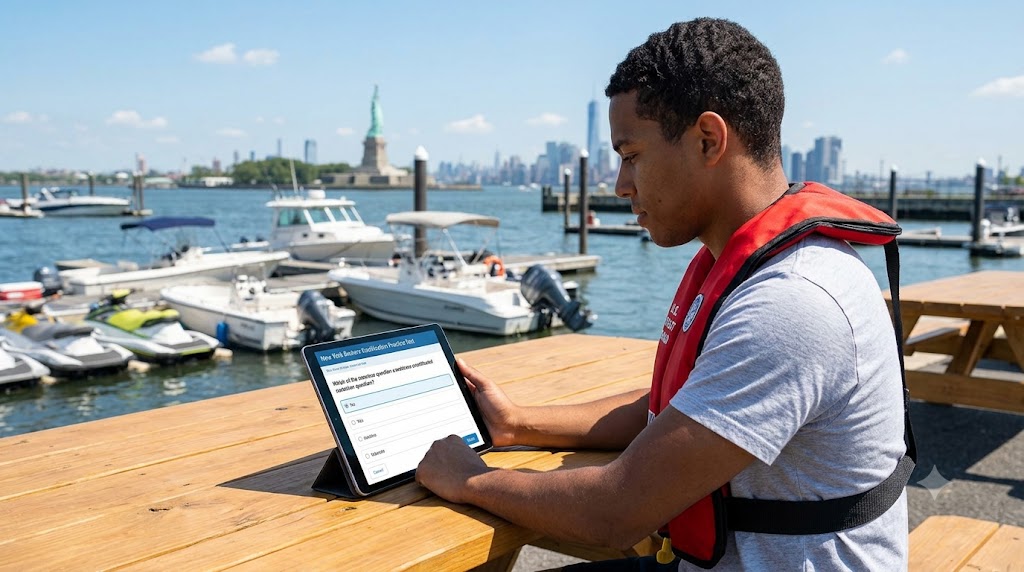
Additional Information
What the Course Entails and Exam Details
The official boater education course typically requires a minimum of eight hours to complete and is designed to build foundational maritime knowledge.
While precise syllabi can vary slightly between state-approved providers, the core curriculum must cover key areas necessary for safe boat operation in New York.
Students can expect to study detailed modules on boat handling, launching and docking, fueling procedures, and required safety equipment such as life jackets and fire extinguishers.
A significant portion of the course focuses on the "Rules of the Nautical Road," teaching students how to interpret buoys, navigation markers, and how to operate safely around other vessels.
Furthermore, students are educated on New York state-specific laws, environmental responsibilities including clean boating practices, and critical emergency response techniques for scenarios like capsizing, onboard fires, or cold-water immersion.
What to Expect in the Final Exam
The New York State Boating Safety Exam is designed to verify your retention of the material covered during the eight-hour course.
You should prepare for a final assessment consisting of multiple-choice questions that objectively test your knowledge.
While the exact number of questions can vary slightly by official test provider, the exam typically includes between 50 and 60 questions.
To pass and earn your lifetime certificate, you generally need to achieve a score of 80% or higher.
It is important to remember that most state-approved providers offer two attempts to pass the final exam without requiring you to retake the full educational course.
How to Study and Exam Centers
Effective preparation is key to passing the New York State Boating Safety Exam on your first try.
Your most valuable resource is an officially approved New York Boaters Certification Practice Test, which replicates the format and topic distribution of the final assessment, allowing you to identify your weak points.
We recommend focusing your study efforts particularly on navigation rules, interpreting buoys, and New York’s specific legal requirements, as these areas often comprise a large portion of the exam.
Because New York requires an approved educational course before the exam, students have two main pathways to certification: online or in-person.
Most residents prefer the convenience of online learning through authorized portals like Boat-Ed or BOATsmart!, where you can study at your own pace and take the final exam immediately upon completing the modules from your own home.
Alternatively, you may seek in-person classes through authorized schools, local marinas, or organizations like the U.S. Coast Guard Auxiliary and the United States Power Squadrons, which offer traditional classroom settings with instructors.
Job Opportunities from the Course
While many boaters seek this certification to enjoy recreational boating legally under state regulations, possessing a New York Boating Safety Certificate can also unlock several relevant career paths in the marine industry.
Here is a clear list of specific job titles and career paths this certification helps unlock:
Marinas and Boat Clubs: Dockhand, Marina Assistant, Boat Rental Agent.
Eco-Tourism and Recreation: Small Charter Launch Operator, Fishing Guide (non-mastered vessels), Eco-Tour Guide.
Instruction: Assistant Sailing or Boating Instructor.
Commercial Support: Boat Skimmer Operator, Marine Debris Recovery Specialist, Vessel Delivery Assistant.
Maintenance: Marine Service Technician Apprentice.
Safety: Summer Seasonal Marine Patrol Officer (depending on specific agency requirements).
Foundation for Captain’s License: This certificate serves as an ideal educational foundation if you intend to pursue a U.S. Coast Guard (USCG) Merchant Mariner Credential for higher-level commercial employment.
Frequently Asked Questions
Reviews
5.0
Based on 0 reviews
Leave a Review
No reviews yet. Be the first to review!