
New York Correctional Officer Practice Exam
$69.00
- Buy to unlock unlimited access to all Quiz questions and Answers in this Quiz.
- After purchase you can print a PDF of the whole quiz at any point. The PDF will contain the questions and the correct answers.
About this Exam
The New York Correctional Officer screening process is the crucial first step toward a rewarding career as a Peace Officer within the New York State Department of Corrections and Community Supervision (DOCCS) or various local county and municipal correctional agencies. This certification process is designed for motivated, principled individuals committed to maintaining public safety and rehabilitation within the justice system. It is not merely an educational course but a multi-stage examination designed to identify candidates with the necessary cognitive abilities, physical aptitude, integrity, and situational judgment required to manage the unique challenges of a correctional environment. Success in this entire process is mandatory before an individual can be appointed as a Correction Officer Trainee and advance to the full Academy training program.
Ready to test your knowledge?
Buy Now to Access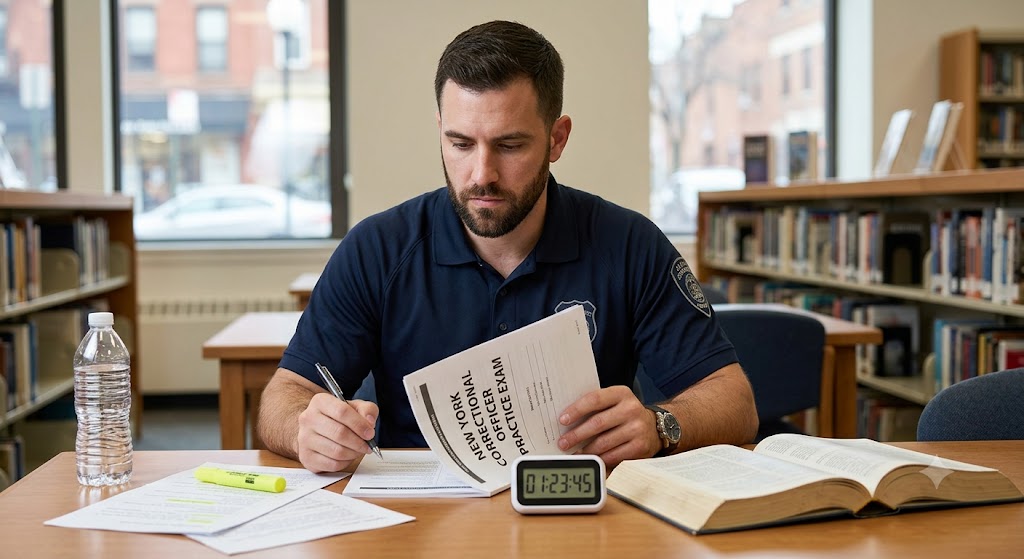
Additional Information
What the Course Entails and Exam Details
This examination is not structured as a conventional classroom course with a rigid syllabus; rather, it is a comprehensive competency assessment comprising several distinct parts.
The screening focuses on the foundational skills required of any effective Peace Officer:
Cognitive Abilities: Depending on the specific jurisdiction (NYS State vs. New York City, or specific counties), candidates may face a written examination or a structured Training and Experience (T&E) Questionnaire that evaluates key attributes such as:
Reading Comprehension: The ability to understand and apply complex written rules, procedures, and legal guidelines.
Report Writing: Evaluates clarity, grammar, vocabulary, and the capacity to accurately document incidents.
Logical Reasoning & Observational Skills: The capability to analyze data, spot inconsistencies, and make sound, defensible judgments under pressure.
Situational Judgment & Problem-Solving: Applying protocols to hypothetical scenarios commonly encountered in correctional settings.
Background and Character Investigation: A rigorous verification of identity, employment history, education, criminal record, and credit history to ensure moral fitness.
Qualifying Physical Fitness Test (PFT): Candidates are assessed on their cardiovascular capacity, muscular strength, and agility, typically through timed events like sprints, push-ups, sit-ups, or obstacle courses.
What to Expect in the Final Exam
While some local jurisdictions maintain a classic written multiple-choice cognitive test, the primary method for NYS DOCCS candidates is often a structured online Training and Experience (T&E) Questionnaire, supplemented by other screening stages.
Therefore, the "final exam" experience for this career pathway involves several milestones:
Format:
Cognitive Screening: If a multiple-choice written exam is used (e.g., NYC Department of Correction), it often covers the cognitive areas listed in Section 2. The newer NYS DOCCS focus uses the T&E format, which is an online questionnaire where candidates answer structured questions regarding their past education, employment, and experiences related to peace officer competencies.
Physical Fitness: This is a physical performance test, scored on a pass/fail basis against established standards.
Evaluations: Standardized medical and psychological examinations are conducted by professionals.
Time Limits: Written cognitive exams typically have a 2- to 3-hour time limit. The PFT components are timed individually. T&E questionnaires generally have an expiration date for submission rather than a strict timed session.
Passing Score Requirements: For cognitive written exams, a score of 70% or higher is commonly the required baseline to pass and be placed on the eligible list, although a higher score is necessary to remain competitive in a large pool of applicants. The T&E questionnaire uses a complex scoring rubric to rank candidates based on their structured responses, and applicants must meet a minimum "pass" threshold. The PFT and medical/psychological evaluations are strictly qualifying (pass/fail).
Specific Rules: Misrepresentation on the T&E or during the background check is grounds for automatic disqualification. Adherence to strict scheduling for PFT and medical exams is non-negotiable.
How to Study and Exam Centers
Preparation must address every component of the screening process. Because Correctional Officers are designated as Peace Officers, candidates must familiarize themselves with the ethical and operational mindset of the profession.
Cognitive Prep:
Use Practice Exams: For jurisdictions using a written multiple-choice format, practice tests focusing on Civil Service cognitive skills, particularly situational judgment and observation, are essential.
T&E Strategy: The T&E questionnaire is not a random survey; it is an exam of your career history. Study the official job description of a New York Correction Officer. Before answering, reflect deeply on your own history, identifying specific examples where your previous roles required leadership, integrity, adherence to protocol, observation, or conflict resolution. Answer those structured questions accurately, highlighting those transferable peace officer skills.
Reading Comprehension: Practice reading and summarizing legal procedures or technical manuals.
Physical Prep:
Train for the PFT Standards: Do not wait for an exam notice. Obtain the specific physical fitness requirements for the testing agency (e.g., NYS DOCCS requirements include endurance, strength, and cardiovascular capability) and begin a rigorous, progressive workout regimen focused on those exact components (cardio, strength training, agility drills).
Where to Take the Exam/Exam Centers:
State Civil Service: For NYS DOCCS Correction Officer Trainee positions, you must apply continuously through the New York State Department of Civil Service website (www.cs.ny.gov/jobseeker). Most cognitive screening (like the T&E) is conducted through an online portal from any location with internet access.
PFT and Medical: These components are scheduled on-site. The PFT and medical screenings for state trainees are typically conducted at the DOCCS Training Academy in Albany, NY, or regional testing centers throughout New York State.
Local Jurisdictions: For county or NYC positions, you must apply directly with the relevant local civil service commission or Department of Correction (e.g., NYC.gov/DCAS). Written exams or PFT components are usually held at designated authorized physical test centers within that specific county or within NYC.
Job Opportunities from the Course
Successfully navigating the New York Correctional Officer screening process unlocks a structured career path with competitive pay, standard government benefits (including medical and dental insurance, paid leave, and retirement benefits), and promotional opportunities.
Completing this screening leads to the following job titles and career paths:
Correction Officer Trainee (the standard entry-level position)
Correction Officer (after successful completion of the probationary 12-month training program)
Correction Officer (Spanish Language) (for qualified candidates in designated positions)
Senior Correction Officer
Correction Sergeant
Correction Lieutenant
Correction Captain
Correctional Facility Administrator/Superintendent (career advancement through managerial ranks)
Specialized Units (e.g., Specialized Response Teams, SORT; Investigator)
Frequently Asked Questions
Reviews
5.0
Based on 0 reviews
Leave a Review
No reviews yet. Be the first to review!