
New York Falconry License Practice Exam
$69.00
- Buy to unlock unlimited access to all Quiz questions and Answers in this Quiz.
- After purchase you can print a PDF of the whole quiz at any point. The PDF will contain the questions and the correct answers.
About this Exam
Are you passionate about working with birds of prey and looking to enter the ancient art of falconry in the Empire State?
The New York Falconry License is a mandatory requirement managed by the Department of Environmental Conservation (NYSDEC) for anyone wishing to possess and train raptors for hunting.
This license ensures that practitioners understand the ethical responsibility, biological knowledge, and legal constraints required for the safety of both the falconer and the wildlife.
It is designed for individuals seeking to become Apprentice Falconers under the guidance of a qualified sponsor.
Ready to test your knowledge?
Buy Now to Access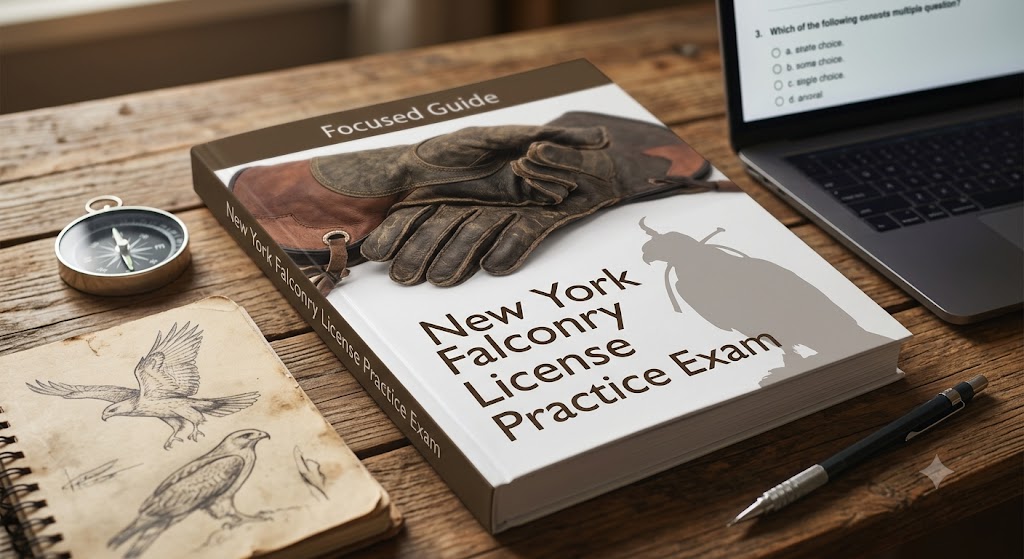
Additional Information
What the Course Entails and Exam Details
Successfully preparing for the NYSDEC falconry exam requires masterly knowledge across several critical domains.
A comprehensive study guide will cover raptor identification and biology, essential for recognizing different species and understanding their natural history.
You must understand falconry equipment, known as furniture, including jesses, leashes, bells, and hoods, and how to maintain them.
Considerable focus is placed on raptor management, which includes properly housing (mews and weathering areas), feeding, and maintaining the daily health of your bird.
Crucial sections involve training techniques, moving from the first days of a bird's capture to active hunting.
Finally, you must be well-versed in New York State and federal falconry regulations, ethics, and the safe handling of firearms and other hunting equipment.
What to Expect in the Final Exam
The actual examination is a rigorous assessment administered directly by the New York State Department of Environmental Conservation (NYSDEC).
The test typically consists of multiple-choice and true/false questions designed to thoroughly challenge your knowledge of raptor biology, care, and regulations.
Candidates can generally expect around 100 questions covering the broad syllabus.
To pass and secure your apprentice license, a minimum score of 80 percent is required.
There is usually a generous time limit, often around two to three hours, which allows for careful reading of each scenario-based question.
The exam is often offered at specific times of the year and may require preregistration and a nominal application fee.
How to Study and Exam Centers
Preparing effectively requires a blend of theoretical study and practical exposure.
Start by obtaining and thoroughly reading the official "New York State Falconry Examination Manual" provided by the NYSDEC, which is the cornerstone of the exam.
Create digital or physical flashcards to memorize species identification, equipment terms, common raptor diseases, and legal seasons.
Utilizing a practice test is highly recommended; it helps familiarize you with the question formatting and highlights areas where your knowledge needs improvement.
Crucially, begin searching for a sponsor—a General or Master Falconer—early in the process, as their practical guidance and experience will provide context that books cannot offer.
Regarding exam centers, you cannot take this test online; it must be completed at a designated physical location.
The DEC typically administers the exam at various NYSDEC regional offices throughout the state on specific dates, which are announced well in advance.
Job Opportunities from the Course
While falconry is often practiced as a serious personal sport and hunting methodology, obtaining this license can also support diverse professional trajectories involving birds of prey.
A licensed falconer may find unique opportunities within bird abatement, utilizing raptors to manage nuisance birds on properties like airports, agricultural lands, or golf courses.
Opportunities exist in wildlife rehabilitation, where your handling and husbandry skills can contribute significantly to releasing injured birds back into the wild.
The license enhances qualifications for roles in environmental education and public demonstration, where you educate the public on wildlife conservation and biology.
You might pursue positions as a research technician, assisting in academic or government studies on raptor populations and behavior.
For some, it is a stepping stone to operating a state-authorized educational raptor facility or sanctuary.
Additionally, it can bolster careers in professional wildlife writing, photography, and film production that require specialized animal handling knowledge.
Frequently Asked Questions
Reviews
5.0
Based on 0 reviews
Leave a Review
No reviews yet. Be the first to review!