
New York Private Investigator Exam Study Guide
$69.00
- Buy to unlock unlimited access to all Quiz questions and Answers in this Quiz.
- After purchase you can print a PDF of the whole quiz at any point. The PDF will contain the questions and the correct answers.
About this Exam
The New York Private Investigator Regulations practice exam is an indispensable preparatory tool designed specifically for aspiring private investigators seeking licensure within the state of New York. This comprehensive practice assessment is tailored to align precisely with the legal and ethical framework established by the New York Department of State, Division of Licensing Services. By engaging with these practice questions, candidates can critically self-evaluate their comprehension of essential NYS laws, ethical guidelines, and investigative protocols. This exam simulation is crafted to ensure potential investigators are fully prepared to navigate the complexities of real-world cases while adhering strictly to statutory requirements, making it a pivotal step for anyone aiming to establish a successful and compliant investigative practice in New York.
Ready to test your knowledge?
Buy Now to Access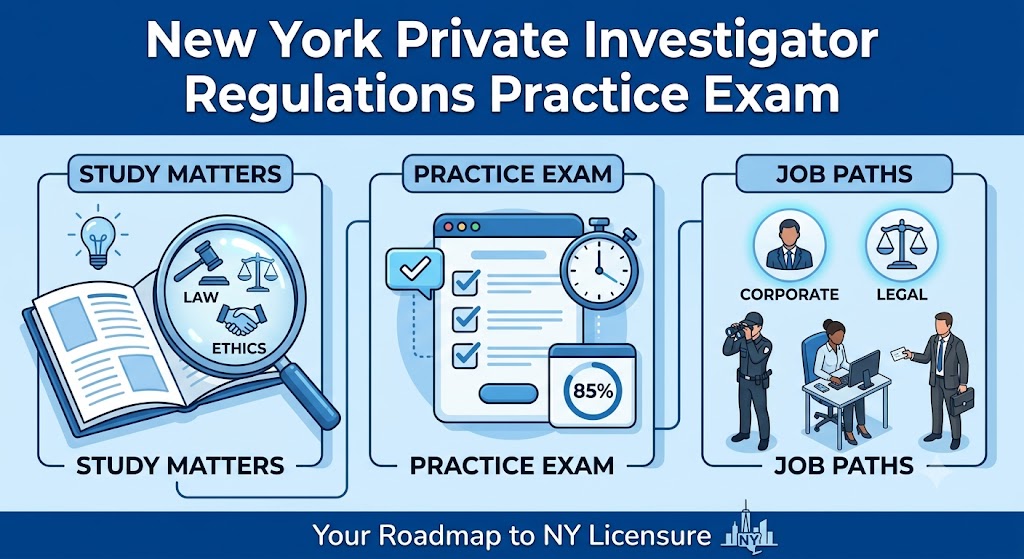
Additional Information
What the Course Entails and Exam Details
The focus of this practice guide and the underlying regulatory knowledge it tests is strictly centered on the Laws, Rules, and Regulations governing the private investigative industry in New York State. Candidates must demonstrate deep understanding of key legal tenets to operate legally and ethically.
Core Legal Frameworks (New York State Specific):
NY General Business Law Article 7 (The primary statute regulating PIs)
NY General Business Law Article 7-A (Security Guard Act related provisions)
Official Compilation of Codes, Rules and Regulations of the State of New York (NYCRR) Title 19, Part 170
Critical Topics Covered in Practice:
Licensure Requirements & Renewals: Understanding eligibility criteria, background checks, bond requirements, and the process for maintaining licensure validity.
Permissible & Prohibited Business Practices: Distinguishing between lawful investigative techniques and activities that violate state or federal law (e.g., electronic surveillance laws, wiretapping, trespassing).
Client Confidentiality & Record Keeping: Strict adherence to privacy regulations and mandated documentation practices required by the Department of State.
Advertising & Marketing Compliance: Rules governing how private investigators can legally market their services and represent themselves to the public.
Disciplinary Procedures & Penalties: Understanding the consequences of regulatory violations, including license suspension or revocation.
Employee Supervision: Regulations concerning the hiring, training, and oversight of any employees or independent contractors working under the lead investigator's license.
Interactions with Law Enforcement: Proper protocols for engaging with official police investigations.
What to Expect in the Final Exam
While the exact structure of the official licensing exam administered by the New York Department of State may vary, this practice exam is designed to simulate the general format and difficulty. The practice material focuses exclusively on testing the application of regulations to scenarios.
Predicted Exam Format:
Question Type: Predominantly multiple-choice questions (e.g., 50 to 100 questions).
Focus: A combination of direct regulatory knowledge questions and scenario-based questions where the candidate must determine the legal or compliant course of action.
Passing Score: The official passing score is determined by the NY Department of State, but a high percentage (typically 70% or above) is expected for licensure.
Time Limit: A defined time window (e.g., 90 to 120 minutes) designed to test efficiency in recalling regulatory information.
Critical Considerations:
Open Book? The official exam is generally a closed-book examination. This practice guide emphasizes memorization and immediate recall of regulatory details.
Scenario Focus: Many questions will not simply ask to recite a law; they will present a scenario (e.g., a surveillance request, a client confidentiality situation) and ask for the compliant response based on NY PI regulations.
How to Study and Exam Centers
Preparation for the New York Private Investigator Regulations exam demands diligent study, as regulatory knowledge is binary—you either know the law or you do not.
Targeted Study Strategies:
Direct Study of NYS Statutes: Download and thoroughly read NY General Business Law, Article 7, and the corresponding NYCRR sections (Title 19, Part 170). These are the definitive sources for the exam content. Highlight key sections, prohibitions, and timelines.
Scenario Simulation: Active recall is essential. When studying a specific regulation (e.g., regarding the use of GPS tracking), create hypothetical investigation scenarios and decide how the law applies. The practice exam helps simulate this mental process.
Utilize Practice Exams Repeatedly: Take this practice exam multiple times. Review all answers, understanding not just which answer is correct, but why it is correct based on the specific wording of New York law. This identifies knowledge gaps in specific regulatory areas.
Create Flashcards: Make digital or physical flashcards for definitions, license renewal timelines, specific fine amounts, and prohibited practices.
Official Department of State Resources: Monitor the New York Department of State, Division of Licensing Services website for any regulatory updates or official exam content outlines.
Where to Take the Official Exam:
The actual licensure examination for Private Investigators in New York is administered directly by the NYS Department of State. Candidates generally cannot take this exam online and must schedule a physical test slot at authorized NYS testing sites. To register, visit the New York Division of Licensing Services Private Investigator page. They provide information on upcoming exam dates and locations across the state, often including sites in major cities such as New York City, Albany, and Syracuse. Registration and scheduling must be completed through the official state portal.
Job Opportunities from the Course
Earning licensure as a New York Private Investigator opens numerous career paths in the lucrative and high-demand specialized investigative sector. Compliance knowledge is a critical skill for all these roles.
Career Paths and Job Titles:
Sole Proprietor PI (Starting Your Own NY Investigation Firm)
Corporate Investigator (Internal fraud, loss prevention, intellectual property theft)
Insurance Fraud Investigator (SIU)
Legal Investigator (Working for law firms on civil and criminal litigation)
Missing Persons Investigator
Background Investigator (For government or sensitive corporate vetting)
Due Diligence Specialist (Investigating businesses for mergers/acquisitions)
Contract Investigator (For large investigative agencies)
Skip Tracing/Asset Recovery Specialist
Frequently Asked Questions
Reviews
5.0
Based on 0 reviews
Leave a Review
No reviews yet. Be the first to review!