
New York State EMT-B Practice Exam
$69.00
- Buy to unlock unlimited access to all Quiz questions and Answers in this Quiz.
- After purchase you can print a PDF of the whole quiz at any point. The PDF will contain the questions and the correct answers.
About this Exam
This exam is designed for individuals seeking to become certified Basic Emergency Medical Technicians (EMT-B) in the state of New York. The certification validates the knowledge and skills necessary to provide basic emergency medical care and transportation for critical and emergent patients. It is intended for aspiring first responders, ambulance personnel, and healthcare professionals looking to advance their careers. This exam assesses understanding of fundamental EMT principles, protocols, and best practices.
Ready to test your knowledge?
Buy Now to Access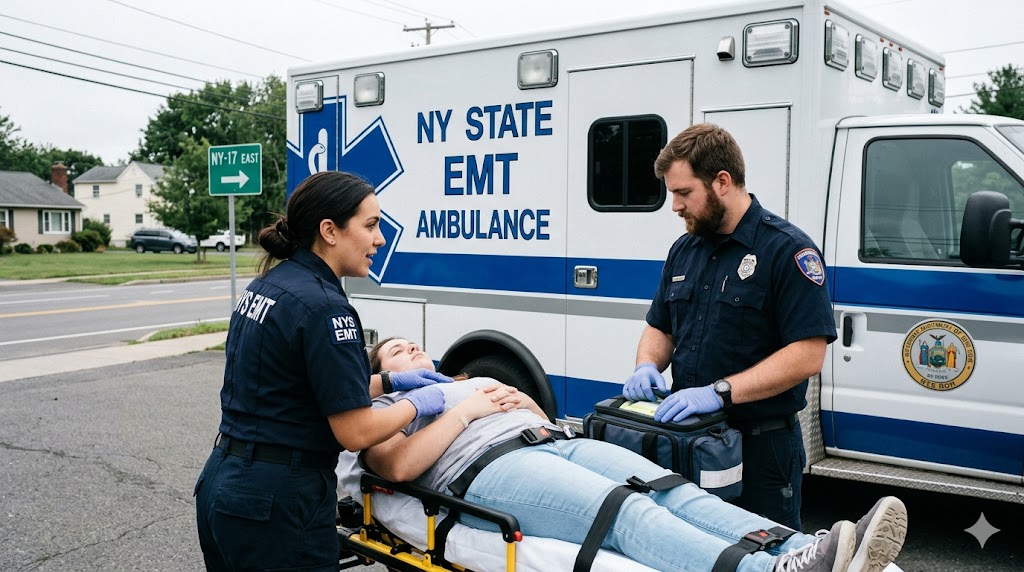
Additional Information
What the Course Entails and Exam Details
The course covers a broad spectrum of topics related to emergency medical care. Key areas include:
Preparatory: Introduction to EMS systems, legal and ethical issues, and workforce safety and wellness.
Airway: Advanced airway management techniques, oxygen administration, and suctioning.
Assessment: Comprehensive patient assessment, including scene size-up, primary survey, and secondary survey.
Medical Emergencies: Management of medical emergencies, including respiratory distress, cardiac arrests, and neurological emergencies.
Trauma: Management of traumatic injuries, including fractures, dislocations, and hemorrhage control.
Obstetrics/Gynecology: Care for pregnant patients and newborns, including childbirth and neonatal resuscitation.
Pediatrics: Pediatric emergencies and assessment.
Special Considerations: Geriatric care and special populations.
EMS Operations: Ambulance operations, disaster response, and scene management.
The exam details are:
Format: Multiple-choice questions.
Number of Questions: Approximately 100 questions.
Time Limit: Roughly 2 hours.
Passing Score: A passing score of 70% or higher is typically required.
Mode: The written exam is administered in person at designated testing centers.
What to Expect in the Final Exam
The final exam consists of a written multiple-choice test and a practical skills assessment. The written portion is a standardized test that evaluates the candidate's understanding of the EMT-B curriculum. Questions are designed to test application of knowledge and problem-solving skills in simulated emergency scenarios. The practical assessment involves a series of stations where candidates are evaluated on their ability to perform specific EMT skills, such as:
CPR and AED: Proper performance of cardiopulmonary resuscitation and automated external defibrillator operation.
Airway Management: Techniques for managing an airway, including suctioning and oxygen delivery.
Immobilization: Stabilization of injured body parts, including spinal immobilization and splinting.
Patient Assessment: Performing a systematic patient assessment.
Medication Administration: Proper administration of basic EMT medications.
Candidates must pass both the written and practical examinations to achieve certification.
How to Study and Exam Centers
Effective preparation is key to success. Here are some actionable study strategies:
Review the Official Curriculum: Study the New York State EMT-B curriculum thoroughly.
Practice with Mock Exams: Take practice exams to identify areas of weakness and become familiar with the exam format.
Review Key Concepts: Focus on high-yield topics, such as patient assessment and medical emergencies.
Create Flashcards: Use flashcards to memorize key terms, definitions, and algorithms.
Practice Practical Skills: Practice practical skills consistently to build muscle memory and confidence.
Utilize Study Guides: Use comprehensive study guides to reinforce learning.
The New York State EMT-B exam is typically administered at authorized testing centers, which may include educational institutions or contracted testing organizations. Candidates will need to register for the exam through the appropriate channels, often after successfully completing an approved EMT-B training course.
Job Opportunities from the Course
A NY State EMT-B certification opens doors to various job opportunities, including:
Basic Emergency Medical Technician: Provide basic life support and transportation for patients.
Ambulance Driver: Transport patients in a medical vehicle.
First Responder: Respond to emergency calls and provide initial medical care.
Firefighter: Many fire departments require or prefer EMT certification.
Police Officer: EMT skills are highly valued in law enforcement.
Security Officer: EMT certification is a strong asset for security personnel.
Healthcare Assistant: Work in hospitals or clinics under the supervision of advanced medical professionals.
Lifeguard: EMT certification is often required for lifeguards at beaches and pools.
Search and Rescue: Participate in search and rescue operations with EMT training.
Event Medic: Provide medical coverage for sports events and concerts.
Frequently Asked Questions
Reviews
5.0
Based on 0 reviews
Leave a Review
No reviews yet. Be the first to review!