
New York State Police Trooper Practice Exam
$69.00
- Buy to unlock unlimited access to all Quiz questions and Answers in this Quiz.
- After purchase you can print a PDF of the whole quiz at any point. The PDF will contain the questions and the correct answers.
About this Exam
The New York State Police Trooper entrance exam is the crucial first step on the path to a challenging and rewarding career in law enforcement. Designed for individuals with a commitment to public service and a desire to make a difference in their communities, this comprehensive assessment evaluates the fundamental skills and aptitudes required to excel as a State Trooper. Succeeding on this exam is essential for advancing in the selection process and gaining admittance to the prestigious New York State Police Academy, where troopers receive their world-class training.
Ready to test your knowledge?
Buy Now to Access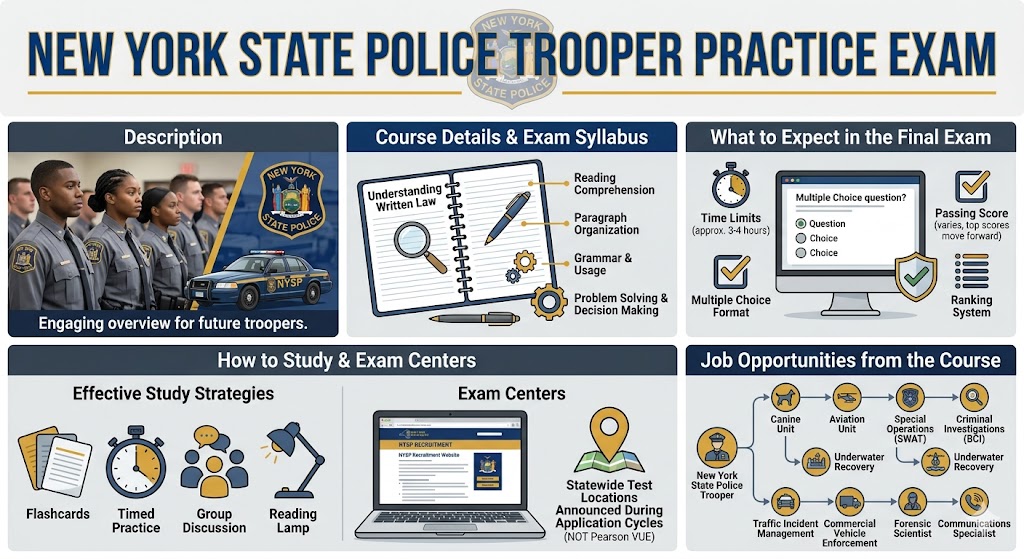
Additional Information
What the Course Entails and Exam Details
A thorough study course and subsequent practice exam for the New York State Police Trooper position are meticulously structured to cover the key cognitive areas critical for policing. Unlike many purely knowledge-based exams, this assessment focuses heavily on evaluating your ability to learn, reason, and make sound judgments in various situations. The core topics, skills, and syllabus areas covered in depth typically include:
Understanding and Interpreting Written Material: Your ability to read complex information, comprehend its meaning accurately, and make logical inferences is essential for report writing, understanding laws, and analyzing evidence.
Preparing Written Material (Paragraph Organization and Grammar/Usage): Mastering clear, concise, and grammatically correct written communication is vital for documenting incidents, completing reports, and effectively conveying critical information in writing.
Applying Written Law Enforcement Information: Can you read detailed policies, regulations, and legal descriptions and apply that specific information to practical scenarios? This skill is tested rigorously through questions that present real-world situations and ask for the appropriate legal response.
Solving Problems and Making Decisions: Effective law enforcement officers must be able to quickly evaluate facts, identify core issues, weigh different options, and determine the most effective and appropriate course of action, even under pressure.
What to Expect in the Final Exam
The actual New York State Police Trooper entrance exam is a demanding, multi-hour assessment. It is primarily presented in a multiple-choice format, requiring you to carefully analyze questions and select the single best answer from several options. While the precise details and passing scores can evolve with each exam administration cycle, candidates generally have approximately three to four hours to complete all sections. Achieving a high score is paramount, as candidates are typically ranked based on their performance, with top scorers moving forward first to the next stages of the recruitment process.
How to Study and Exam Centers
How to Study and Practice:
Practice with Real-World Scenarios: The most effective preparation involves replicating the exam conditions as closely as possible. Utilize high-quality practice tests that feature legal passages, written materials, and complex situational judgment questions similar to those you'll encounter on the actual exam day.
Develop Strong Reading and Analytical Skills: Read widely, particularly news articles, legal summaries, and instructional texts. Practice summarizing information and identifying key points.
Master Reasoning and Critical Thinking: Work through logic puzzles, practice decision-making scenarios, and focus on evaluating all relevant factors before drawing a conclusion.
Hone Writing Skills: Review grammar and usage rules, practice organizing paragraphs logically, and strive for clear, precise communication in all your writing.
Time Yourself and Build Stamina: Practice taking full-length practice tests under realistic time constraints to improve your pacing and build the mental endurance needed for the long exam session.
Exam Centers:
Job Opportunities from the Course
New York State Police Trooper: Your initial role, involving highway patrol, crime prevention, emergency response, and community policing across the state.
Trooper - Canine Unit: Working with specially trained police dogs for tracking, drug detection, and search operations.
Trooper - Aviation Unit: Piloting or operating specialized aircraft for aerial surveillance, search and rescue, and logistical support.
Trooper - Special Operations: Joining elite teams like the Special Weapons and Tactics (SWAT) unit or other specialized task forces.
Trooper - Investigator (Bureau of Criminal Investigation): Conducting in-depth investigations into serious crimes, such as homicides, narcotics trafficking, and organized criminal activity.
Trooper - Underwater Recovery Team: Participating in specialized diving operations for evidence recovery, search and rescue, and homeland security.
Trooper - Traffic Incident Management: Specializing in managing major traffic accidents, implementing safety measures, and coordinating emergency responses on New York's highways.
Trooper - Commercial Vehicle Enforcement: Ensuring the safe and compliant operation of large trucks and buses on state roads.
Trooper - Communications Specialist: Managing critical communications systems and ensuring seamless coordination during police operations and emergencies.
Trooper - Forensic Scientist (State Police Laboratory System): Applying advanced scientific techniques to analyze evidence in diverse fields, such as DNA analysis, toxicology, and drug chemistry.
Frequently Asked Questions
Reviews
5.0
Based on 0 reviews
Leave a Review
No reviews yet. Be the first to review!