
New Zealand EMT CAD Practice Exam
$69.00
- Buy to unlock unlimited access to all Quiz questions and Answers in this Quiz.
- After purchase you can print a PDF of the whole quiz at any point. The PDF will contain the questions and the correct answers.
About this Exam
Prepare for a critical component of emergency medical services in Aotearoa with the New Zealand EMT Computer-Aided Dispatch (CAD) Practice Test. This resource is meticulously designed for individuals training to become Emergency Medical Technicians or those specializing in medical dispatch. This practice test bridges the gap between theoretical knowledge and the high-stakes, real-world application of CAD systems within the New Zealand emergency response framework. Mastering this system is not optional; it is fundamental to ensuring rapid, accurate, and coordinated emergency medical responses.
Ready to test your knowledge?
Buy Now to Access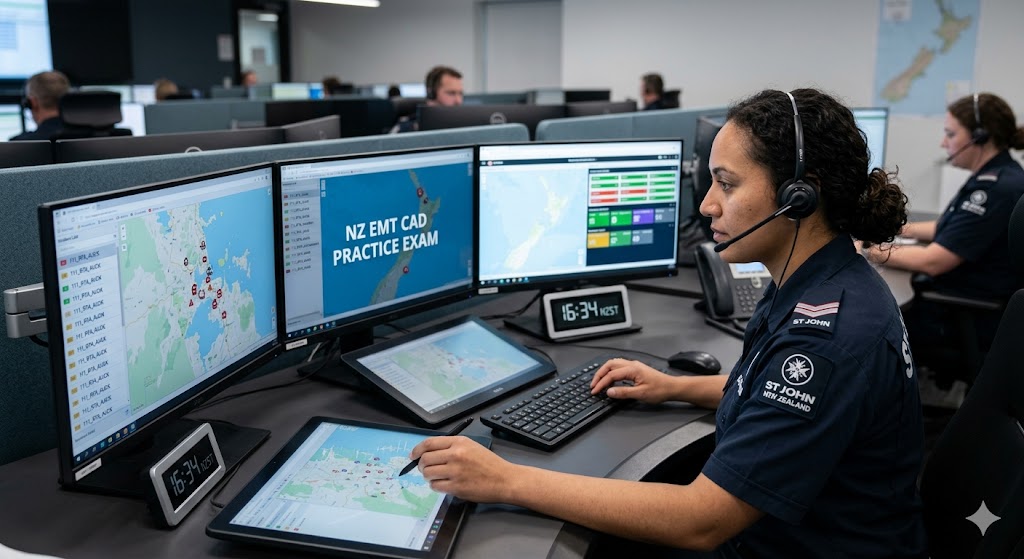
Additional Information
What the Course Entails and Exam Details
The New Zealand EMT CAD Practice Test covers the full spectrum of dispatch skills required by the modern EMT. The core topics focus heavily on understanding and navigating the specific CAD software utilized across New Zealand's emergency services. Candidates must demonstrate proficiency in:
Incident Data Entry: Accurately inputting 111 call information, including the nature of the emergency and precise locations, often using standard protocols.
Resource Management: Identifying and dispatching the closest appropriate EMT units, ambulances, and specialized resources based on location, availability, and skillset.
Geographic Proficiency: Interpreting mapping data, understanding regional boundaries, and optimizing routing for emergency vehicles across diverse New Zealand terrains.
Operational Procedures: Adhering strictly to established communication protocols, radio usage etiquette, and inter-agency coordination procedures, particularly during multi-agency responses.
System Functionality: Navigating the specific features of the New Zealand CAD interface, including standard operating procedures (SOPs) for data management and call prioritization.
The knowledge and skills evaluated align directly with the demanding standards required for efficient and effective emergency medical dispatch.
What to Expect in the Final Exam
The final examination for the New Zealand EMT CAD certification typically utilizes a computer-based format. Candidates can expect a multi-faceted assessment comprising different question types designed to measure cognitive understanding and practical decision-making.
Format: The exam predominantly uses multiple-choice questions to assess a wide range of CAD-related knowledge and scenarios. It may also include simulated scenarios or "point-and-click" tasks to evaluate basic interface navigation and operational decision-making under time constraints.
Time Limit: Candidates are generally given a specific time window, often ranging from 90 to 120 minutes, to complete all sections of the examination. Effective time management is crucial to success.
Passing Score: The required passing score is generally high, often set between 75% and 80%, reflecting the critical nature of dispatch accuracy in emergency services.
Rules: The examination is typically proctored and closed-book, strictly prohibiting the use of outside resources, including textbooks, notes, or unauthorized digital aids.
How to Study and Exam Centers
A multifaceted study approach is highly recommended for success in the New Zealand EMT CAD exam.
Utilize Authorized Resources: Focus your studies primarily on the official training materials, manuals, and standard operating procedures (SOPs) provided by your specific EMT training institution or the relevant emergency services agency. These materials are the foundation of the exam content.
Practice with Simulations: If available, utilize any provided CAD simulation software or practice modules. These hands-on tools are invaluable for developing muscle memory and operational efficiency within the CAD interface.
Develop Scenarios: Create hypothetical emergency calls (e.g., a multi-car accident in central Auckland, a medical emergency on the Heaphy Track) and mentally practice inputting the data and assigning resources within the CAD framework.
Simulate Test Conditions: Practice taking time-limited quizzes and simulating actual test conditions. This helps manage test anxiety and improves the speed of recall and decision-making.
Exam Centers: The exam is typically administered through authorized training centers across New Zealand, such as accredited polytechnics or dedicated training academies within organizations like St John or Wellington Free Ambulance. Candidates register for their specific exam dates and locations directly through these institutions.
Job Opportunities from the Course
Earning certification in New Zealand EMT Computer-Aided Dispatch (CAD) opens multiple specialized career pathways within the emergency medical services sector. This qualification is invaluable for:
Emergency Medical Dispatcher (EMD): Transitioning into a primary role answering 111 calls and managing critical dispatch operations.
Advanced EMT / Paramedic with Dispatch Specialization: Enhancing career progression opportunities within clinical roles by mastering the logistics of dispatch.
Clinical Hub Call Taker: Managing medical triage and initial call assessment in major communications hubs.
Communications Duty Manager (with experience): Leading and supervising teams of dispatchers during emergency response operations.
EMS Logistics Coordinator: Managing resource deployment and operational planning within larger EMS organizations.
Frequently Asked Questions
Reviews
5.0
Based on 0 reviews
Leave a Review
No reviews yet. Be the first to review!