
Newborn Life Support Practice Exam: Your Key to Confident Neonatal Resuscitation
$69.00
- Buy to unlock unlimited access to all Quiz questions and Answers in this Quiz.
- After purchase you can print a PDF of the whole quiz at any point. The PDF will contain the questions and the correct answers.
About this Exam
The Newborn Life Support (NLS) certification is a vital credential for healthcare providers responsible for the initial care and resuscitation of infants at birth. This critical exam assesses your knowledge and practical skills in managing neonatal emergencies during the crucial minutes following delivery. It's specifically designed for physicians, nurses, midwives, paramedics, and respiratory therapists who attend births and provide immediate newborn care, ensuring they have the confidence and capability to stabilize and resuscitate a compromised neonate.
Ready to test your knowledge?
Buy Now to Access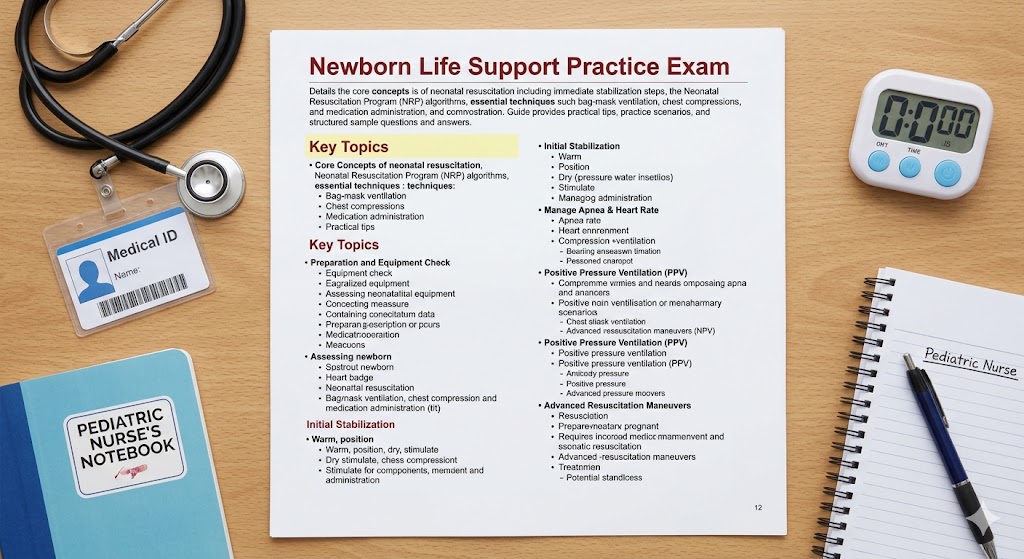
Additional Information
What the Course Entails and Exam Details
This intensive course covers a wide spectrum of neonatal resuscitation topics, usually following the guidelines established by the International Liaison Committee on Resuscitation (ILCOR) or the specific requirements of your regional resuscitation council (like the American Heart Association in the US or the Resuscitation Council UK). You’ll delve into:
Understanding the Transition to Extrauterine Life: How a baby adapts after birth and common factors that complicate this process.
Routine Newborn Care: Standard procedures for healthy newborns.
The Neonatal Resuscitation Algorithm: A structured, step-by-step approach to assessing and managing an infant in distress.
Essential Skills: Mastery of ventilation (especially positive pressure ventilation via bag-mask), chest compressions, vascular access (umbilical catheterization), and medication administration.
Managing Complex Scenarios: Techniques for premature infants, meconium-stained fluid, and specific conditions like congenital diaphragmatic hernia.
Post-Resuscitation Care: Monitoring and stabilization procedures after initial resuscitation.
Effective Teamwork and Communication: Critical soft skills for seamless collaboration in high-stakes neonatal resuscitation settings.
The exam usually consists of a theoretical assessment (typically multiple-choice questions) and a practical, scenario-based evaluation where you must demonstrate key resuscitation skills in a simulated environment. Check with your local training center for specific details on length and format.
What to Expect in the Final Exam
While exact details depend on the specific training body and country, here's a general overview of what you can expect during your final Newborn Life Support exam:
Exam Format: Most certifications involve both a written (multiple-choice or short-answer) test to assess your theoretical knowledge and a practical skill station assessment where you must successfully manage simulated neonatal resuscitation scenarios, demonstrating competence in airway management, ventilation, chest compressions, and team leadership.
Passing Score Requirements: Passing requirements differ across organizations. Aim for a high standard, typically around 80% or more for the written component. Practical assessments are usually pass/fail based on correct application of techniques within required timelines.
Time Limits: The written portion often has a specific time limit (e.g., 60-90 minutes). Practical scenarios are typically shorter, focusing on immediate, correct action within critical response windows.
Specific Rules: You may be allowed access to official guidelines or algorithms during certain parts of the assessment, though rote memory and swift action are prioritized in practical scenarios. Prior preparation is key to confidence and accuracy in both exam formats.
How to Study and Exam Centers
Successfully passing the Newborn Life Support exam requires diligent study and hands-on practice. Here are actionable strategies:
Master the Algorithm: The resuscitation flow chart is your compass. Understand every step and decision point thoroughly. Create flow chart diagrams or use flashcards to reinforce your memory.
Study Official Guidelines: Focus intensely on the current guidelines provided by your local resuscitation council or official course manual. These are your ultimate source of truth for the exam.
Simulate Scenarios: Partner with colleagues or use medical simulation software to practice running entire resuscitation scenarios. Mimicking real-life pressures is invaluable for honing your critical thinking and procedural skills.
Take Practice Exams: Dedicate time to answering practice questions under timed conditions to familiarize yourself with the question types and improve your speed.
Attend a Review Course: Many authorized schools offer refresher or exam-prep workshops that condense key concepts and provide practical practice time with instructors.
Where and how to take the exam varies. You can find authorized testing facilities through:
Official Resuscitation Council Websites: Use their online portals to find approved training providers and testing centers near you.
Hospital and Healthcare Institutions: Many large hospitals manage their own accredited Newborn Life Support programs for staff.
Accredited Training Schools: Numerous educational institutions specialize in providing certified medical resuscitation courses and exams.
Search for local chapters: Look for organizations like the American Heart Association (AHA), the American Academy of Pediatrics (AAP), or equivalent national bodies for lists of certified instructors and centers in your region.
Job Opportunities from the Course
A Newborn Life Support certification significantly boosts your resume, validating your ability to care for vulnerable neonates. It's often mandatory or highly preferred for roles such as:
Neonatal Nurse (NICU Nurse)
Obstetrical Nurse (Labor and Delivery Nurse)
Pediatrician
Neonatologist
Midwife
Respiratory Therapist (especially in NICU/L&D settings)
Paramedic/EMT (providing critical pre-hospital neonatal care)
Neonatal Resuscitation Program (NRP) Instructor
Frequently Asked Questions
Reviews
5.0
Based on 0 reviews
Leave a Review
No reviews yet. Be the first to review!