
NFPA 1035 Educator Level 1 Practice Exam
$69.00
- Buy to unlock unlimited access to all Quiz questions and Answers in this Quiz.
- After purchase you can print a PDF of the whole quiz at any point. The PDF will contain the questions and the correct answers.
About this Exam
The National Fire Protection Association (NFPA) 1035 Fire and Life Safety Educator Level 1 Certification is a vital benchmark for individuals dedicated to reducing community risks.
This certification is designed for diverse professionals, including fire service personnel, public health workers, and community advocates, who are responsible for delivering life-saving safety education to the public.
It validates that a candidate has the fundamental knowledge and skills to identify community hazards, implement educational programs, and effectively deliver safety messages to a wide array of audiences, from young children to the elderly.
For those entering the field of community risk reduction, this certification is often the first, and most important, step in a rewarding career dedicated to preventing fires and injuries.
Ready to test your knowledge?
Buy Now to Access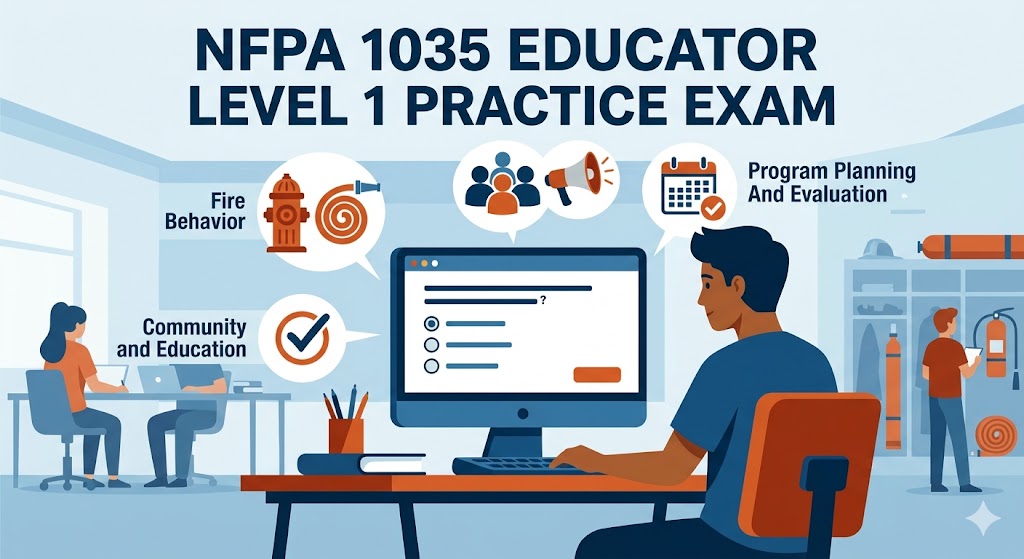
Additional Information
What the Course Entails and Exam Details
The core training aligned with NFPA 1035 Level 1 provides a comprehensive foundation in the principles of fire and life safety education.
Candidates can expect to cover a broad spectrum of critical topics and master essential job performance requirements.
The curriculum is typically organized around key domains such as:
General Requirements: Understanding fire behavior, human behavior during fires, injury prevention concepts, and the legal issues surrounding safety education.
Administration: Creating and maintaining accurate activity records, preparing detailed activity reports, and effectively scheduling educational events.
Planning and Development: Identifying and collaborating with community partners and selecting appropriate instructional materials for target audiences.
Education and Implementation: Mastering methods of instructional delivery, adapting lesson plans to meet specific needs, and presenting engaging safety programs.
Evaluation: Administering and scoring evaluation instruments to measure the success of an educational activity.
The full certification process often involves two components: a comprehensive written examination and a practical skills evaluation, where candidates must demonstrate their proficiency in areas like presenting a lesson or conducting a risk assessment. This article focuses on preparing for the written examination, typically delivered as a practice exam to help candidates gauge their readiness.
What to Expect in the Final Exam
The final written examination for NFPA 1035 Level 1 is a rigorous test of your knowledge across the entire scope of the standard.
Here is what candidates should anticipate on exam day:
Exam Format: The written exam is typically a proctored, closed-book test consisting of multiple-choice questions.
Weighting: The questions are distributed across the primary domains, with heavier emphasis on "Education and Implementation" and "General Requirements." For example, some certifying bodies use a weight distribution similar to: Education and Implementation (30%), General Requirements (18%), Administration (14%), Evaluation (10%), and Planning and Development (5%).
Passing Score: A common requirement for a passing score is 70%, but this can vary depending on the local or state authority having jurisdiction (AHJ) and the accrediting body (such as Pro Board or IFSAC).
Time Limits: You will be given a specific time allotment to complete the exam, designed to be sufficient for well-prepared candidates to read each question carefully.
Final Certification: Achieving a passing score on the written exam is a major milestone, but full certification usually requires the successful completion of the practical skills evaluation as well.
How to Study and Exam Centers
Preparation is the absolute key to success on the NFPA 1035 Level 1 exam, and using a strategic study plan is crucial.
Actionable Study Strategies:
Master the Standard: Your primary study material should be the actual NFPA 1035 standard, supplemented by an official textbook, such as Jones & Bartlett's "Fire and Life Safety Educator: Principles and Practice."
Use Practice Exams: A high-quality practice exam is your best tool to simulate the test experience, identify your knowledge gaps, and become comfortable with the wording of multiple-choice questions.
Active Learning: Don't just read. Create flashcards for definitions and fire behavior principles. Write summaries of the key responsibilities for each JPR domain.
Group Study: Teaching a concept to someone else is a powerful way to reinforce your own understanding. Practice presenting safety lessons to friends or colleagues.
Hands-on Practice: For the skills component, physically practice documenting activity reports, creating a lesson plan, and identifying common household hazards.
Where to Take the Exam:
The NFPA 1035 Level 1 written exam is delivered through a network of accredited agencies and institutions. It is important to check with your local state fire academy, fire department, or emergency management agency to determine the specific path for certification. These exams are frequently proctored at local physical testing centers or administered as online proctored exams through specialized platforms. Many state-level certifications are accredited by national bodies like Pro Board or IFSAC, which allows your certification to be recognized in multiple jurisdictions.
Job Opportunities from the Course
Obtaining your NFPA 1035 Level 1 certification unlocks a dedicated career path in public safety and community risk reduction.
This credential validates your expertise and makes you a competitive candidate for various specialized roles.
Specific job titles and career paths this certification unlocks include:
Fire and Life Safety Educator Level 1
Fire Department Community Risk Reduction Specialist
Public Information Officer (PIO) (a natural progression from educator)
Youth Firesetter Intervention Specialist
Fire Safety Inspector (often bundled with educator duties)
Health and Safety Educator
Injury Prevention Coordinator
Industrial Safety Officer
Disaster Preparedness Educator
Frequently Asked Questions
Reviews
5.0
Based on 0 reviews
Leave a Review
No reviews yet. Be the first to review!