
NFPA 921: Guide for Fire and Explosion Investigations Practice Exam
$69.00
- Buy to unlock unlimited access to all Quiz questions and Answers in this Quiz.
- After purchase you can print a PDF of the whole quiz at any point. The PDF will contain the questions and the correct answers.
About this Exam
Welcome to your essential study companion for the definitive guide in your field. This practice exam and study guide are meticulously designed for professionals seeking to demonstrate their expertise in fire and explosion investigation, based on the NFPA 921 standard. NFPA 921, "Guide for Fire and Explosion Investigations," is the undisputed "standard of care" in the industry, providing the scientifically based methodology required to determine incident origin, cause, and responsibility.
Whether you are a firefighter, a law enforcement officer, an insurance claims adjuster, or a private forensic investigator, mastering NFPA 921 is not just a career milestone; it is the key to producing credible, reliable, and admissible results. This practice exam serves as a crucial bridge between your knowledge of the text and your success in the final certification assessment, helping you identify areas for improvement and gain confidence in your interpretive skills.
Ready to test your knowledge?
Buy Now to Access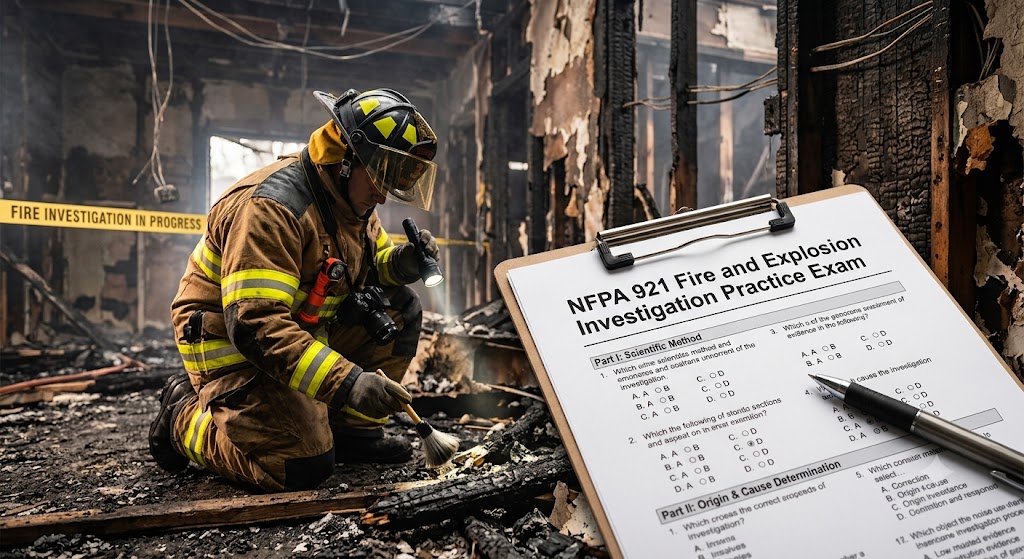
Additional Information
What the Course Entails and Exam Details
Preparing for an NFPA 921-based certification entails a deep
dive into the 20+ chapters of the official guide. This course of study is not
about rote memorization but rather about understanding and applying a rigorous
systematic approach. You will learn to integrate fire science principles with
practical field techniques. The practice exam mirrors this comprehensive
coverage to ensure you are tested on all critical areas.
The core domains you must master include:
- The
Scientific Method: This is the cornerstone of NFPA 921, emphasizing a
systematic, hypothesis-driven approach to every investigation.
- Basic
Fire Science: You must understand fire dynamics, thermodynamics,
combustion, heat transfer, and fire pattern generation to accurately
interpret a scene.
- Safety:
Prioritizing investigator health and safety at hazardous scenes.
- Legal
Considerations: Guidance on evidence preservation, managing a chain of
custody, and preparing for expert testimony.
- Scene
Documentation: Best practices for photography, sketching, note-taking,
and data collection.
- Origin
& Cause Determination: Developing and testing hypotheses for the
fire’s point of origin and the ignition source/sequence.
- Specific
Investigation Types: Specialized chapters covering motor vehicle
fires, appliance-related incidents, wildfire investigations, and
explosions.
What to Expect in the Final Exam
When you move beyond the practice exam to the official
certification, you are typically engaging with organizations such as the
National Association of Fire Investigators (NAFI) for the Certified Fire and
Explosion Investigator (CFEI) designation, or the International Association of
Arson Investigators (IAAI) for the Certified Fire Investigator (CFI)
credential.
While specific formats vary by the certification body, a
final exam based on NFPA 921 is almost universally a comprehensive, timed, and
proctored assessment.
- Exam
Format: You should expect approximately 100 to 150 multiple-choice
questions. These questions are designed to be challenging, often using
scenario-based problems to test your ability to apply the guide’s
principles, not just recall facts.
- Time
Limit: You will usually have between 2 to 4 hours to complete the
test. Time management is crucial for success.
- Passing
Score: The typical required passing score is 70% or higher.
- Focus:
The questions are heavily weighted toward the application of the
scientific method, fire scene safety, and the interpretation of physical
evidence.
How to Study and Exam Centers
Effective preparation for this rigorous exam requires a
structured study plan centered on the NFPA 921 text itself. Do not rely solely
on summary guides or condensed flashcards.
Actionable Study Strategies:
Read and Re-read NFPA 921:
Make the guide your primary textbook. Focus intently on the chapters concerning
the Scientific Method (Chapter 4), Fire Scene Safety (Chapter 13), and the
logic of Origin and Cause Determination.
Use Active Recall: After
reading a chapter, try to explain the core concepts in your own words. Create
diagrams to illustrate fire pattern generation.
Take Practice Exams
Methodically: Use the NFPA 921 Practice Exam not just to gauge your score
but to identify your weak points. Review the full explanations for every
answer, especially those you missed or were unsure about.
Join a Study Group: Collaborative study with peers
can provide different perspectives and help resolve confusing concepts.
Exam Centers and Registration:
Because the "NFPA 921 Practice Exam" is a study
tool, it is usually accessed through online educational platforms. For the
actual certification, you will register through the respective organizations:
- NAFI
(CFEI): Certification exams are often administered upon the completion
of one of their official training programs or at a testing center by
appointment.
- IAAI
(CFI): Their certification process is modular. After completing the
requisite training hours, you will register and pay for the final
comprehensive exam, which is typically taken proctored at a physical
testing center such as those operated by Pearson VUE.
Job Opportunities
from the Course
Earning a certification that validates your expertise in
NFPA 921 is a powerful asset, opening doors to advanced roles in both the
public and private sectors. This certification demonstrates to employers,
clients, and the legal system that you adhere to the highest scientific
standards of care.
A strong understanding of NFPA 921 unlocks specific job
titles and career paths, including:
- Fire
Investigator (Public Sector): working for municipal fire departments
or state agencies.
- Fire
Marshal / Deputy Fire Marshal: responsible for both prevention and
investigation.
- Law
Enforcement Detective: specializing in arson units.
- Private
Fire Investigator: employed by insurance companies or law firms to
conduct independent investigations.
- Forensic
Engineer: specializing in analyzing products or systems that caused a
fire.
- Insurance
Claims Adjuster/Investigator: using investigative knowledge to
evaluate claims.
- Expert
Witness: providing credible courtroom testimony on fire origin and
cause.
Frequently Asked Questions
Reviews
5.0
Based on 0 reviews
Leave a Review
No reviews yet. Be the first to review!