
NGA Certification Practice Exam 2026
$69.00
- Buy to unlock unlimited access to all Quiz questions and Answers in this Quiz.
- After purchase you can print a PDF of the whole quiz at any point. The PDF will contain the questions and the correct answers.
About this Exam
The National Guardianship Association (NGA) represents the gold standard for professionals who serve as court-appointed guardians, protecting the rights and well-being of vulnerable individuals. To achieve certification as a National Certified Guardian (NCG) or Master Certified Guardian (MCG), candidates must pass a rigorous examination administered by the Center for Guardianship Certification (CGC). While the CGC is the certifying body, the NGA provides essential educational materials, including the National Guardianship Association (NGA) Practice Exam, which serves as a vital tool for preparation. This practice exam and the certification it leads to are designed for professional guardians, fiduciaries, conservators, case managers, and attorneys seeking to demonstrate their expertise, ethical commitment, and competence in this crucial field.
Ready to test your knowledge?
Buy Now to Access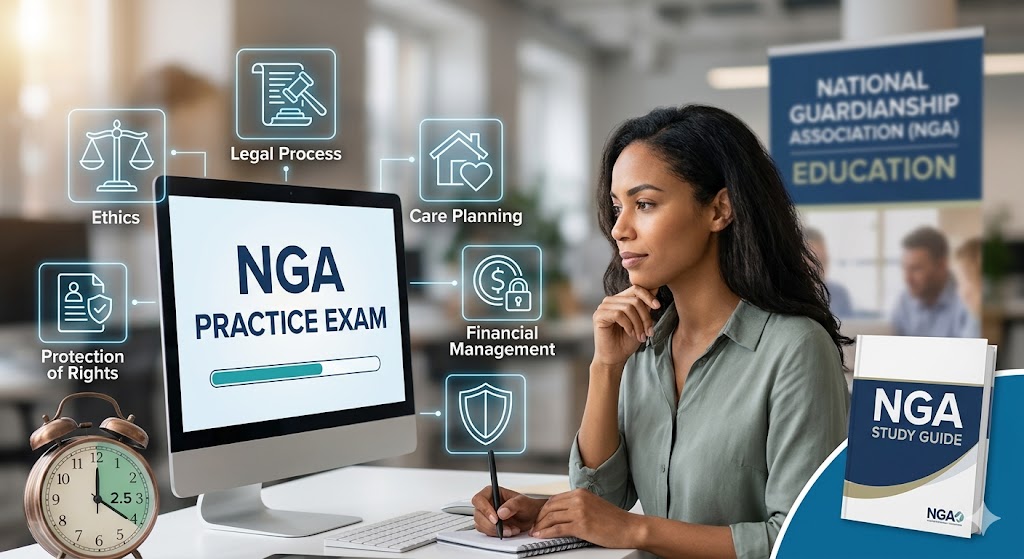
Additional Information
What the Course Entails and Exam Details
Preparing for the NGA-aligned examination involves mastering a wide array of core competencies that define responsible and legal guardianship. The curriculum, supported by NGA study materials and evaluated by the official CGC exam, covers a broad spectrum of critical topics. Students must develop deep knowledge in areas such as ethical principles and decision-making frameworks, including the standards of 'substituted judgment' and 'best interest.' The course entails understanding the complex legal processes, from the initial petition for guardianship to ongoing court reporting and accounting requirements. Candidates will study the specific powers and limitations of a guardian, methods for conflict resolution, and strategies for effective advocacy. A major focus is placed on the rights of the person under guardianship, person-centered planning, informed consent for medical procedures, and the prudent management of a person's estate and financial assets. The practice exam provides a simulated environment to test these skills with realistic, scenario-based questions.
What to Expect in the Final Exam
While the NGA provides practice resources, the final official certification exam is administered by the Center for Guardianship Certification (CGC). This comprehensive examination is designed to measure your mastery of the knowledge base required for professional practice. Candidates should expect a multiple-choice format, featuring scenario-based questions that require you to apply core principles to realistic guardianship situations. The exam is typically a computer-based, proctored test. While specific details can vary, it generally consists of approximately 100 to 125 questions and has a set time limit, often around 2.5 to 3 hours. A passing score is determined by the CGC using psychometric methods to ensure fairness and standard consistency. All exam materials and specific rules regarding what can be brought into the testing room are strictly enforced by the third-party testing administrator.
How to Study and Exam Centers
Effective preparation for the NGA Practice Exam, and subsequently the CGC Certification Exam, requires a strategic approach. We recommend a multi-faceted study plan. First, deeply familiarize yourself with the core standards, code of ethics, and fundamental concepts using the official NGA Study Guide and participation in the NGA Review Course webinar. Second, utilize the NGA Practice Exam repeatedly to identify knowledge gaps, practice time management, and become comfortable with the multiple-choice, scenario-based question format. Form study groups with peers and create flashcards for key terms and legal concepts. Candidates are encouraged to simulate exam conditions to build confidence. When ready for the final, official CGC certification exam, you must first apply through the Center for Guardianship Certification. Once approved, you will schedule your proctored exam with the authorized third-party testing service, which operates numerous authorized testing centers located in major cities throughout the nation and, in some cases, provides options for online proctored exams through standard, secure portals.
Job Opportunities from the Course
Earning a national guardianship certification unlocks a rewarding and in-demand career path focused on service and advocacy. This credential demonstrates professional competence and a commitment to ethical practice, making you a preferred choice for courts, families, and organizations. The job opportunities and career paths unlocked by this certification include:
Professional Guardian
Certified Professional Conservator
Professional Fiduciary
Public Guardian (for government agencies)
Corporate Guardian (for banks or trust companies)
Guardianship Case Manager
Court Visitor or Investigator
Advocate for Vulnerable Adults
Non-Profit Guardianship Program Director
Frequently Asked Questions
Reviews
5.0
Based on 0 reviews
Leave a Review
No reviews yet. Be the first to review!