
NHA Clinical Patient Care Practice Test
$69.00
- Buy to unlock unlimited access to all Quiz questions and Answers in this Quiz.
- After purchase you can print a PDF of the whole quiz at any point. The PDF will contain the questions and the correct answers.
About this Exam
The NHA Clinical Patient Care Practice Exam is a comprehensive assessment tool designed to measure your readiness for the clinical component of the National Healthcareer Association (NHA) Certified Clinical Medical Assistant (CCMA) certification exam. This practice test focuses specifically on the critical hands-on skills and medical knowledge you will need to demonstrate in a real-world healthcare setting. It is the ideal resource for medical assistant students approaching graduation or healthcare professionals looking to validate their clinical competency. By taking this practice exam, you are not just testing your recall, but simulating the decision-making processes required for effective, compassionate patient care. Succeeding in this area is paramount, as the Clinical Patient Care domain typically represents the largest portion of the final certification test.
Ready to test your knowledge?
Buy Now to Access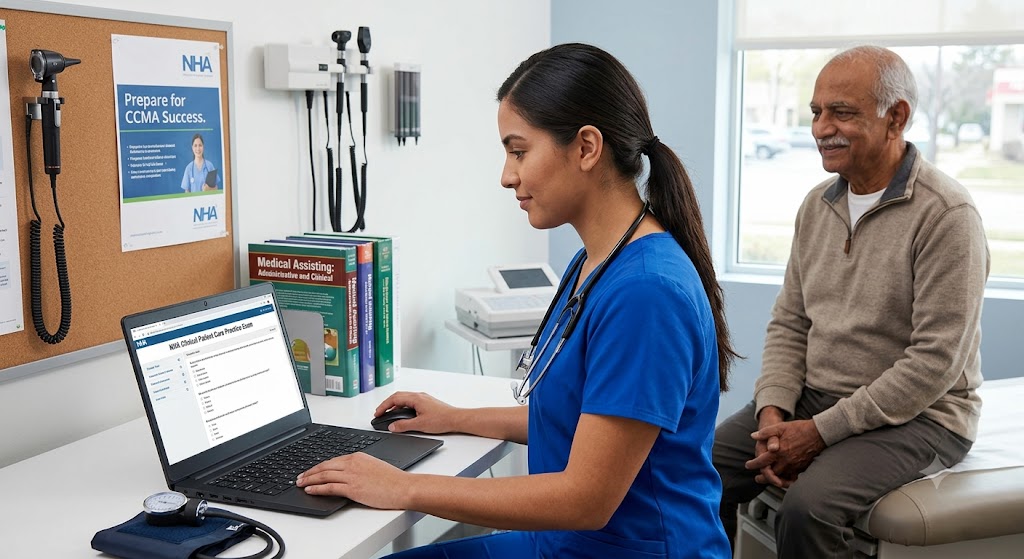
Additional Information
What the Course Entails and Exam Details
This practice exam meticulously covers the multiple domains
within the clinical scope of a medical assistant’s duties. Specifically, it
entails rigorous questions on Patient Intake and Vitals, including measuring
and recording accurate measurements. It also includes comprehensive sections on
Infection Control and Safety, ensuring you understand surgical asepsis and
standard precautions. Other crucial areas include Point-of-Care Testing and
Laboratory Procedures, Phlebotomy basics, and EKG and Cardiovascular Testing
workflows. The final NHA CCMA exam, for which this test prepares you, generally
consists of 150 scored multiple-choice questions and 30 pretest questions, with
a 3-hour time limit. This practice test is structured to mirror that
experience, focusing heavily on the clinical reasoning required for daily
operations. Eligibility for the full exam usually requires either completion of
an accredited training program or specialized work experience.
What to Expect in
the Final Exam
When you arrive for your scheduled final exam, you should be
prepared for a three-hour, computer-based test consisting primarily of
multiple-choice questions with four answer choices. Do not be surprised by the
weighting; a majority of the questions will fall directly under the Clinical
Patient Care domain, which is why specialized practice is so effective. You
will encounter recall questions, but the most challenging items will be
situational or workflow-based, asking you to identify the correct "first"
or "next" step in a patient care scenario. To pass the NHA CCMA exam,
you will need a scaled score of at least 390 out of 500. This passing threshold
is standard across all NHA certifications, reflecting a minimum level of
competency to safely enter the allied health workforce. The practice exam helps
you adjust to the pacing and style, reducing anxiety on test day.
How to Study and
Exam Centers
Effective preparation requires a structured approach. Start
by taking a full-length practice test to establish your baseline and identify
your weakest clinical areas. From there, create a focused study plan. Use
flashcards for medical terminology, normal vital sign ranges, and the order of
draw for phlebotomy. We highly recommend using official NHA study guides and
review modules, which are tailored to the official test plan. Practice
answering situational questions by default to prioritizing safety, infection
control, and patient privacy (HIPAA). When you are ready for the official exam,
you can schedule it through the NHA website. The test can be taken in person at
an NHA-affiliated school or authorized testing center, such as Pearson VUE.
Alternatively, NHA offers an online proctoring option, allowing you to take the
exam from the comfort of your home.
Job Opportunities
from the Course
Earning your NHA CCMA certification, backed by strong
clinical patient care proficiency, opens doors to a diverse range of rewarding
career paths. Many healthcare employers require or strongly encourage this
certification, viewing it as a mark of verified clinical skill. Graduates can
unlock numerous opportunities, including the following roles: Certified
Clinical Medical Assistant (CCMA), Clinical Assistant, Patient Care Associate
(PCA), Clinic Medical Assistant, Specialty Assistant (e.g., in pediatrics, cardiology,
or dermatology), Laboratory Assistant (in some outpatient settings), and
stacked credential paths leading to roles as a Certified Phlebotomy Technician
(CPT) or Certified EKG Technician (CET). With this qualification, you are
prepared to become an essential member of a healthcare team, providing direct,
high-quality care to patients in doctors’ offices, hospitals, and outpatient
clinics.
Frequently Asked Questions
Reviews
5.0
Based on 0 reviews
Leave a Review
No reviews yet. Be the first to review!