
NHIE Mechanical Practice Exam
$69.00
- Buy to unlock unlimited access to all Quiz questions and Answers in this Quiz.
- After purchase you can print a PDF of the whole quiz at any point. The PDF will contain the questions and the correct answers.
About this Exam
The National Home Inspector Examination (NHIE) is the definitive competency assessment for aspiring home inspectors in North America, establishing the high standard required for state licensing and professional certification. While the final licensing exam is comprehensive, this targeted NHIE Mechanical Practice Exam focuses specifically on the essential "mechanical" systems of a home: Heating, Ventilation, Air Conditioning (HVAC), and Plumbing. It is designed for students, trainees, and professionals needing to master these complex, high-risk systems to ensure they can accurately identify defects, ensure safety, and protect future homebuyers. This practice tool isolates the mechanical domains to provide a rigorous and focused review of the knowledge necessary for success on the overall examination.
Ready to test your knowledge?
Buy Now to Access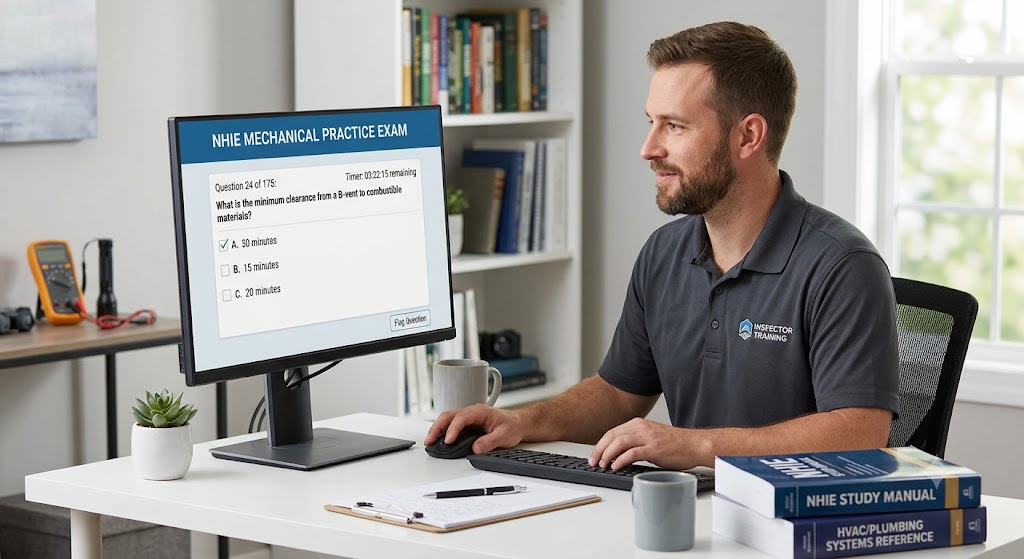
Additional Information
What the Course
Entails and Exam Details
This specialized practice exam mirrors the technical
difficulty and scope of the mechanical sections within the comprehensive NHIE.
The course of study that this practice test supports focuses heavily on the
interpretation and application of standards related to the following core
areas:
HVAC Systems: Mastery of heating and cooling systems
is paramount.
You must deeply understand the operation of forced-air
furnaces, heat pumps, boilers, and radiant heating systems.
The exam focuses on proper installation methods, normal
operating controls, necessary maintenance access, and recognizing typical
defects.
Special emphasis is placed on safety, including combustion
air requirements, proper venting systems, and fuel storage protocols.
Plumbing Systems: You will be tested on the entire
plumbing infrastructure of a dwelling.
This includes water supply, water distribution piping, waste
management (DWV systems), and fuel piping (gas or oil).
You must be able to identify acceptable and hazardous
plumbing materials, installation errors, cross-connections, and drainage
inefficiencies.
The syllabus covers the condition and operation of
permanently installed kitchen appliances and water heaters.
General Inspection Knowledge: You must also integrate
the analysis of these findings into standard reporting practices.
This involves understanding what the client must be informed
about and what common limitations may apply to the mechanical inspection.
What to Expect in the Final Exam
It is vital to understand that the specialized
"mechanical" practice exam is designed to help you pass a major
component of the comprehensive final test.
The actual National Home Inspector Examination (NHIE) is a
strictly proctored, four-hour, computer-based examination.
The complete final exam contains a total of 200
multiple-choice questions.
Of these 200 questions, only 175 count toward your final
score, while 25 are pretest questions used by the Examination Board of
Professional Home Inspectors (EBPHI) to validate future exam content.
The scoring for the NHIE is scaled, ranging from a low of
200 to a high of 800.
To officially pass the examination and meet standard state
licensing requirements, you must achieve a scaled score of 500 or higher.
Upon completing the test, you will receive your score report
before you leave the testing center. Note that you are generally not allowed to
use calculators or references during the actual exam
How to Study and
Exam Centers
Successfully passing the NHIE requires dedicated preparation
that goes beyond basic memorization.
How to Study: Don't just focus on memorizing the
answers to practice questions.
Instead, prioritize understanding the why behind
every rule, standard, and defect.
Utilize the comprehensive NHIE Study Manuals provided by
EBPHI as your primary reference material.
Take full-length practice exams to understand your weak
areas.
When using this specialized mechanical practice exam,
revisit the official study manuals for every question you miss.
Create flashcards for specific technical requirements, such
as minimum venting clearances or gas line material compatibility.
Allocate study time for learning proper terminology, as this
is essential for both the exam and professional reporting.
Exam Centers: The physical NHIE is not taken online
from home; it is a proctored, high-stakes examination taken at an authorized
testing facility.
In most jurisdictions across North America, the exam is
administered through authorized third-party testing providers, primarily PSI
Services (PSI) or Pearson VUE.
To register and schedule your exam, you must visit the
Examination Board of Professional Home Inspectors (EBPHI) website to find the
direct link to the testing provider authorized in your specific state.
Make sure to schedule your exam well in advance, as physical
testing spots can fill up quickly.
Job Opportunities from the Course
Earning your NHIE certification is the direct pathway to a
dynamic, flexible, and rewarding career in the real estate and built
environment sector. Successfully passing the examination allows you to pursue
diverse career paths and specialize in numerous areas.
Licensed Home Inspector (Residential)
Commercial Property Inspector
Multi-Unit Housing Inspector
Municipal Building and Code Inspector
Facility Manager
Real Estate Risk Consultant
Insurance Property Inspector
Construction Progress Inspector
Specialized Inspector (e.g., HVAC Specialist, Energy
Auditor)
Radon and Environmental Tester (with additional credentials)
Home Inspection Educator or Franchise Owner
NHIE Mechanical Practice Exam Study Image
This image depicts a professional trainee utilizing a
focused study interface for the NHIE Mechanical Practice Exam, complete with
reference manuals and icons illustrating the HVAC and plumbing systems you must
master.
Frequently Asked Questions
Reviews
5.0
Based on 0 reviews
Leave a Review
No reviews yet. Be the first to review!