
NHS Pathways Distance Learning Package (DLP) Practice Test
$69.00
- Buy to unlock unlimited access to all Quiz questions and Answers in this Quiz.
- After purchase you can print a PDF of the whole quiz at any point. The PDF will contain the questions and the correct answers.
About this Exam
The NHS Pathways Distance Learning Package (DLP) is a critical training program developed by NHS England for individuals seeking roles within the NHS 111 and 999 services.
It is specifically designed for non-clinical staff, such as Health Advisors and Call Handlers, who are the first point of contact for members of the public seeking urgent or emergency medical advice.
The DLP provides these professionals with the essential skills and knowledge required to navigate the NHS Pathways clinical decision support system.
This software guides them through a series of clinically-approved questions to assess a patient's symptoms and direct them to the most appropriate level of care, whether that's an emergency ambulance, an urgent care centre, or self-care advice.
The initial part of this comprehensive training is often delivered via the DLP, allowing flexible, remote learning.
Successfully completing the DLP is the first major step toward achieving full certification and licensing to use the live NHS Pathways system.
It is an intensive program demanding high focus, but it opens the door to a rewarding career making a real difference in people's lives.
Ready to test your knowledge?
Buy Now to Access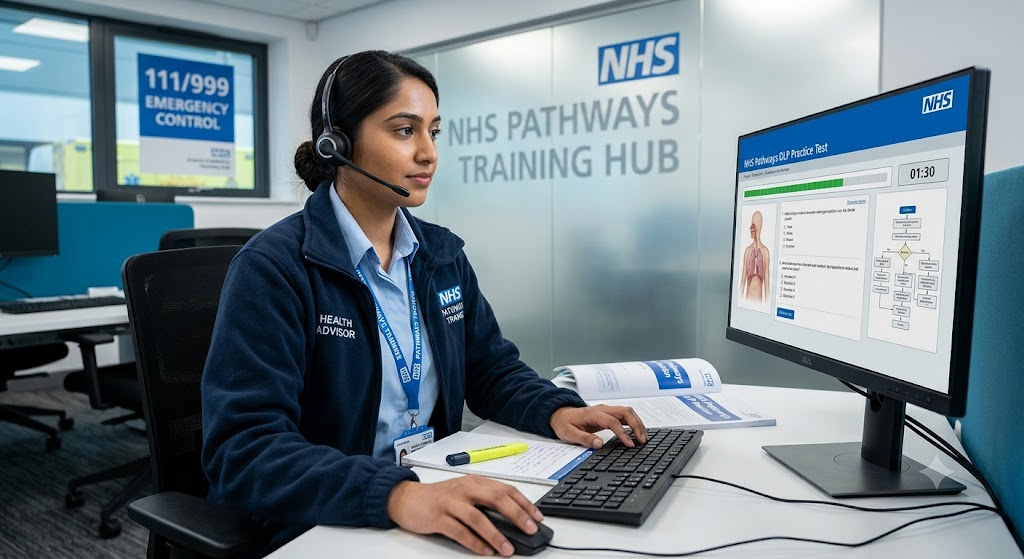
Additional Information
What the Course Entails and Exam Details
The NHS Pathways DLP covers a wide array of fundamental
subjects needed for safe and effective telephone triage.
Students will delve into the core principles of clinical
assessment and the operational mechanics of the NHS Pathways software.
The course syllabus typically includes, but is not limited
to, the following key modules:
- Understanding
NHS Pathways: An introduction to the system's purpose, structure, and
clinical governance.
- The
Triage Process: Detailed training on the clinical hierarchy, the
importance of non-trauma vs. trauma pathways, and how the system excludes
life-threatening conditions.
- Module
0 (The Entry Point): Master the essential skills for initiating a
call, identifying a "major" or "critical" incident,
and gathering the primary symptom.
- Key
Clinical Topics: Learning to recognize and triage symptoms related to
critical conditions like cardiac arrest, chest pain, stroke, breathing
difficulties, unconsciousness, and severe bleeding.
- Specific
Populations: Guidelines for assessing neonates, infants, children, and
the elderly.
- Mental
Health and Interpersonal Skills: Training on handling mental health
crisis calls and communication techniques for challenging situations.
- System
Navigation: Practical training on using the software, understanding
dispositions, and the role of the Directory of Services (DoS).
- Clinical
Safety: The absolute necessity of following system prompts precisely
without deviation.
The DLP component itself acts as the self-study phase.
Completion of the DLP modules is a prerequisite for
advancing to the next, typically face-to-face, phase of training, which
includes high-fidelity call simulations.
The "practice test" you are preparing for is
designed to mimic the final validation assessments that occur throughout and at
the end of the full training program.
What to Expect in the Final Exam
The full NHS Pathways certification training involves
multiple forms of assessment to ensure complete competence before a trainee
"goes live."
While the DLP practice test focuses on knowledge retention,
the final "exam" to become a licensed user is multi-faceted and
rigorous.
Trainees must expect the following final assessment
components:
- Written
Knowledge Assessments: These are often formal, invigilated
multiple-choice exams designed to test your deep understanding of the
protocols, clinical concepts, system rules, and Module 0 priorities.
- Practical
Listening and Triage Assessments (Audits): This is the most crucial
part. Taped practice calls, and eventually, live, monitored calls, are
audited by accredited trainers. They assess your ability to accurately
apply Module 0, choose the correct pathway, listen actively, and achieve
the safe, appropriate disposition.
- System
Competency Validations: Trainers will observe your ability to navigate
the software correctly, handle complex call flows, and use the
accompanying tools, such as the Directory of Services.
Passing Scores and Rules:
The passing standards for NHS Pathways are exceptionally
high due to the clinical risk involved.
A 100?curacy rate is often required for critical
sections, such as Module 0 and the correct identification of life-threatening
"Red Flags."
Trainees must demonstrate absolute adherence to the system's
rules and protocols.
Failure to follow the clinical pathway precisely during an
assessment is considered a "critical fail."
There are strict time limits within which a trainee must
achieve "go-live" status, typically within 12 months of starting the
license-to-practice course.
Failing key assessments will lead to a required period of
retraining and reassessment.
How to Study and
Exam Centers
Preparation is paramount for the NHS Pathways DLP. You are
learning a skill that directly impacts patient safety.
How to Study Effectively:
- Master
Module 0: Treat the Module 0 flow charts and priorities as the
foundation of your knowledge. Memorize the 10 core questions and the major
incident criteria. 100% mastery is non-negotiable.
- Utilize
All Learning Resources: Do not just skip to the quizzes. Read every
page of the DLP workbooks. Engage with the interactive system simulations
repeatedly.
- Practice
with Listening: NHS Pathways provides audio clips of call examples.
Listen to them critically. Can you identify the caller's main symptom?
Which pathway would you choose?
- Create
Your Own Scenarios: Challenge yourself by creating simple patient
scenarios (e.g., "An 80-year-old female with a fall"). Walk
through how you would navigate the system for that call.
- Use
Practice Tests Wisely: Do not just memorize answers. Analyze why
an answer is correct and why other options are incorrect. If you get a
question wrong, revisit the source material immediately.
- Focus
on 'Why' over 'What': Understand the clinical reasoning behind the
questions NHS Pathways asks. This will help you manage "vague"
calls or those with multiple symptoms.
Where to Take the Exam (and Practice Test):
The practice tests for the DLP are typically taken within
the online learning portal (e.g., a specific NHS Trust's Learning Management
System) where you access the DLP itself.
You can take these from home or any location with a computer
and internet access.
However, the final, formal assessments to achieve full
license-to-practice certification are different.
These must be taken at:
- Authorized
NHS Training Centers: Each NHS 111 and 999 provider has dedicated,
accredited training facilities.
- Invigilated
Conditions: Written assessments and call audits are conducted
in-person, under strict supervision, within these designated NHS centers,
not at generic Pearson VUE centers.
Your employer (the specific ambulance service or 111
provider) will organize and schedule these official final assessments for you.
Job Opportunities
from the Course
Successfully completing the NHS Pathways training and
becoming a licensed user is the primary entry requirement for several vital
non-clinical roles within the UK’s urgent and emergency care infrastructure.
Here are the specific job titles and career paths this
qualification unlocks:
- NHS
111 Health Advisor (or Call Handler): This is the most direct
application of the license. These professionals use NHS Pathways daily to
assess and direct public calls to the 111 urgent care service.
- Emergency
Medical Dispatcher (999 Call Handler): Many ambulance services use NHS
Pathways within their 999 control rooms to triage emergency calls that do
not immediately qualify as life-threatening (e.g., Category 3 or 4 calls).
- Clinical
Advisor Support: While this is a clinical role, clinicians (Nurses,
Paramedics) also undergo NHS Pathways training to support the non-clinical
advisors and provide complex clinical triage. Experienced Health Advisors
can transition into this path with further clinical qualification.
- NHS
Pathways Trainer: With significant experience and demonstrated
expertise, a licensed advisor can become an accredited NHS Pathways
Trainer, responsible for teaching the DLP and conducting validation
assessments for new trainees.
- NHS
Pathways Auditor: Licensed advisors with excellent quality assurance
scores can move into auditing roles, reviewing taped calls to ensure all
advisors are maintaining the required high standard of clinical safety.
- Urgent
Care Operations Manager: This credential provides a fundamental
understanding of how urgent care and triage services operate, which is
valuable for those pursuing leadership or management roles within 111 or
999 control centres.
- Integrated
Urgent Care (IUC) Coordinator: Coordination roles within integrated
urgent care systems often require a deep understanding of the triage
protocols and dispositions used by first-contact advisors.
Frequently Asked Questions
Reviews
5.0
Based on 0 reviews
Leave a Review
No reviews yet. Be the first to review!