
NIC Esthetics Practice Test
$69.00
- Buy to unlock unlimited access to all Quiz questions and Answers in this Quiz.
- After purchase you can print a PDF of the whole quiz at any point. The PDF will contain the questions and the correct answers.
About this Exam
The NIC Esthetics Examination is the premier national standard used by state regulatory boards to ensure that incoming estheticians possess the critical knowledge necessary to practice safely and effectively. This certification process is a mandatory requirement in many states, designed specifically for individuals who have completed their required hours of esthetic training and are ready to transition from student to licensed professional. If you are aiming for a successful and legally compliant career in skincare, this exam is your final, essential hurdle. This study guide is crafted for ambitious aspiring estheticians preparing to prove their mastery of the comprehensive fields of skincare, sanitation, and cosmetology sciences.
Ready to test your knowledge?
Buy Now to Access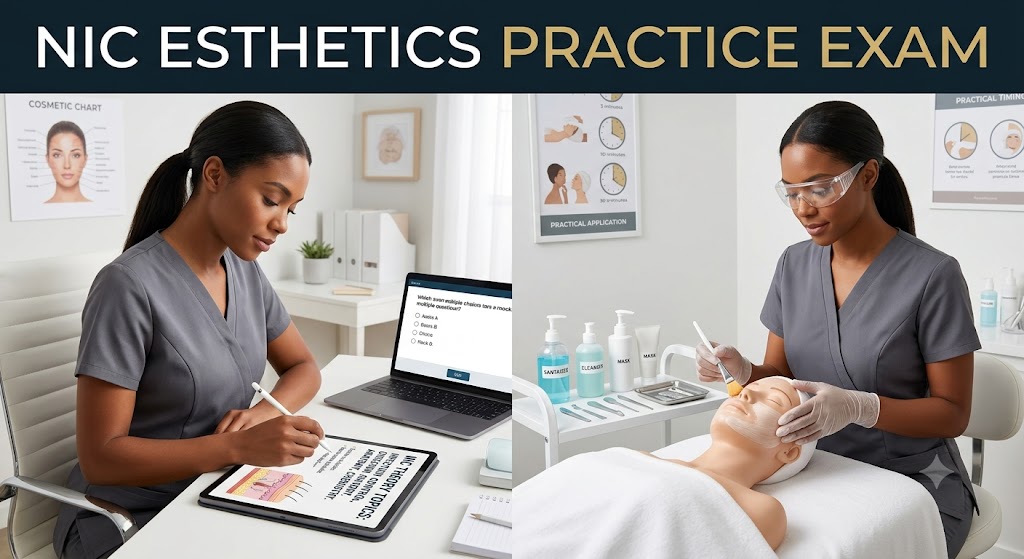
Additional Information
What the Course
Entails and Exam Details
To achieve success on the NIC Esthetics Exam, you must
demonstrate a rigorous synthesis of both theoretical scientific knowledge and
practical technical dexterity. The exam details are generally split between two
main categories of proficiency that cover the entire syllabus of esthetics
training. The theory section will challenge your scientific knowledge base.
This includes advanced understandings of microbiology, human anatomy, skin
histology, physiology, and basic product chemistry as it relates to cosmetic
ingredients. Furthermore, you will be tested on the principles of electricity
as used in facial machines, safety standards, and infection control procedures.
The practical component demands hands-on technical accuracy.
Here, you must prove complete competence in client consultation, documentation,
and the complete spectrum of skincare services. This encompasses thorough skin
analysis, cleansing protocols, steaming, exfoliation, manual extraction
techniques, and facial massage movements. Additionally, candidates must
demonstrate proficiency in non-facial services such as lash and brow tinting,
artificial eyelash application, hair removal (tweezing and waxing), and general
cosmetic makeup application.
What to Expect in the Final Exam
You must approach the final NIC exam knowing it is a
high-stakes verification of your readiness to enter the beauty industry. Most
state boards divide the examination process into two distinct parts: a
multiple-choice Theory Examination and a hands-on Practical Examination. Some
states may also require a third section known as the "Written
Practical" exam, which uses hypothetical scenarios to test your procedural
application skills. You must check your specific state board’s Candidate
Information Bulletin (CIB) to confirm the exact requirements for your
jurisdiction.
The Theory Examination is typically a computer-based test
that contains approximately 110 multiple-choice questions, with 100 of those
items counted toward your score and 10 being pre-test (non-scored) items. You
are generally allowed 90 minutes to complete this theory portion. The passing
score varies by state but often ranges around 70 to 75 percent. The Practical
Examination requires you to physically perform core services on a model or
mannequin in a timed, supervised testing environment. Throughout this hands-on
test, you are evaluated not just on the final outcome of the service, but
intensely on your ability to maintain a strictly sanitary work area, protect
the client through proper draping, and handle all tools safely.
How to Study and Exam Centers
Actionable preparation is the key to minimizing anxiety and
maximizing your score. To study effectively for the theory portion, consistency
beats intensity. Regular use of a simulated NIC Esthetics Practice Test is the
single most effective method to build stamina and familiarize yourself with the
specific wording used in the national exam. When you use practice tests, do not
just memorize answers; focus on understanding the logical rationale behind why
one answer is correct and the others are not.
For the Practical Exam, physical rehearsal is crucial for
mastering muscle memory. Obtain the official NIC kit packing list for your
state and rehearse assembling and labeling your kit exactly as required. When
practicing services, recite the sanitation steps aloud to ensure they become
reflexive actions. Study hard on infection control protocols, as these are the
most common areas where candidates lose significant points.
When you are ready to register, you must obtain an
"Authorization to Test" (ATT) from your state board. The theory
portion of the exam is generally administered at specialized, authorized
professional testing centers. These centers are often run by third-party
vendors such as PSI or Pearson VUE, which have numerous physical locations
across each state. The practical portion may be held at a different designated
state board testing site or authorized cosmetology school.
Job Opportunities
from the Course
Earning your official esthetician license via the NIC
examination transforms your passion into a legitimate profession and opens
diverse career paths within the lucrative multibillion-dollar beauty and
wellness industry. Licensure is the legal foundation employers are looking for,
giving them and your future clients confidence in your skills. This
certification unlocks several specific job roles and career paths, including:
Licensed Esthetician Medical Esthetician Clinical
Esthetician Brow Specialist Lash Technician Waxing Specialist Makeup Artist Spa
Manager or Director Cosmetic Brand Representative Beauty Educator or Trainer
State Board Licensing Inspector Cosmetics Buyer
Frequently Asked Questions
Reviews
5.0
Based on 0 reviews
Leave a Review
No reviews yet. Be the first to review!